



Health Ministry Boosts Post‑Earthquake Care in East Nusa Tenggara
- 28 Agt 2026 00:10 WIB
- Voice of Indonesia
Key Points
- The Ministry of Health is deploying health workers and operating field hospitals to address the post‑earthquake health crisis in East Nusa Tenggara (NTT).
- Field hospitals were established after severe damage to RSUD East Manggarai and RSUD Nagekeo, which require new construction costing IDR 150–200 billion.
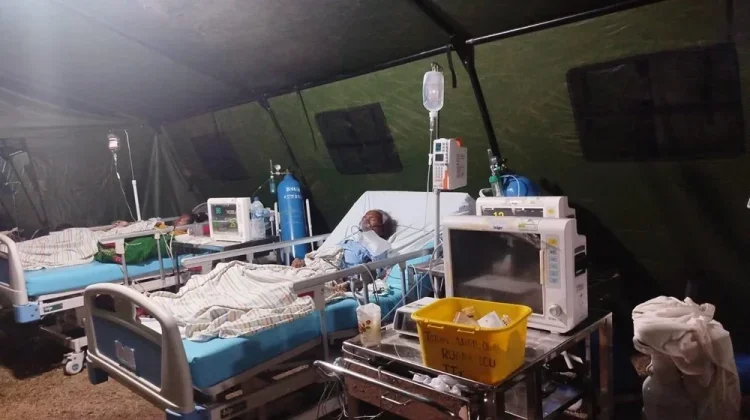
RRI.CO.ID, Jakarta - The Ministry of Health is strengthening its response to the post‑earthquake health crisis in East Nusa Tenggara (NTT) by deploying hundreds of health workers, operating field hospitals, and preparing the restoration of damaged health facilities.
Health Minister Budi Gunadi Sadikin said the Ministry has dispatched 206 volunteers from the Health Reserve Workforce (TCK) to treat victims in six severely affected areas: Manggarai, East Manggarai, Ngada, Nagekeo, Ende, and Sikka.
The volunteers will serve for 14 days to support disrupted health services. Of the 206 volunteers, 128 are medical personnel with various specialties, including internal medicine, pediatrics, surgery, and orthopedics. They will reinforce local health workers and 78 intern doctors who have been treating victims since the disaster began.
Ministry of Health Secretary‑General, Kunta Wibawa Dasa Nugraha, said volunteers were given three directives: focus on managing the medical crisis, work as a unified cross‑institutional team, and prioritize personal safety.
According to the latest report from the National Disaster Mitigation Agency (BNPB), the magnitude‑7.7 earthquake in NTT had killed 111 people and injured hundreds as of Thursday, August 27, 2026. A total of 176,621 residents have taken refuge in evacuation centers. Several health facilities were damaged and unable to operate optimally.
Minister Budi explained that the response is being carried out in stages. The first stage focuses on identifying and treating all affected patients. Those who can be treated at community health centers (Puskesmas) will receive care there, while cases requiring advanced treatment will be referred.
“The second stage involves reactivating all health facilities affected by the disaster. The third stage, which will be undertaken later, will focus on restoring damaged facilities,” Minister Budi said during a meeting with the House of Representatives (DPR) in Jakarta on Thursday, August 27, 2026, as reported by Antara.
The Ministry has also established field hospitals in response to severe damage at the East Manggarai Regional General Hospital (RSUD) and the Nagekeo Regional General Hospital. Both hospitals require new construction.
Minister Budi estimates that repairing the two RSUDs will require a budget of IDR 150–200 billion (USD 8.5–11.3 million). The Ministry targets a repair timeline of one to two months for minor damage, three to six months for moderate damage, and six to 12 months for severe damage.
The Ministry is also focusing on 166 community health centers in NTT and is opening opportunities for private sector support through sponsorships to accelerate recovery.
“We are setting an example here. Sometimes relying solely on the government takes too long,” he said.
The Ministry is taking inventory of damaged medical equipment to determine what can be repaired and what must be replaced, enabling the gradual resumption of operations.
A shortage of healthcare workers continues to hinder service recovery. Some facilities cannot operate because staff cannot reach remote areas, while residents’ preference for traditional medicine leads to cases being handled independently.
To reach these areas, the Ministry is collaborating with the Airlangga Hospital Ship to provide services in hard‑to‑access regions. Common cases include trauma and limb fractures. ***
News Recomendation
Loading latest news.....