



Legislation Body Ensures Legal Recognition for Indigenous Communities
- 11 Agt 2026 17:45 WIB
- Voice of Indonesia
Key Points
- The Indigenous Peoples Bill protects the rights of indigenous communities, including land, territories, culture, and natural resources.
- The Legislation Body gathered input from multiple stakeholders to ensure the bill addresses real challenges faced by indigenous communities.
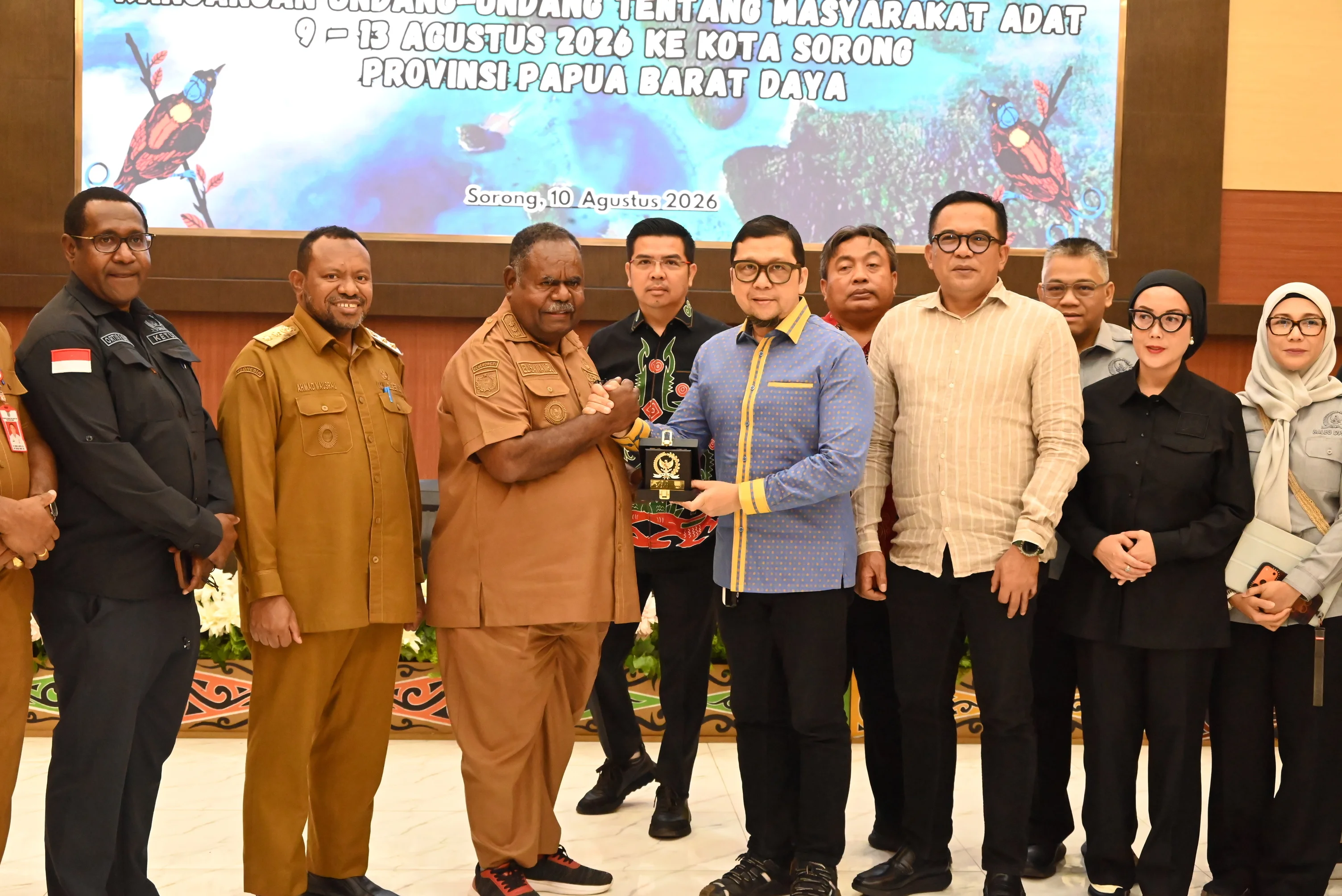
RRI.CO.ID, Jakarta – Deputy Speaker of the House of Representatives’ Legislation Body (Baleg), Ahmad Doli Kurnia Tandjung, emphasized the importance of the Indigenous Peoples Bill in protecting the rights of indigenous communities across Indonesia.
These rights include land, territories, culture, and natural resources that form the foundation of indigenous life.
Doli said indigenous communities are vulnerable to marginalization when their customary territories overlap with development interests or natural‑resource‑based economic activities. Without legal certainty, such situations threaten the living spaces and identities of indigenous peoples.
“This law aims to strengthen the position of indigenous communities, who have historically lacked recognition, respect, and protection. It will ensure that all assets of indigenous communities -- including their land, territories, culture, and natural resources -- are safeguarded,” Doli said during a working visit by Baleg to Sorong City, Southwest Papua, on Monday, August 10, 2026, as quoted on the official DPR RI website.
He noted that conflicts most often arise when customary territories intersect with development projects or natural‑resource exploitation. In these situations, indigenous communities are frequently perceived as being in a weaker position.
“Historically, problems have arisen from conflicts between development interests -- particularly economic interests involving natural‑resource management -- and customary territories. Indigenous communities often lose out, which can lead to marginalization and the erosion or even disappearance of their way of life. This is something we do not want to see happen,” he said.
Doli stressed that the Indigenous Peoples Bill must provide legal certainty while ensuring that development does not infringe upon indigenous rights. The bill is expected to clarify the status of indigenous communities in relation to land, territory, and natural‑resource management.
During the drafting process, Baleg also assessed the need to harmonize the Indigenous Peoples Bill with existing regulations, including the Special Autonomy Law and the Job Creation Law. Alignment is essential to prevent regulatory overlap and avoid creating new issues for indigenous communities.
He explained that the bill does not override other laws or special‑autonomy provisions. It applies nationally, while special‑autonomy laws for Aceh and Papua function as lex specialis -- meaning national laws must operate in harmony with these special provisions.
During the working visit, Baleg gathered input from local administrations, the Papuan People’s Assembly (MRP), the Southwest Papua Regional House of Representatives (DPRD), indigenous leaders, and academic institutions.
This input is considered crucial to ensuring that the bill addresses the real challenges faced by indigenous communities.
One issue raised was the unresolved status of the Regional Spatial Plan (RTRW) in Southwest Papua. Doli said Baleg would convey this matter to the central government, specifically the Ministry of Home Affairs and the Ministry of Agrarian Affairs and Spatial Planning/National Land Agency (ATR/BPN).
“We also discussed the Regional Spatial Plan, which has remained unfinished for three years. This will certainly be part of the input we convey to the central government, particularly the Ministry of Home Affairs and the Ministry of ATR/BPN, so that the proposal for this Regional Spatial Plan can be finalized,” he said.
Doli emphasized that finalizing the RTRW is vital because spatial planning is directly linked to territorial certainty, including areas that serve as living spaces for indigenous communities. Therefore, the formulation of national policy on indigenous peoples must consider evolving conditions and regulations at the regional level.
Baleg will also take into account regional experiences in formulating protections for indigenous communities. One example is the draft regional regulation on indigenous peoples currently being deliberated by the Southwest Papua Regional House of Representatives.
“There have also been experiences regarding the protection of indigenous communities. A local regulation is currently being deliberated by the Provincial House of Representatives (DPRP), and the material involved may well prove relevant to the drafting of this bill on indigenous communities,” he said.
Baleg hopes that deliberations on the Indigenous Peoples Bill will produce regulations that provide legal certainty and tangible protection for indigenous communities, ensuring that national development objectives can be pursued without compromising their rights, territories, living spaces, and identities. ***
News Recomendation
Loading latest news.....