



MUI: Fatwas Should Serve as Moral Diplomacy to Build Global Civilization
- 28 Jul 2026 15:39 WIB
- Voice of Indonesia
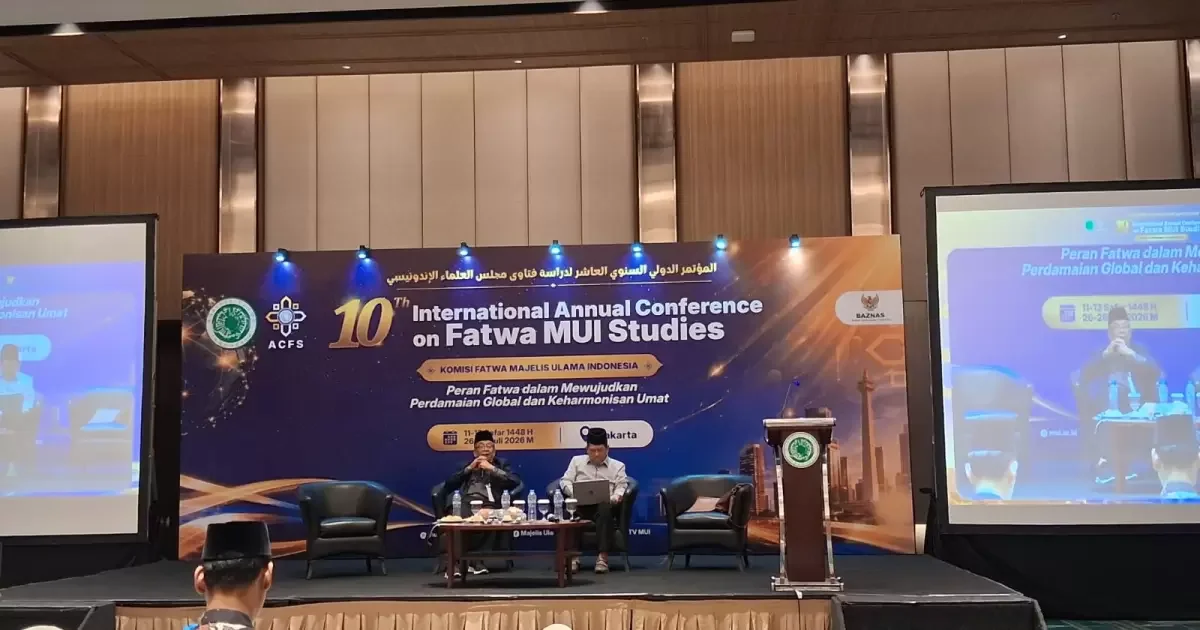
RRI.CO.ID, Jakarta - Deputy Chairperson of the Fatwa Commission of the Indonesian Ulema Council (MUI), Prof. KH Shofiyullah Muzammil, has called for strengthening the role of fatwas. He said they extend beyond local and national contexts to become instruments of moral diplomacy and drivers of global civilization-building (bina'ul hadharah).
Prof. Shofiyullah, who also serves as Professor at State Islamic University (UIN) Sunan Kalijaga Yogyakarta, made these remarks while speaking at Plenary Session III of the International Annual Conference on Fatwa Studies (IACFS) 2026, held in South Jakarta on Sunday, July 26, 2026.
During the plenary session, themed "The Maqāṣid al-Sharī'ah-Based Fatwa Paradigm as the Foundation for Communal Harmony and Global Peace," Prof. Shofiyullah underscored the need to reformulate the paradigm of Islamic legal reasoning to address the challenges of the 21st century.
"Fatwa commissions need to design their fatwa so that they are not only oriented toward their traditional functions, but also contribute to bina'ul hadharah (civilization-building). Fatwa must demonstrate their capacity as instruments of moral diplomacy and as guardians of public policy at the international level," he said as quoted by mui.or.id.
Prof. Shofiyullah further conveyed the MUI's role in providing moral guidance to the global community has already been demonstrated, particularly through its fatwa supporting the Palestinian people's struggle, which has gained recognition and reference among various groups worldwide.
He further explained that this broader orientation represents an important step in strengthening the MUI's institutional role. Traditionally, the MUI has upheld two pillars of service (tsaniyyatul khidmah): serving as a partner to the government (shadiqul hukumah) and as the protector of the Muslim community (himayatul ummah).
However, Prof. Shofiyullah argued that the growing complexity of contemporary global dynamics requires the explicit recognition of a third pillar: bina'ul hadharah (civilization-building).
"The measure of a fatwa's success should no longer rest solely on its legal validity, but also on its civilizational responsibility," he affirmed.
To realize fatwas with a civilizational dimension, Prof. Shofiyullah proposed a legal reasoning methodology that integrates uṣūl al-fiqh, maqāṣid al-sharī'ah, and the tradition of modern legal philosophy through the approach of pronesis al-shar'iyyah (Sharia-based practical wisdom or virtuous policy).
According to him, this integrative method is designed to uphold two fundamental principles: remaining steadfast in immutable and definitive religious teachings (istiqāmah fi al-'aqīdah / al-thawābit) to prevent interpretative liberalism, while maintaining flexibility in matters that are dynamic and subject to change (hanīfiyyah fi al-mutaghayyirāt).
News Recomendation
Loading latest news.....