



The Government Cuts the Average Waiting Period for Regular Hajj from 40 to 26 Years
- 15 Jul 2026 18:14 WIB
- Voice of Indonesia
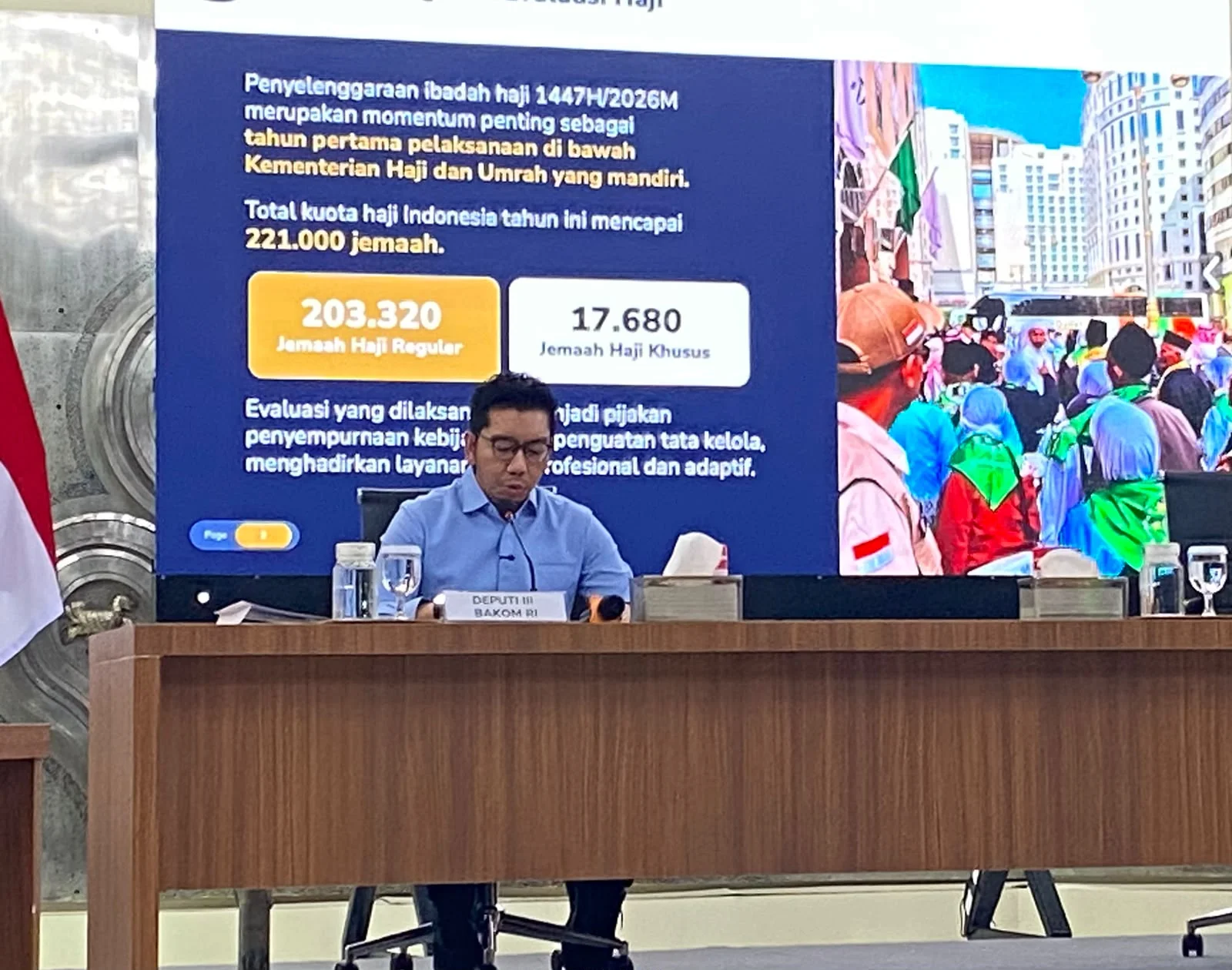
RRI.CO.ID, Jakarta - The Indonesian government has successfully reduced the average waiting period for regular Hajj pilgrims across the country from approximately 40 years to 26 years. This achievement is one of the results of improvements in Hajj governance implemented for the 1447 Hijri/2026 Hajj season.
Acting Deputy III for Partnership and Media Relations at the Government Communications Agency (Bakom RI), Kurnia Ramadhana, stated that the government is continuing its efforts to shorten the waiting period without compromising the quality of service for pilgrims. "Under the leadership of President Prabowo Subianto, the government has succeeded in reducing and equalizing the waiting period for regular Hajj pilgrims across all provinces," Kurnia stated at the Priority Program Update Press Conference at the Bakom RI Office in Jakarta on Wednesday, July 15, 2026.
According to him, the Indonesian government aims to further shorten the waiting period in the coming years. However, this effort is highly dependent on the Hajj quota set by the Saudi Arabian government.
Mathematically, he said, the waiting period is determined by the number of prospective pilgrims on the waiting list and the size of the quota accepted by Indonesia. "The larger the Hajj quota, the shorter the waiting period," he said.
However, he emphasized that increasing the quota cannot be done simply because it must be accompanied by the readiness of service infrastructure in Indonesia and Saudi Arabia, the adequacy of staff, and the ability to finance through the value of Hajj fund management benefits. Therefore, the government is currently reviewing the best scheme to shorten the waiting period without sacrificing the quality of service to pilgrims.
In addition to reducing the waiting period, the Ministry of Hajj and Umrah is also implementing several innovations in the 2026 Hajj implementation. These include a more equitable allocation of provincial quotas and a reduction in the Hajj Pilgrimage Management Fee (BPIH) by IDR 2 million to IDR 87.4 million per pilgrim, up from IDR 89.4 million in the previous period.
Kurnia stated that the 1447 Hijri Hajj implementation is a significant milestone because it is the first time it is being implemented under the Ministry of Hajj and Umrah as a separate ministry. For this year's Hajj season, Indonesia has a quota of 221,000 pilgrims, consisting of 203,320 regular pilgrims and 17,680 special pilgrims.
The Indonesia's government has also begun preparations for the 1448 Hijri Hajj, or the 2027 Hajj season. These preparations include establishing stages according to the Saudi Arabian government's schedule, submitting a proposal for the BPIH (Planning for Hajj Restrictions) to the House of Representatives (DPR), strengthening pilgrim health screenings, accelerating service negotiations with Hajj service providers, and improving accommodation, transportation, meals, and governance in Mina.
Kurnia also said these improvements have received a positive response from pilgrims who have returned home. The government is committed to using the results of the 2026 Hajj evaluation as a basis for providing increasingly professional, efficient, safe, and pilgrim-oriented Hajj services.
News Recomendation
Loading latest news.....