



BRIN Reveals Chronology of Large Meteorite Crossing Java, Indonesia
- 13 Jul 2026 17:48 WIB
- Voice of Indonesia
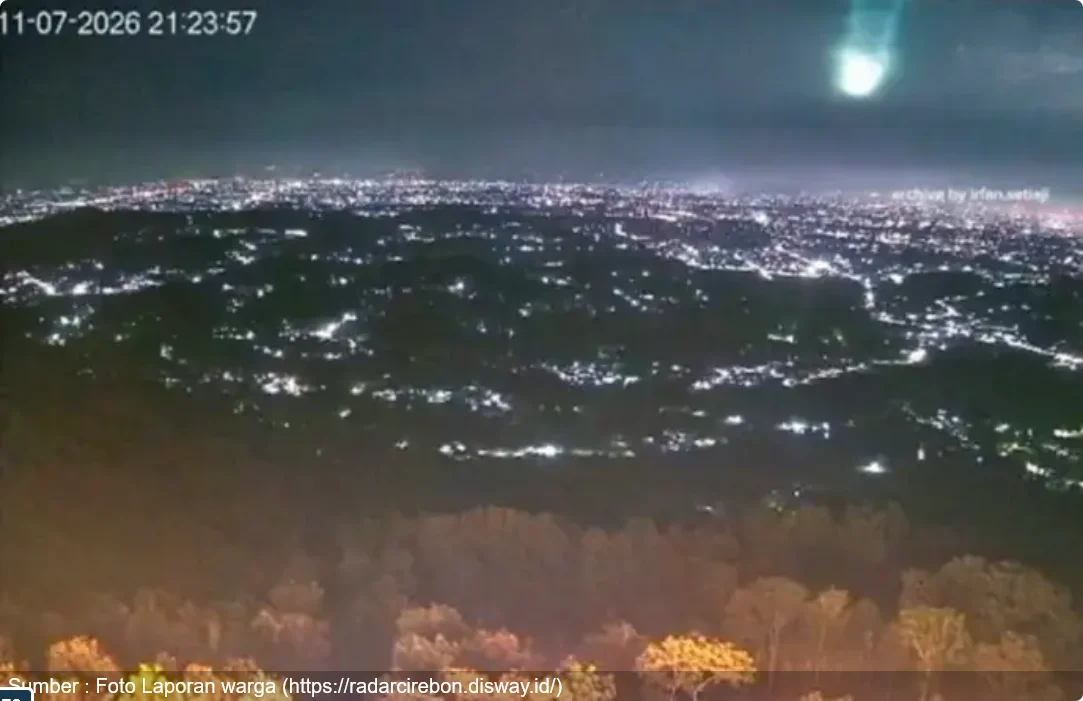
RRI.CO.ID, Jakarta - The phenomenon of a bright celestial object passing over and visible in several areas of Java on Saturday evening, July 11, 2026, has become a widespread topic of discussion on social media. Many residents have uploaded videos showing the luminous object streaking across the sky, and some even reported hearing a booming sound moments after the object passed.
According to information received by RRI VOI from the National Research and Innovation Agency (BRIN) on Sunday, July 12, 2026, Senior Researcher in Astronomy and Astrophysics at BRIN, Thomas Djamaluddin, explained that the phenomenon was a large meteor entering Earth's atmosphere. According to Thomas, based on a series of public reports from various regions, the meteor was first detected passing over the Java Sea before being seen from the Bekasi area at around 9:22:35 PM WIB.
He explained that at the time, the meteor was still at a fairly high altitude, making it appear as a relatively small, white, glowing object. "Meteors originate from space rocks orbiting the Sun, and friction with the atmosphere causes their surfaces to heat up and incandescent, thus appearing as meteors," he said.
He explained that the glowing process began when the space rock entered the atmosphere at an altitude of approximately 120 kilometers above Earth's surface. During this phase, the rock material began to undergo abrasion or erosion due to the extremely high temperatures, producing a bright light that could be seen from Earth's surface.
Based on its trajectory analysis, the meteor moved southeastward, crossing parts of Java Island. As it entered the denser atmosphere, the object grew brighter and began to exhibit varying color changes at various observation locations.
In eastern West Java, several residents of Cirebon and Kuningan reported hearing a booming sound moments after the meteor passed. Thomas explained that the sound did not originate from an explosion on the surface, but rather from a shock wave (sonic boom) formed when the meteor traveled at very high speed in the lower atmosphere.
In Majalengka, the meteor reportedly appeared blue. The same object was subsequently seen in the Nagreg area at around 9:23:37 PM WIB and in Tasikmalaya as a bright light that occasionally illuminated the clouds. This color variation is a common phenomenon in meteors, influenced by the mineral composition of their constituents and the atmospheric conditions they pass through.
While passing over the Yogyakarta area at around 9:23:57 PM WIB, several residents witnessed the meteor emitting a very bright green light. According to Thomas, the green color comes from the magnesium element contained in the space rock, which emits a distinctive light when it burns at very high temperatures due to friction with the atmosphere.
He explained that each chemical element has a different color or light spectrum when heated. "The green color of meteors is generally related to the magnesium or nickel content that burns during atmospheric entry," he said.
From a series of observations collected, BRIN estimates that the meteor continued moving southeast until it finally lost its speed and likely ended up in the Indian Ocean, south of East Java or Bali. Large meteors like the one that passed this time are much rarer and therefore widely visible.
Thomas explained that meteor phenomena like this are actually nothing extraordinary on an astronomical scale. Every day, Earth receives millions of rocks of various sizes from space, but most are so small that they burn up in the atmosphere and appear only as "shooting stars."
He added that Earth's atmosphere serves as a highly effective natural shield against space objects. Most meteoroids (space rocks) burn up before reaching the surface, so there's no need to panic if you see a similar phenomenon.
News Recomendation
Loading latest news.....