



Minister Invites Universities to Accelerate E20 and Bioethanol Development
- 29 Jun 2026 14:29 WIB
- Voice of Indonesia
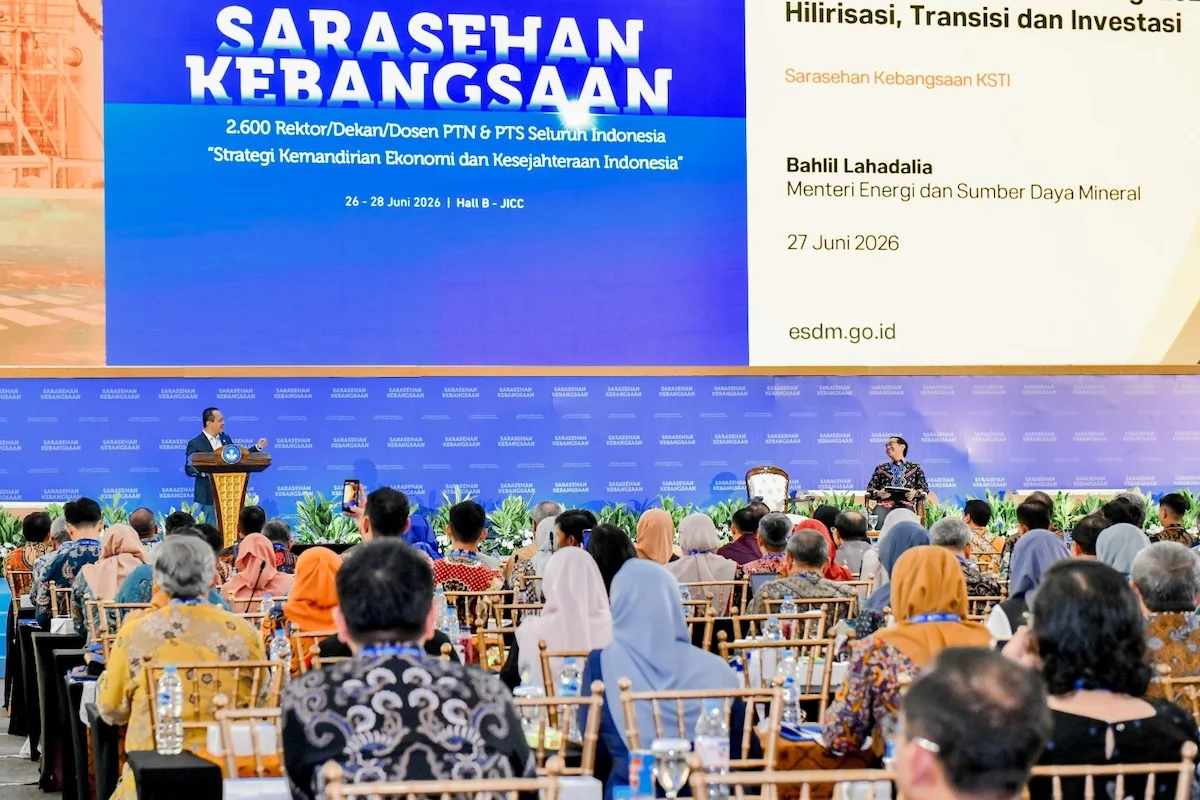
RRI.CO.ID, Jakarta – Indonesia's Ministry of Energy and Mineral Resources (ESDM) accelerates the implementation of the E20 program, a fuel blend consisting of 20 percent bioethanol and 80 percent gasoline. The Minister of ESDM, Bahlil Lahadalia, encouraged universities across Indonesia to support the program during the National Symposium of the Indonesian Science, Technology, and Industry Convention (KSTI) 2026 in Jakarta on Saturday, June 27, 2026.
According to the ministry’s press release, Minister Bahlil has urged universities across Indonesia to take an active role in advancing bioethanol processing technologies and strengthening the integration between academic research and the national energy industry. The initiative is part of a broader effort to reduce reliance on fossil fuels and enhance national energy security.
“I invite universities to collaborate on the E20 program. The state will act as the off-taker because we need 4 million kiloliters. This can be structured through a nucleus-plasma partnership model with the people. It is much clearer with the state as the off-taker than importing from America or Europe,” Bahlil said as quoted by the press release.
He stated that the government has prepared an electric stove procurement program in 2027 with a budget of around IDR 600 billion, which also opens opportunities for universities to participate in production and technological innovation. Through this scheme, the government hopes universities can bridge research outputs with industrial needs, particularly in improving the efficiency of bioethanol production from local resources.
“In the Ministry of Energy and Mineral Resources in 2027, there will be a Rp600 billion electric stove procurement program, and whichever campus wants to produce them will have the procurement directly ordered from that campus,” Bahlil said.
The E20 program and electric stove procurement are seen as part of the government’s broader strategy to accelerate the energy transition, reduce energy imports, and maintain national foreign exchange stability through the utilization of domestic resources.
The E20 program is projected to require around 4 million kiloliters (KL) of pure bioethanol per year, in line with national gasoline consumption of approximately 40 million KL annually. This large demand opens opportunities for the development of a bioethanol industry based on local commodities such as sugarcane, cassava, and corn.
Bioethanol itself is a form of biofuel derived from biomass feedstocks. According to the Food and Agriculture Organization of the United Nations (FAO), biofuels are fuels produced directly or indirectly from biomass, serving as “energy carriers” for energy conversion.
Biofuels are classified into three main types: woodfuels (wood-based), agrofuels (agricultural crop-based), and biofuels derived from municipal waste. Meanwhile, in the context of E20, bioethanol falls under the category of agrofuels, as it is generally produced from agricultural commodities such as sugarcane, cassava, and corn through fermentation processes.
News Recomendation
Loading latest news.....