



Global Experts Speak on Indonesia's Pancasila Ahead of Its Commemorative Day
- 01 Jun 2026 13:10 WIB
- Voice of Indonesia
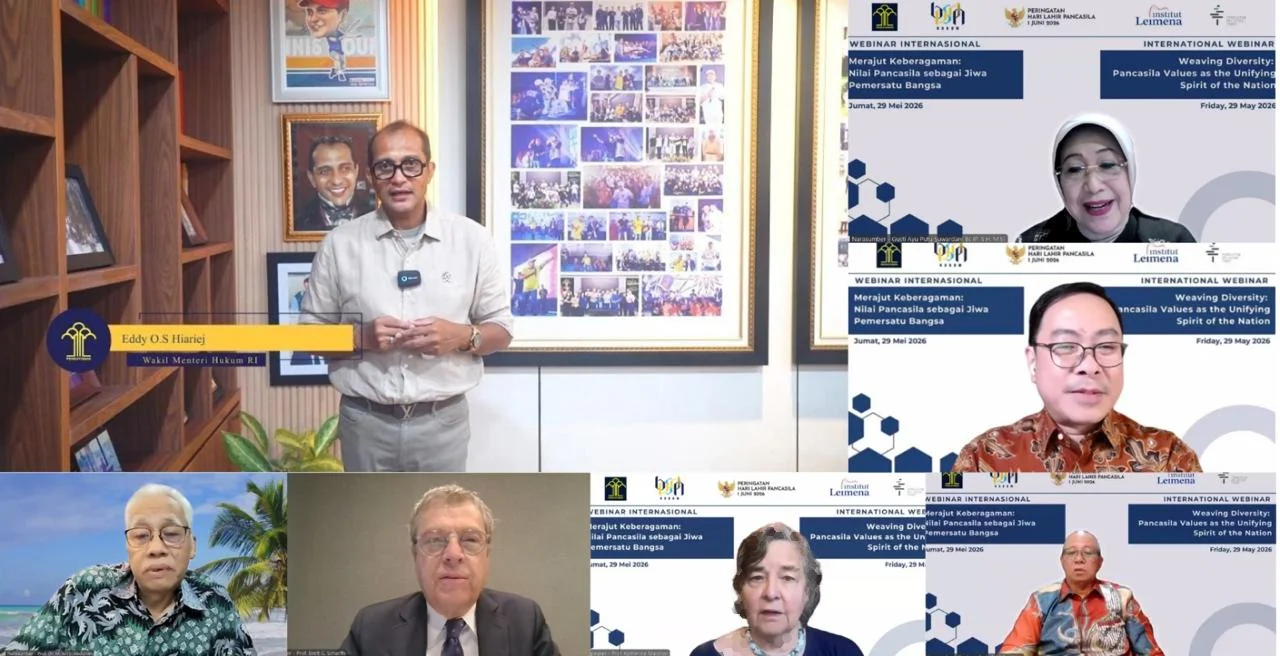
RRI.CO.ID, Jakarta - Various Indonesian and international experts spoke about Indonesia’s state ideology, Pancasila, ahead of Pancasila Day on Monday, June 1, 2026. The day commemorates the "Pancasila" naming by Soekarno — who would later become Indonesia’s first President — for his proposal of five foundational state principles on June 1, 1945.
Pancasila consists of five principles, which are "summarized from the values of Indonesian society". These are "beliefs in One Almighty God, a just and civilized humanity, Indonesian unity, peopleness (democracy) guided by the inner wisdom arising out of deliberations/representatives, and social justice to all Indonesian people".
Indonesia’s Vice Minister of Law, Edward Omar Sharif Hiariej, said that Pancasila is a "valuable legacy" from Indonesia’s founding fathers for restoring social trust and human dignity in a world currently facing a crisis of values. He noted that UNESCO’s 2021 report, Reimagining Our Futures Together, warned that the current global order is experiencing a crisis of values.
"The normalization of violence, inequality, and the loss of respect for fellow human beings have become real threats to the sustainability of society," Eddy said during an international webinar organized by Indonesia’s Ministry of Law and the Leimena Institute on Friday, May 29, 2026.
He said that the key to restoring and maintaining a healthy society is rebuilding social trust. However, he argued that social trust can only take root through a genuine recognition of human dignity, where every individual must be respected regardless of their background.
"This is where the uniqueness and brilliance of our nation’s founders lie in formulating Pancasila. Pancasila serves as a golden bridge that brings together human dignity and social trust," Eddy said.
Vice President of the G20 Interfaith Forum, Katherine Marshall, said that amid successive crises, it often seems inevitable that diversity will lead to conflict and division. However, she saw Indonesia’s leadership in the G20 demonstrated a "concrete" example of how Pancasila can be practiced as a living reality in everyday life.
"Pancasila goes beyond tolerance to become respect, care, and compassion. It means not only accepting others, but truly understanding and caring for them," Katherine said.
Meanwhile, Director of the International Center for Law and Religion Studies at Brigham Young University of the United States, Brett G. Scharffs, elaborated on the five principles of Pancasila in relation to human dignity. One example is the second principle, "a just and civilized humanity", which closely relates to concepts of human dignity found in other parts of the world, such as South Africa’s philosophy of ubuntu.
"Human dignity enhances the effectiveness of institutions, offices, governments, and schools because societies become more cohesive, innovative, resilient, and sustainable. People give their best when they feel respected and valued," he said.
News Recomendation
Loading latest news.....