



BMKG Predicts El Nino Phenomenon to Occur in the Second Semester of 2026
- 06 Apr 2026 13:34 WIB
- Voice of Indonesia
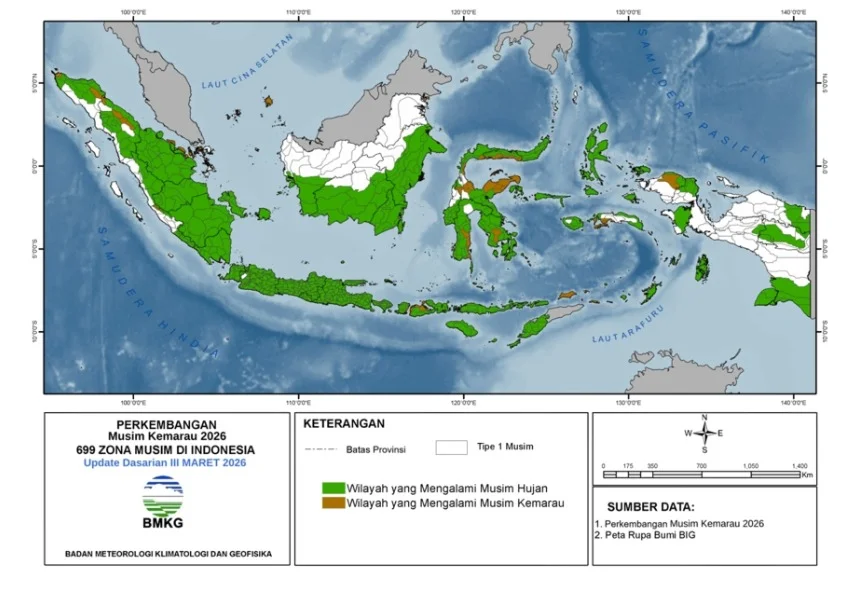
RRI.CO.ID, Jakarta - Following the Press Conference on Drought Season Predictions and El Nino Predictions on March 4, 2026, the Meteorology, Climatology, and Geophysics Agency (BMKG) recorded that by the end of March 2026, 7% of the Seasonal Zones (Z0M) in Indonesia had entered the dry season. The number will continue to increase significantly, with most regions of Indonesia predicted to enter the dry season in April, May, and June 2026.
As quoted by the official website Bmkg.go.id, the head of BMKG, Teuku Faisal Fathani, explained that several regions that have entered the dry season are a small part of provinces of Aceh, North Sumatra, Riau, Central Sulawesi, South Sulawesi, Southeast Sulawesi, West Nusa Tenggara, East Nusa Tenggara and Maluku, and West Papua.
"BMKG will continue to monitor the developments of global and regional climate dynamics and provide periodic updates. The public is expected to keep following the official information provided by BMKG thru various available communication channels," Faisal conveyed in Jakarta, Sunday, April 5, 2026.
On the other hand, the Deputy for Climatology at BMKG, Ardhasena Sopaheluwakan, explained that BMKG also predicts the possibility of the El Niño phenomenon developing in the second semester of this year. Until the end of March 2026, the El Niño-Southern Oscillation (ENSO) and Indian Ocean Dipole (IOD) conditions were still observed to be in the Neutral phase. However, climate modeling indicates that ENSO could develop into the El Niño phase in the second semester of 2026.
"At this time, the BMKG's prediction for the intensity of El Niño is in the weak to moderate category with a 50-80% chance, and there is a small possibility (less than 20%) that this phenomenon will develop into a strong category," he said.
BMKG reminds the need for caution in interpreting current data due to the spring predictability barrier phenomenon, which reduces climate prediction accuracy during the March to May period. The accuracy of forecasts during this period is generally only reliable for the next three months, thus requiring special expertise in understanding the interactions of the causes and impacts of El Niño in Indonesia.
For that reason, BMKG needs to continuously monitor data updates periodically and assess their developments. In line with this, the level of confidence in the intensity of El Niño will be higher in the May 2026 predictions. Statistically, predictions made in May have better reliability for forecasting climate conditions up to six months ahead.
News Recomendation
Loading latest news.....