



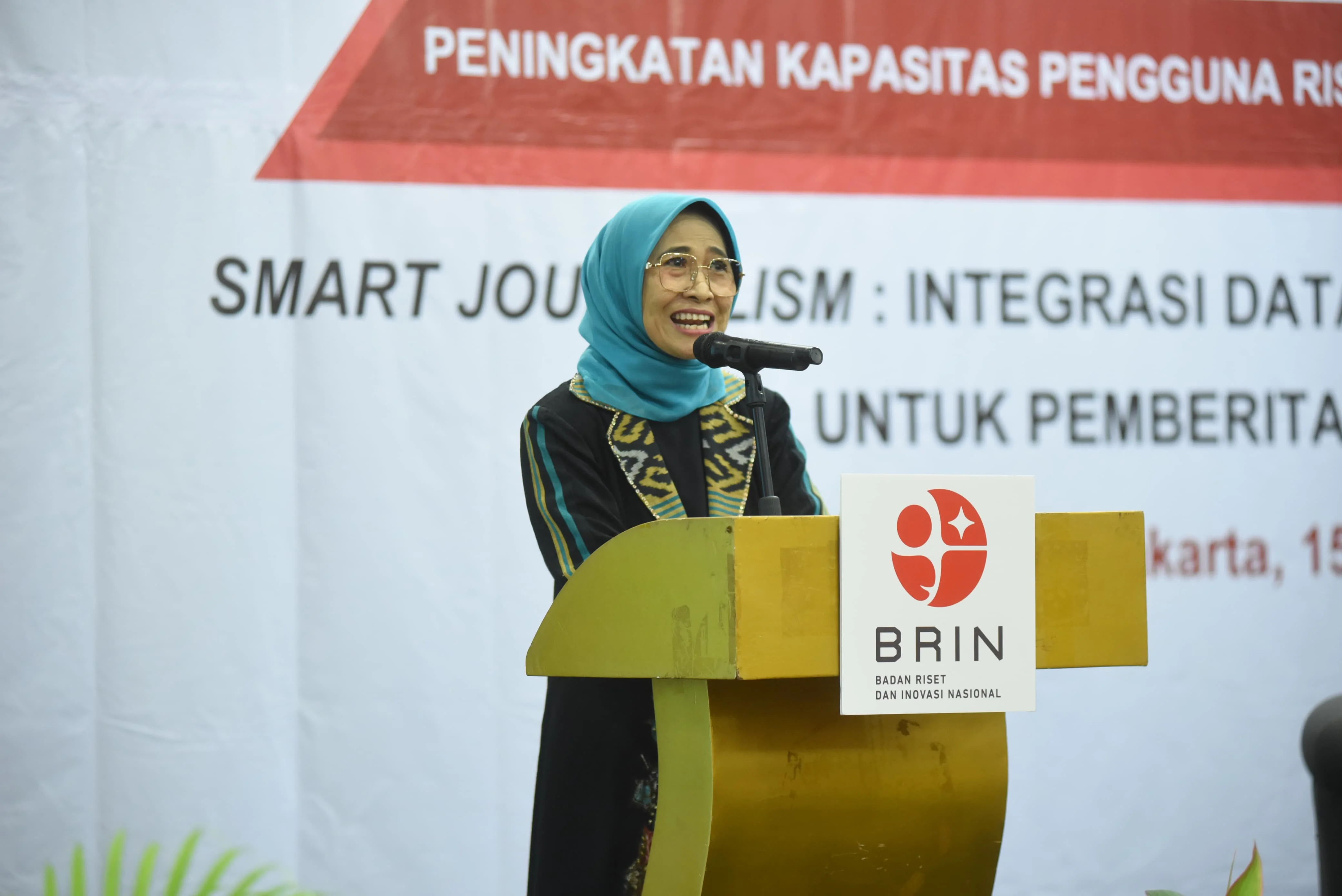
RRI.CO.ID, Jakarta – Chairperson of Commission X of the Indonesian House of Representatives (DPR), Hetifah Sjaifudian, stated that Artificial Intelligence (AI) should be positioned as a co-pilot or assistive tool, not as a replacement for human roles.
As quoted by dpr.go.id, Hetifah made the statement while delivering a keynote speech at a discussion attended by journalists in Jakarta on Sunday, March 15, 2026. Based on a survey in Southeast Asia, although 95 percent of journalists are already familiar with AI, editorial decisions, fact verification, and ethical considerations must remain entirely under the control of human journalists.
The discussion was titled “Smart Journalism: Integration of Data, Research, and Artificial Intelligence for Quality News Reporting,” held in collaboration with BRIN.
According to her, this phenomenon indicates that AI is no longer merely a technological experiment, but rather a gateway that is reshaping the traditional role of mass media. The rapid development of artificial intelligence has fundamentally transformed the global journalism landscape, from the production of news to how information is consumed by the public. Data shows that more than 70 percent of Generation Z now rely on AI for information.
“This ecosystem shift brings significant opportunities for the newsroom's efficiency, where AI is capable of handling data-heavy tasks such as analyzing thousands of documents, transcription, and processing public data instantly,” she explained.
She also noted that the integration of this technology has given rise to the concept of smart journalism, an evolution in journalistic practice that combines the power of research, data, and artificial intelligence.
With this approach, journalists are expected not only to report events but also to simplify complex information for the public to understand. However, behind this efficiency, she warned of serious threats such as disinformation and manipulative content like deepfakes.
This technology can create highly realistic audio-visual material that has the potential to be misused for fraud or manipulation of public opinion.
Furthermore, the speed of digital information flows often traps media organizations in a race to be the fastest, which unfortunately undermines accuracy, the cornerstone of journalistic products.
“AI can help accelerate the work process, but integrity, conscience, and moral responsibility cannot be delegated to algorithms,” she said.
News Recomendation
Loading latest news.....