



Javan Rhino Calf Caught on Camera in Ujung Kulon National Park
- 04 Feb 2026 23:07 WIB
- Voice of Indonesia
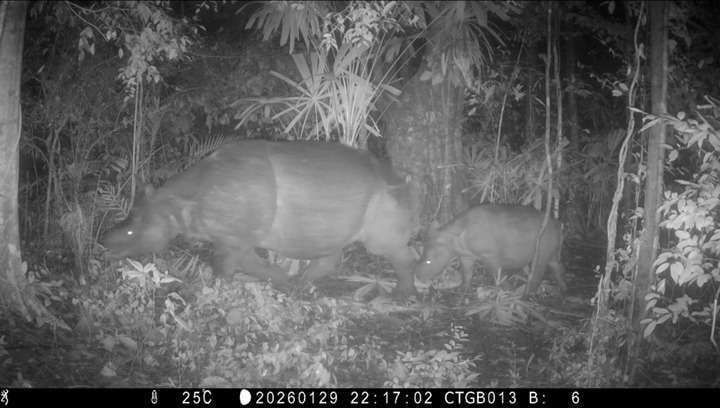
RRI.CO.ID, Jakarta - The conservation program for the Javan rhinoceros (Rhinoceros sondaicus), also known as the one-horned rhinoceros, has recorded another positive result. A female Javan rhinoceros and her calf were captured on a camera trap in the Cigenter Block of Ujung Kulon National Park, Banten.
“The footage was obtained by the Monitoring and Evacuation Team of the Red and White Operation for Javan Rhinoceros Translocation on January 29, 2026, at 10:17 p.m. Jakarta Time. This marks the first recording of a Javan rhinoceros calf in 2026,” said Satyawan Pudyatmoko, Director General of Natural Resources and Ecosystem Conservation (KSDAE) at the Ministry of Forestry, on Wednesday, February 4, 2026.
Satyawan said the presence of the mother and calf indicates successful area management and effective habitat security. The recording demonstrates that the Javan rhinoceros habitat in Ujung Kulon National Park remains well preserved. “Consistent area security and support from various parties are essential factors. This is what allows Javan rhinos to breed naturally,” he said.
Based on preliminary analysis, the mother is believed to be Arum, previously identified in the monitoring system. The calf is a new individual estimated to be less than five months old.
Ujung Kulon National Park will continue intensive monitoring of the mother and calf, as well as the entire Javan rhinoceros population in the area.
Monitoring efforts include enhanced patrols, technology use, and habitat management. Collaboration with conservation partners, non-governmental organizations, law enforcement agencies, local administrations, and communities also supports this conservation program.
The government has called on all parties to continue supporting the preservation of the Javan rhinoceros, one of the world’s rarest species, to ensure its survival in the future.
The Javan rhinoceros, or one-horned rhinoceros, is one of five rhinoceros species still living in South Asia and Africa. It has been classified as Critically Endangered (CR) by the International Union for Conservation of Nature (IUCN) due to declining numbers and poaching. (Gusti Panji/Lasti Martina)
News Recomendation
Loading latest news.....