



Indonesia's Demographic Bonus Need to be Optimized
- 23 Mar 2025 19:36 WIB
- Voice of Indonesia
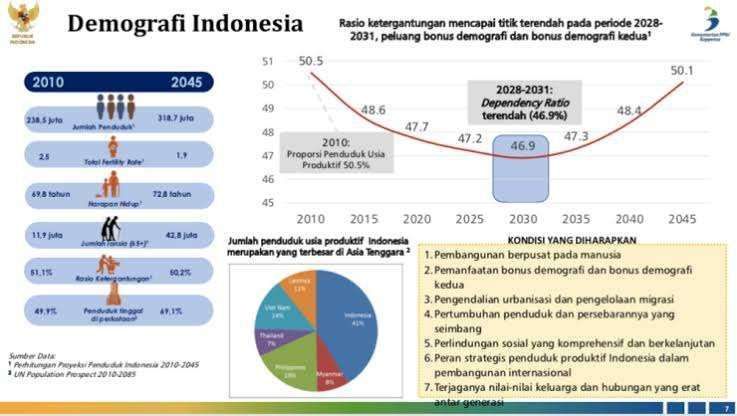
KBRN, Jakarta: The Main Secretary of the National Population and Family Planning Agency (BKKBN), Budi Setyono, emphasized the importance of the Grand Design for Population Development (GDPK) to optimize Indonesia's demographic bonus which lasts from 2020 to 2030.
A demographic bonus occurs when the population of productive age (15-64 years old) is greater than the population of non-productive age. GDPK was prepared by the regional government as a guide for integrating population variables in development.
"The targets and indicators of the 2025-2029 population development roadmap include controlling population quantity, improving population quality, family development, arranging the distribution and directing population mobility, and integrating population data," said Budi at the Kickoff Meeting of the Population and Family Development Roadmap in GDPK on Friday, March 21, 2025, quoted by rri.co.id.
He said that the success of the demographic bonus depends on the quality of the productive age population, women's participation in the labor market, job creation, and birth control.
Despite the great opportunities, Indonesia faces challenges such as high unemployment amidst a large workforce. Around 50 percent of women of productive age do not work in the formal sector and many individuals have difficulty competing due to lack of skills and education.
"As many as 50 percent of women of productive age do not work in the formal sector so they do not contribute fiscally and become dependent variables in the context of population," said Budi.
According to data from the Directorate General of Taxes in 2024, the number of taxpayers in Indonesia reached 69 million people, while the number of productive age population reached 195 million.
"This means that many productive ages do not contribute taxes because 59 percent of them work in the informal sector," he added.
To overcome these challenges, the Ministry of Population and Family Development/BKKBN has five programs, namely the Foster Parents Movement to Prevent Stunting (Genting), the Child-Loving Foster Care Park (Tamasya), the Indonesian Exemplary Father Movement (GATI), the Empowered Elderly, and the Super Apps 'Indonesian Family'.
Based on the 2020 National Socio-Economic Survey by the Central Bureau of Statistics (BPS), Generation Z and Millennials dominate Indonesia's population with proportions of 27.94 percent and 25.87 percent respectively.
The GDPK will be implemented with a five-year roadmap and an implementable annual action plan to achieve five population development targets.
Deputy for Population Control at BKKBN, Bonivasius Prasetya Ichtiarto, emphasized that the GDPK is expected to be able to answer the problems of population dynamics in Indonesia and optimize existing opportunities now and in the future. ***
News Recomendation
Loading latest news.....