



Indonesian Government Promotes Digital Economic Inclusivity in the RCEP Region
- 21 Sep 2026 07:17 WIB
- Voice of Indonesia
Key Points
- The Ministry of Trade hosted the 22nd Gambir Trade Talk (GTT) to examine how digital trade rules, connectivity, and economic development can be maximized across the RCEP region.
- Experts emphasized that robust digital trade agreements lower transaction costs, expand market access for MSMEs, and foster online trust through paperless authentication and cyber security cooperation.
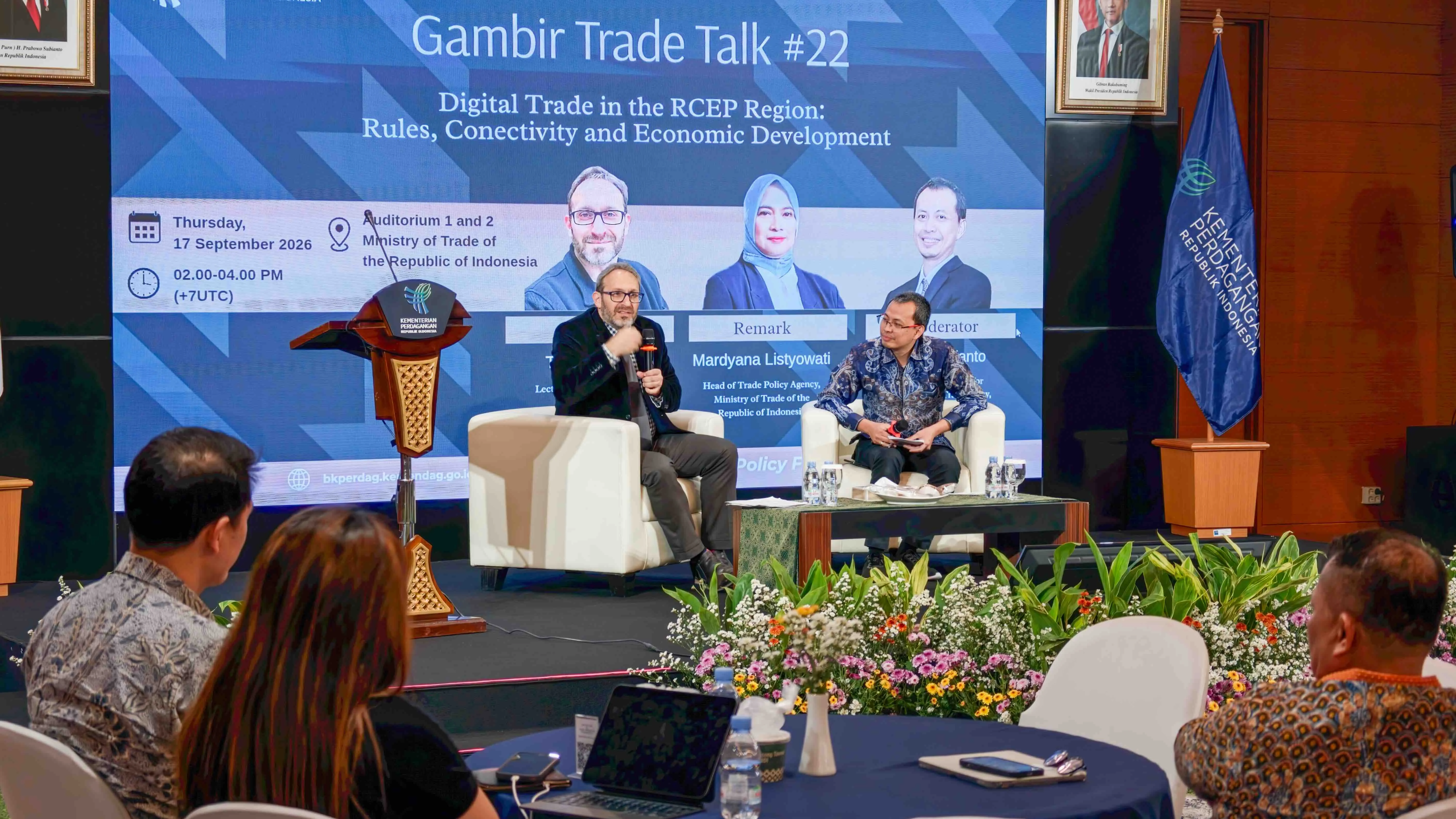
RRI.CO.ID, Jakarta – The Ministry of Trade hosted the 22nd Gambir Trade Talk (GTT) under the theme "Digital Trade in the RCEP Region: Rules, Connectivity and Economic Development" in a hybrid format at the Ministry of Trade Office in Jakarta on Thursday, September 17, 2026.
This event was held to enhance understanding of trade digitalization developments and their implications for economic growth, particularly within the Regional Comprehensive Economic Partnership (RCEP) region.
GTT also serves as a dialogue platform to discuss trade issues and generate constructive inputs to support trade policy formulation. For this year's GTT edition, the Ministry of Trade invited a Professor of International Economics from the University of Adelaide, Tony Cavoli, as a keynote speaker.
Head of the Center for International Trade Policy at the Ministry of Trade, Rifan Adianto, stated in his opening remarks, "The Regional Comprehensive Economic Partnership serves as a vital framework for supporting trade integration and responding to digital economic progress. Other initiatives, including the ASEAN Digital Economy Framework Agreement (DEFA), also underline how strategic digital trade has become in the regional economic agenda."
Rifan added that digitalization opens up massive opportunities to reduce transaction and information costs, broaden market access, boost productivity, and strengthen the involvement of business players, including MSMEs, in regional and global value chains. Nevertheless, he noted that a sound policy and regulatory framework is essential to facilitate cross-border trade, provide business certainty, and ensure that the benefits of digitalization are distributed widely.
Tony explained that digital trade can support development through several key channels. These include digital capabilities such as connectivity, skills, and platforms; lower trade costs; market expansion and an increase in exporters; enhanced services and innovation; as well as growth in productivity and employment.
"Recent studies prove that trade agreements with robust digital rules can boost online cross-border transactions. This happens because such rules provide legal clarity and reduce transaction costs," Tony elaborated.
Regarding RCEP, Tony detailed that the pact plays a crucial role in digital trade by reducing digital barriers through paperless trading and electronic authentication or signatures, which help lower documentation, verification, and compliance costs. He stated that RCEP has successfully built trust in online markets through consumer protection, personal data safeguards, and cybersecurity cooperation.
News Recomendation
Loading latest news.....