



Indonesia Seeks Bigger Role in APEC’s Low-Carbon Technology Transition
- 09 Sep 2026 10:53 WIB
- Voice of Indonesia
Key Points
- Indonesia seeks to use the low-carbon transition to strengthen domestic industry, innovation and economic value.
- APEC promotes technology transfer, financing and partnerships for a more inclusive green transition.

RRI.CO.ID, Jakarta - Indonesia is seeking to turn the Asia-Pacific’s low-carbon technology transition into an opportunity to strengthen domestic industry, create jobs and increase added value, rather than becoming only a market for green technology.
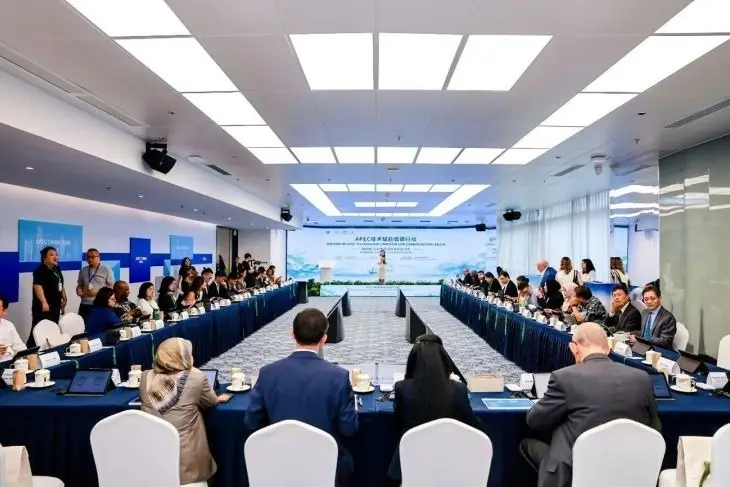
Indonesia’s business community expressed support for the low-carbon technology transition promoted by the Asia-Pacific Economic Cooperation (APEC) at the High-Level Meeting on APEC Technologies Empower Low Carbon Action (TELCA) in Shenzhen, China, from September 2 to 4, 2026.
"Green economy is not merely an environmental agenda. It is the foundation of new economic growth," said Chairman of the Anak Muda Amankan Indonesia (AMAN) community and Chief Commissioner of AMAN Group Indonesia, James Karnadi, in a written statement in Beijing on Wednesday, September 9, 2026, as quoted by Antara.
"Indonesia must ensure that we are not only users or markets for technology, but become an important part of the production, innovation, and value-creation processes," he added.
The meeting was held under the APEC Policy Partnership on Science, Technology and Innovation (PPSTI) and was part of the APEC 2026 series hosted by China.
The forum brought together more than 40 participants from 18 APEC economies, including policymakers, academics, international organizations and private-sector representatives, to discuss low-carbon technology roadmaps, accessibility and cross-border partnerships.
James said the low-carbon transition would influence not only environmental commitments but also investment, industrialization, job creation and economic competitiveness in the Asia-Pacific. He warned that unequal access to green technology could create new economic disparities if technology, financing and industrial capacity remained concentrated in countries with stronger capital and infrastructure.
He, therefore, encouraged APEC economies to expand cooperation beyond technology trade and sales to include knowledge transfer, human-resource development, local industrial ecosystems and competitive financing. "Developing countries do not need technology that can only be purchased. We need partnerships that allow the technology to be operated, adapted, produced, and ultimately developed together," he said.
With its large economy, population, natural resources and strategic position, Indonesia has an opportunity to connect technology-producing countries with developing markets seeking affordable low-carbon solutions.
James said Indonesia should use the green transition to strengthen its industrial structure by directing investment toward added value, human-resource development and domestic production and technological capacity. "Our target is not only increased investment, but investment that strengthens industrial sovereignty and improves Indonesia's bargaining position in global value chains," he added.
The approach could help Indonesia strengthen its position in future-oriented sectors, including clean energy, green manufacturing, electric vehicles and digital technology.
The forum's discussions will be compiled into the "APEC Technologies Empowering Low-Carbon Action Project Report," containing a roadmap and recommendations on low-carbon technology accessibility and cross-economy partnership models.
The results will be followed up under the APEC Policy Partnership on Science, Technology and Innovation (PPSTI). APEC economies account for around 60 percent of global carbon dioxide emissions, placing the Asia-Pacific under strong pressure to pursue a green and low-carbon transition while maintaining economic growth.
On the first day, participants discussed cost-sharing in the energy transition, inclusive standards and governance, and investment mechanisms for green technology. The second day featured discussions on "Accessibility, Green Energy Proficiency, and Empowering Partnerships" through six keynote speeches and three parallel sessions.
A representative of Capol International & Associates Group, an architectural design and engineering consultancy in Shenzhen, said cities could reduce transport-related carbon emissions by better balancing jobs and housing; and strengthening ecological systems.
On the third day, participants toured various locations in Shenzhen to explore existing low-carbon urban solutions. ***
News Recomendation
Loading latest news.....