
Why World War II Bombs Still Exist in Biak?
- 02 Jun 2026 17:50 WIB
- Voice of Indonesia
RRI.CO.ID, Biak - An object suspected to be a bomb exploded on Biak Island, Papua, on Sunday, May 31, 2026, killing five people and injuring dozens more. World War II, which lasted from 1939 to 1945, is suspected of having a role in the incident.
The explosion occurred on Sunday afternoon in the "Fisheries Complex" (Kompleks Perikanan) in Fandoi Village, Biak Kota District, Biak Numfor Regency; destroyed at least nine houses and other buildings, including a church. On Monday, June 1, 2026, a joint team of police, military personnel, and search-and-rescue officers reported that they had recovered 13 human body parts.
"Tomorrow, we will continue searching for the three victims who have not yet been found, focusing on Ring 2, which includes the waters and coastal areas," Biak Numfor Police Chief, Ari Trestiawan, said as reported by RRI Biak.
Further investigation suggests that the object that exploded was likely an unexploded bomb left over from World War II. Biak was indeed a strategically important location, particularly in the Pacific theater of the war between Japan and the United States (U.S.).
Biak was considered one of the key islands by the Imperial Japanese military, partly because of its geographic position, which made it suitable for air bases. Originally controlled by the Netherlands as part of the Dutch East Indies colony, Biak and nearby islands such as Yapen and Supiori came under Japanese control in the early 1940s.
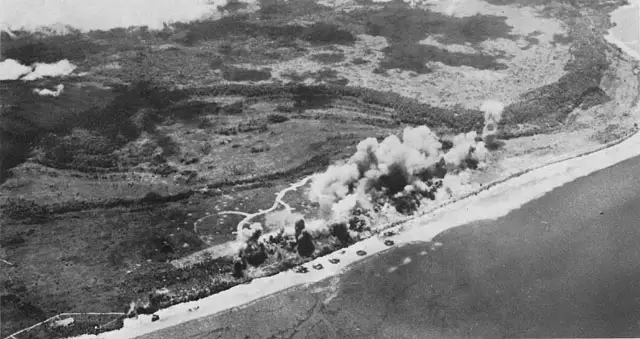
Over time, the U.S. recaptured islands across the Pacific Ocean one by one in an effort to push back Japan following the attack on Pearl Harbor, Hawaii, in 1942. As American forces advanced into Papua and the surrounding areas, Battle of Biak became inevitable.

As part of General Douglas MacArthur’s plan to invade the Philippines, the U.S. launched an assault on Biak on May 27, 1944. With Australia as its ally, the U.S. deployed the 24th and 41st Infantry Divisions against Japan’s 35th and 36th Infantry Divisions.
More than 4,700 Japanese soldiers were killed, along with over 400 American troops. The battle lasted nearly three months, ending on August 17, 1944—exactly a year before Indonesia declared its independence.
In the end, the U.S. and Australia succeeded in driving Japan out of Biak Island. The battle became one of the key victories that enabled the U.S. to regain control of the Philippines, one of its colonial territories in the early 20th century, and ultimately defeat Japan in 1945.
Remnants of World War II can still be seen in Biak today. In addition to the remains of airfields that are still visible, even from the air, Binsari Cave—once a Japanese military base and now a tourist attraction—still contains artifacts and traces from the war.
However, one of the lingering legacies of World War II is the unexploded bombs left behind by Japan or the Allied forces, many of which are scattered along coastal areas. The May explosion is one example of the tragic consequences of World War II that continue to be felt in the 21st century.
Kata Kunci / Tags
News Recomendation
Loading latest news.....