



ASEAN Must Maintain Economic Stability and Growth Amid Global Uncertainty
- 25 Mei 2026 16:44 WIB
- Voice of Indonesia
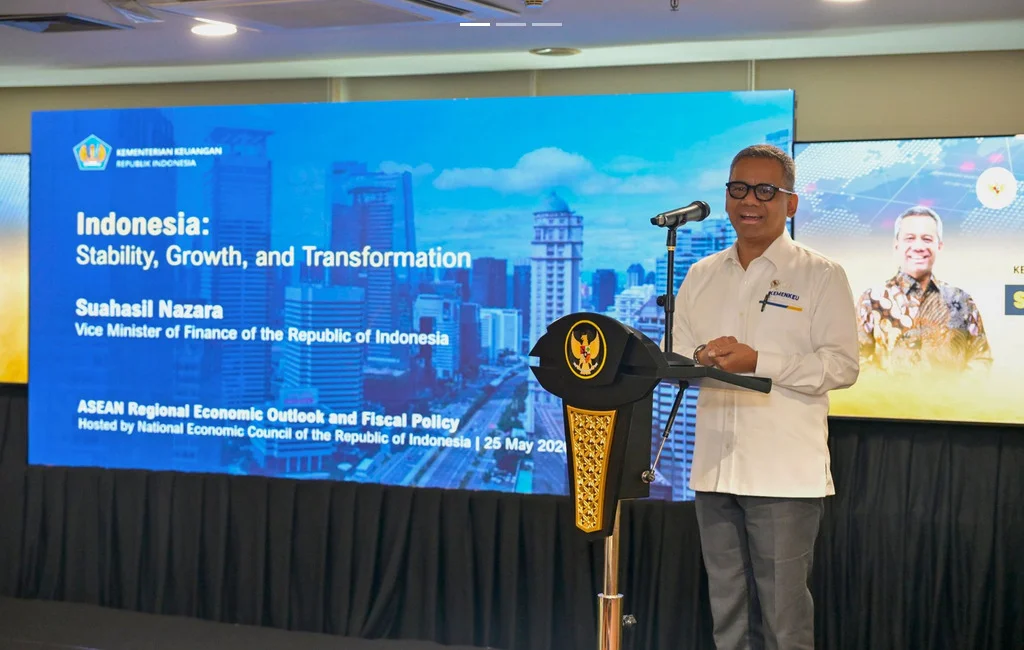
RRI.CO.ID, Jakarta - Indonesia's Vice Minister of Finance, Suahasil Nazara, stated that global uncertainty has now become a new normal challenge that must be faced by countries in the Southeast Asian region. Therefore, stability in this region must be actively built by all ASEAN member states.
"Uncertainty will become our new normal in the future. So, stability or certainty is not simply given to us. It must be built by ourselves," Vice Minister of Finance, Suahasil said at the ASEAN Regional Economic Outlook and Fiscal Policy Seminar in Jakarta on Monday, May 25, 2026.
In his presentation, Vice Minister Suahasil, highlighted various global challenges, ranging from trade wars, trade fragmentation, climate issues, to technological disruptions such as artificial intelligence (AI). He also emphasized ASEAN's grand strategy for improving its economic sector, including encouraging intra-ASEAN trade, reducing non-tariff barriers, and strengthening cooperation in the digital economy and green transition.
He also emphasized prudent macroeconomic policy choices, increased food and energy security, and optimized financial cooperation, such as the Chiang Mai Initiative Multilateralization (CMIM) and local currency settlement. The Vice Minister of Finance expressed his hope that ASEAN would not be trapped within any one geopolitical bloc, but rather embrace various global economic powers, such as the US, China, India, the European Union, and Japan.
Vice Minister, Suahasil also emphasized the Ministry of Finance's commitment to strengthening regional synergy through research collaboration between the Ministry of Finance, the National Economic Council (DEN), and the ASEAN+3 Macroeconomic Research Office (AMRO). He viewed this effort as a crucial instrument in formulating appropriate fiscal policies.
On this occasion, Vice Minister Suahasil also presented Indonesia's economic performance, which recorded solid performance. In the first quarter of 2026, Indonesia's economic growth reached 5.61%, with a very controlled inflation rate of 2.4%. This combination of high growth and low inflation was achieved while maintaining a budget deficit of 2.9%.
Considering the growth trend over the past two to three decades, which has averaged 5%, Vice Finance Minister Suahasil stated that the 8% economic growth target set by President Prabowo Subianto's administration will be crucial. He believes this target can be achieved through increased productivity, infrastructure development, and strengthening human resource capacity to create quality jobs.
News Recomendation
Loading latest news.....