


KBRN, Jakarta: The Indonesian government under President Prabowo Subianto and Vice President Gibran Rakabuming Raka has outlined eight core missions, known as Asta Cita, to achieve the vision of “Together We Bring a Golden Indonesia 2045.” Among these missions, food self-sufficiency stands out as a strategic priority in the face of mounting national and global challenges.
Asta Cita serves as a guiding framework for ministries, government institutions, and stakeholders. It promotes a collective approach to policy, with food independence forming a crucial part of the government’s long-term resilience strategy.
One of the notable contributors to this mission is the Indonesian Air Force (TNI AU), which plays a role beyond its air defense mandate. Through direct involvement in food cultivation and sustainable agriculture, the Air Force has integrated national food resilience into its service ethos.
Across various units, TNI AU actively cultivates rice, vegetables, and fish, while also expanding into goat and cattle breeding. This agricultural push aims to diversify food production and promote sustainability in both military and civilian communities.
On February 5, 2025, the Doctrine, Education, and Training Command (Kodiklatau) in Bandung launched a food cultivation program. By turning vacant land into productive farmland, the initiative supports both service members and the surrounding community in securing essential food supplies.
“Our main focus is to support government programs so that food security can be achieved, both for the welfare of members and the surrounding community,” Commander of Kodiklatau, First Marshal Muhammad Mujib said.
Further east, in Jayapura, the Air Force continued this spirit of collaboration. On February 11, 2025, Air Force Chief of Staff Air Marshal M. Tonny Harjono, alongside PIA Ardhya Garini Chairwoman Isa M. Tonny Harjono, planted sweet potatoes on underutilized land at Silas Papare Air Base. The initiative encouraged Air Force personnel and local residents to take part in food production efforts.
A similar event was held two weeks later in Kupang, East Nusa Tenggara. At Land 48 of El Tari Air Base, the Air Force Chief of Staff and his spouse planted Zahra cayenne pepper and Lamuru corn, while also harvesting a successful chili crop. The selected varieties are known for high productivity and resilience to local conditions.
“This program isn't just for internal needs, but also aims to benefit the surrounding community. Productive land utilization like this is a strategic step in realizing national food security. We hope this program continues to be sustainable and can be an inspiration for other units,” Air Marshal Harjono said.
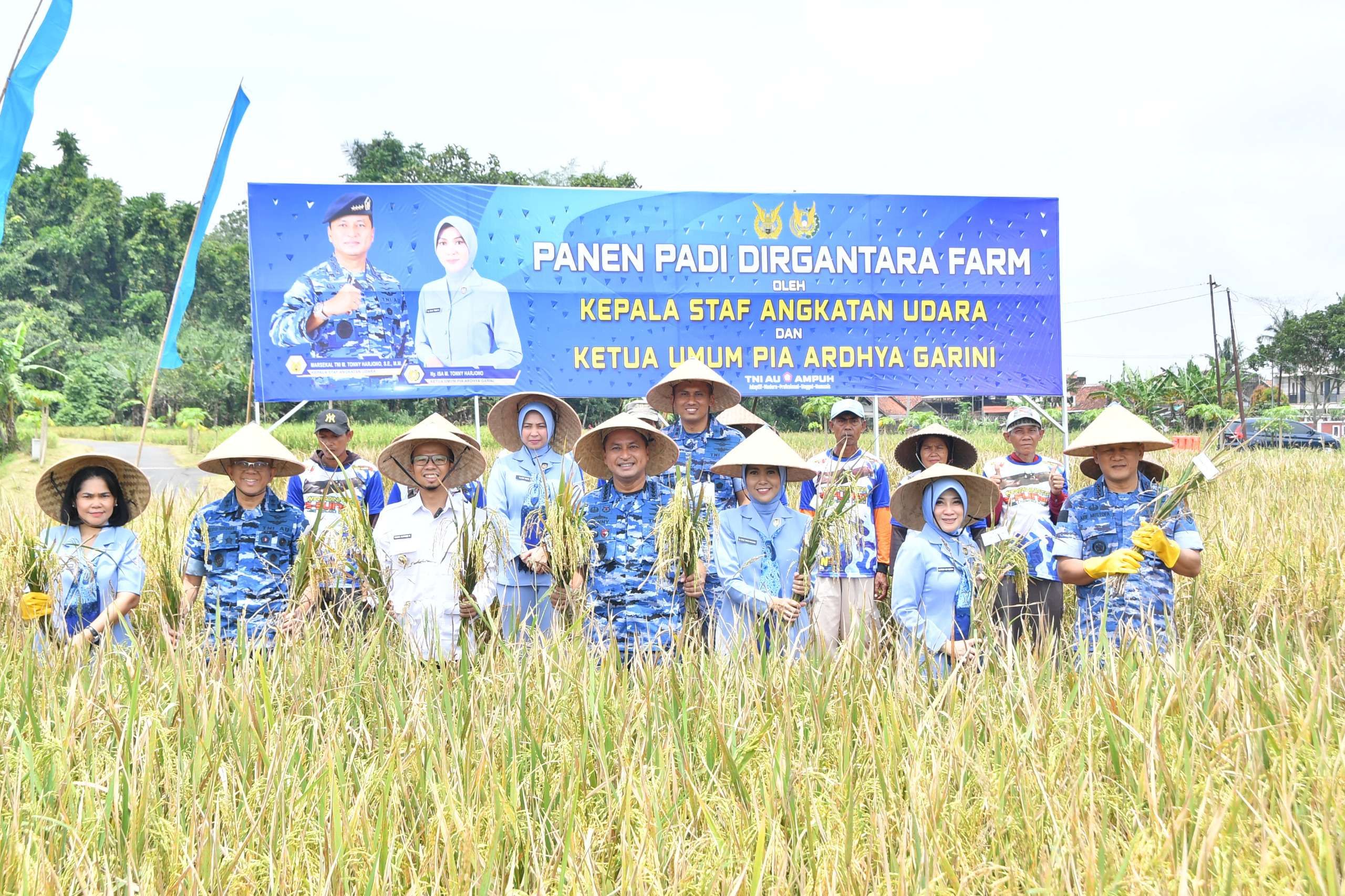
This nationwide momentum culminated on April 7, 2025, in a coordinated rice harvest across 14 provinces and 156 cities. The centerpiece of the event was in Randegan Wetan Village, Majalengka, West Java, led by President Prabowo himself and attended by representatives from ministries, local governments, and the Indonesian Armed Forces (TNI) and Police.
The presence of the Air Force during the harvest underscored its commitment to the AMPUH values—Adaptive, Modern, Professional, Superior, and Humanist. This identity aligns with a broader mission: to defend the skies and cultivate national resilience on the ground.
In his speech, President Prabowo expressed gratitude to all who contributed to the food security agenda. He called the effort a reflection of national dedication and praised the TNI for their visible role in advancing agricultural strength.
The President also noted a turning point: Indonesia’s success in stabilizing food prices and achieving surpluses in key commodities such as eggs. Even amid a global food crisis, Indonesia managed to maintain food stocks and start exporting agricultural products. Farmers, he emphasized, are heroes of food resilience.
“Their role must be supported by the state in a sustainable way,” he affirmed.
BRIN (National Research and Innovation Agency) economic researcher, Saktyanu Kristyanto, recognized the Air Force’s contribution.
“Of course we need to appreciate the Air Force because this is indeed an important part of food security, national resilience for all Indonesian people. Do not let our food needs be lacking,” he told RRI Voice of Indonesia, Wednesday (30/4/2025).
According to data from the Directorate General of Population and Civil Registration, Indonesia's population reached over 282 million in the first half of 2024. With such vast food demand, collaboration across sectors is crucial.
Saktyanu reiterated that efforts like those of the TNI AU offer real value.
“Yes, if we look at it, our country is very vast and the potential to prepare food can be done. Well, in our country which is quite vast and remote, it needs to be supported by good infrastructure. So of course, in principle, I just agree that the overall effort of the Indonesian Air Force in supporting food security through planting various food commodities and developing the fisheries sector is a very good step,” he said.
He also highlighted the importance of modernization in agricultural development.
“The hope is how agricultural development must be understood by Air Force Soldiers because agricultural development is not only farming, but how to prepare an agricultural modernization system for the common good for the realization of national food security,” he concluded.
Through these efforts, the Air Force has shown that safeguarding a nation extends beyond defense—it also means planting seeds for the future.