



Police Deputy Chief Launches New Forest Fire Strategy
- 07 Sep 2026 19:51 WIB
- Voice of Indonesia
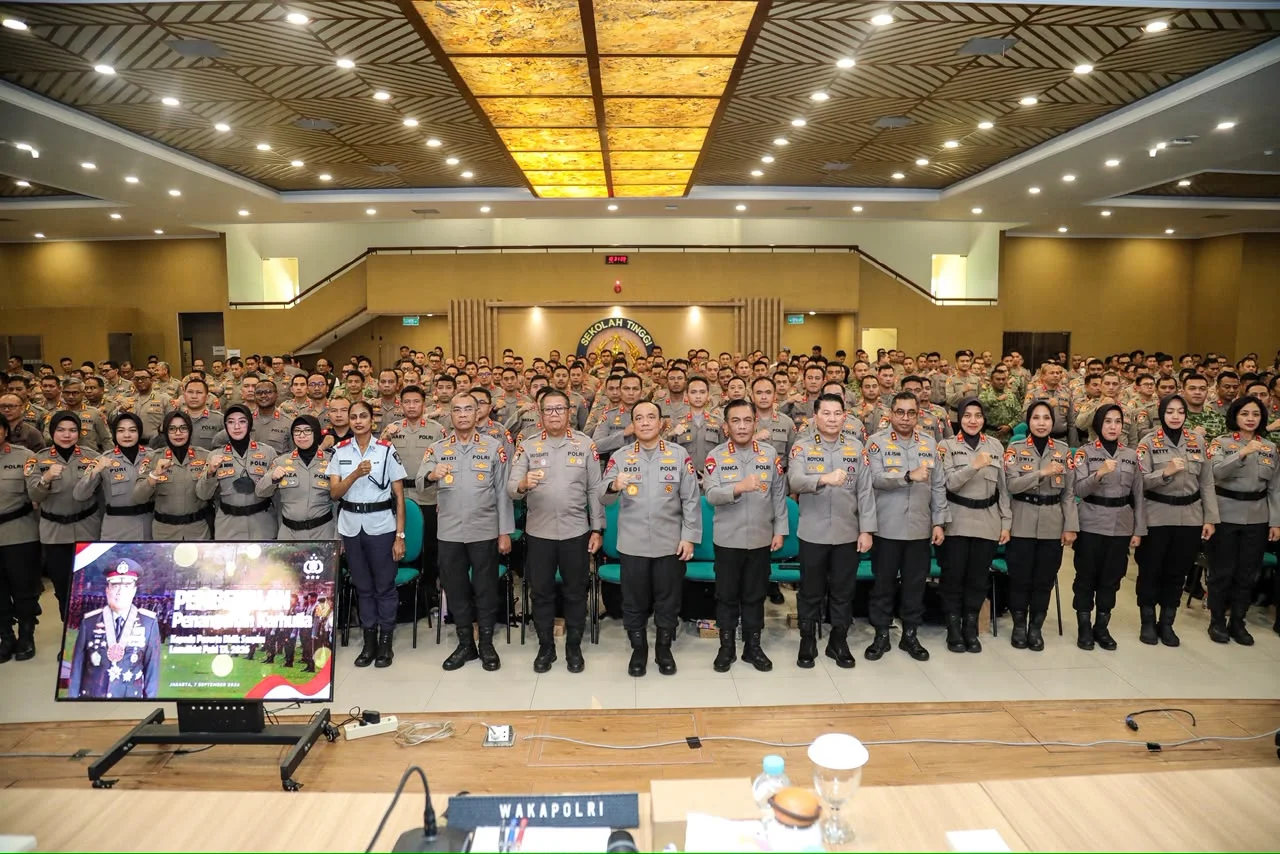
RRI.CO.ID. JAKARTA : Mitigating Forest and Land Fires can no longer rely on a reactive approach of extinguishing fires after they occur. Deputy Chief of the Indonesian National Police, Commissioner General Pol. Dedi Prasetyo, is pushing for a shift toward multi-approach policing. This new strategy combines prediction, prevention, technology, community involvement, ecology, emergency response, law enforcement, and crisis communication.
The strategy was a key point in the Deputy Chief’s briefing to 322 personnel of the Education, Outreach, and Prevention Task Force for Forest and Land Fires, second wave, at Bhara Daksa Field, STIK PTIK Lemdiklat Polri, Jakarta, on Monday, 7 September 2026. The personnel consist of 64 Sespimti participants, 207 Sespimmen participants, 29 SPPK participants, and 22 supervisors. They will be deployed for 10 days to South Sumatra, West Kalimantan, Central Kalimantan, and East Kalimantan. Previously, 189 participants had already been deployed, making this second wave part of a continuous rotation in the regions.
The Deputy Chief emphasized that the personnel must not only conduct outreach but also carry out audits of fire management in the field. “Do not just come for education. You are middle and top managers. Observe how the organization works, the condition of the area, how policies are implemented, and what is still lacking,” he stated. He also stressed that forest fires must be predicted before they happen through predictive policing. This involves integrating hotspot data, weather, groundwater levels, peat conditions, fire history, and technology such as drones, satellites, and artificial intelligence to determine priority areas and mobilize resources early.
As of 6 September 2026, there have been 113,616 hotspots with 202,010 hectares of burned land across 38 provinces. The highest number of hotspots was recorded in August with 58,243 points and in September with 38,237 points. Of all hotspots, 23,228 points or 20.4% were verified as fire points, 26,302 points or 23.1% were unverified, and 64,086 points or 56.4% were not fire points. Firefighting actions have been carried out on 18,085 points. Ecologically, the approach must also address peatland conditions. Data from SiTMAT KLH showed critically low groundwater levels in several areas, such as Central Kalimantan at -143 cm and South Sumatra at -231.1 cm. Therefore, water management through canal blocks, reservoirs, bore wells, and hydrological restoration must be part of the strategy.
All of these efforts must run through collaborative policing. Collaboration is built from the national level involving the Ministry of Forestry, Ministry of Environment, BNPB, BMKG, BRIN, the Police, and the Military, down to regional and grassroots levels. At the regional level, it involves Regional Police, District Police, BPBD, Forest Management Units, and local governments. At the grassroots level, it includes Bhabinkamtibmas, Babinsa, Community Fire Brigades, village heads, traditional leaders, communities, and corporations. In emergencies, local governments take the lead with support from all stakeholders according to their duties and authority.
Law enforcement must also address the issue comprehensively, covering both individuals and corporations. As of 6 September 2026, there were 200 police reports, consisting of 192 individual cases and 8 corporate cases, with 138 suspects and a total case area of 8,637.35 hectares. “If there is evidence of corporate responsibility, do not stop at the direct perpetrators. Look at the entire chain of accountability,” the Deputy Chief asserted. At the same time, handling forest fires also takes place in the digital space. From 1 August to 6 September 2026, there were 117,022 mentions with a reach of 1.67 billion impressions. Sentiment was 83.2% neutral, 13% negative, and 3.8% positive. The peak volume was on 2 September with 7,466 mentions, while the highest negative sentiment of 27.7% occurred on August 21 during #PrayForKalimantan.
The Deputy Chief highlighted three fundamental changes: from reactive to anticipatory, from individual to individual and corporate accountability, and from sectoral to multi-stakeholder. “Do not only look at how the fire is extinguished. Audit the management. See what has been done, what is lacking, and how to improve it. Concrete recommendations must come from this,” he concluded. Through the deployment of 322 personnel, the National Police is strengthening the transformation of forest fire management from merely extinguishing fires to building a system that can predict risks, prevent fires, involve communities, protect ecosystems, integrate resources, enforce the law, and manage public communication.
Source : PR Polri
News Recomendation
Loading latest news.....