



BRIN Saves Threatened Plant Species in Cibodas Botanic Garden
- 05 Agt 2026 12:43 WIB
- Voice of Indonesia
Key Points
- BRIN is implementing an ex-situ conservation program to protect 378 critically threatened plant species at Cibodas Botanic Garden in Cianjur, West Java.
- The agency successfully regenerated Musa insularimontana Hayata, a critically endangered wild banana species on the IUCN Red List, along with propagating two vulnerable species and dozens of endangered collections.
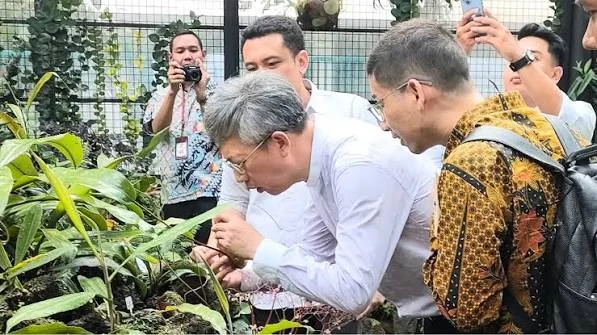
RRI.CO.ID, Jakarta - The National Innovation and Research Agency (BRIN) is prioritizing the rescue of 378 critically threatened plant species at Cibodas Botanic Garden in Cianjur Regency, West Java through an ex-situ conservation program.
Among the hundreds of collections, BRIN has recorded a significant achievement by regenerating Musa insularimontana Hayata, a wild banana species now listed as Critically Endangered on the International Union for Conservation of Nature (IUCN) Red List.
Based on data collection, there are 378 critically threatened plant species in the Cibodas Botanic Garden collection. So far, propagation efforts have produced significant results due to the succession of propagated two vulnerable species, which are Yucca treculeana and Agave vivipara L.
In addition, 18 endangered species, 63 other critically threatened plant collections have also been propagated and regenerated.
“Indonesia, with its rich biodiversity, is facing major pressure from deforestation, land-use change, climate change, and human activity. These conditions are pushing many endemic and ecologically important plants to the brink of extinction,” said Functional Officer for Scientific Collection Processing of the Living Biology Conservation Area (KKI) of the Cibodas Botanical Gardens, Daseng Ahmad Samsudin, on Monday, August 3, 2026.
To address this situation, BRIN has implemented a legal framework under BRIN Regulation No. 7/2024, which serves as the implementing regulation of Presidential Regulation No. 83/2023.
“Not only that, six strengthening steps also need to be carried out, such as inventorying and identifying priority collections by recording plants classified as Vulnerable (VU), Endangered (EN), and Critically Endangered (CR),” added Daseng, as quoted on BRIN official website.
The next step is collecting propagation material by gathering source material from living collections at Cibodas Botanic Garden, field exploration results, seed exchange, and donations, followed by initial production and maintenance.
“Next is acclimatization and regeneration, namely adjusting propagated seedlings to the outdoor environment and regularly renewing the collection population,” he said.
Documentation and data management are the fourth step. Each seedling must have data including accession number, origin, propagation method, sowing date, and successful propagation date.
Once the seedlings are alive and qualify for collection, the plants are registered in the National Scientific Repository (RIN) and the Makoyana application. After receiving a new accession number, the collection is stored in the garden record book.
“The fifth step is developing a reserve stock of collection seedlings, where seedlings of rare species must be kept indoors or in a greenhouse. This safe storage is intended to preserve genetic variation so the plants are ready for planned planting and can adapt to disease and climate change,” he added.
The final step is evaluation to monitor survival rates and reduce the proportion of critically threatened collections.
In practice, BRIN faces challenges such as propagation failure risks, climate change impacts, limited resources, and threats from pests and diseases. To mitigate these obstacles, BRIN is applying various measures, including tissue culture research, greenhouse optimization with precise microclimate control, stronger research collaboration and external funding, as well as intensive monitoring and integrated biological protection.
Ex-situ conservation at Cibodas Botanic Garden is expected to become a sustained, science-based commitment to preserving Indonesia’s flora and ensuring its survival for future generations. ***
News Recomendation
Loading latest news.....