



Rare Twin Proboscis Monkeys Spark Global Praise for Curiak Conservation
- 23 Jun 2026 16:53 WIB
- Voice of Indonesia
Key Points
- Conservationists on Curiak Island, South Kalimantan, recorded a rare birth of twin proboscis monkey (bekantan) infants, attracting international scientific attention.
- The twins were discovered during routine monitoring at Camp Tim Roberts by researchers from Sahabat Bekantan Indonesia (SBI).
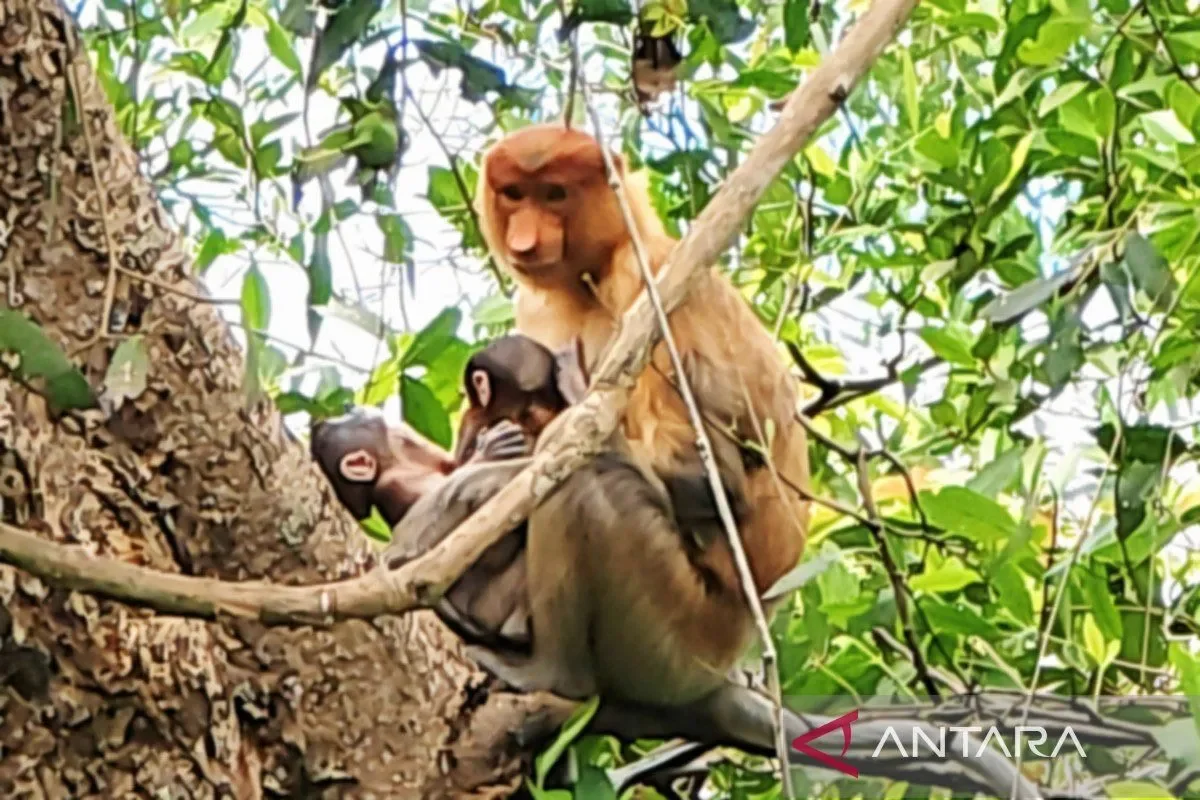
RRI.CO.ID, Banjarmasin - A rare sighting of twin proboscis monkey, also known as bekantan, infants at Camp Tim Roberts on Curiak Island on the Barito River, in Barito Kuala Regency, South Kalimantan, has drawn international attention. The discovery has renewed hope for conservation efforts after years of habitat restoration and community engagement.
The newborns were first seen during routine monitoring by Amalia “Amel” Rezeki and her team at the Sahabat Bekantan Indonesia (SBI) research station. They stood out for their jet-black fur and deep blue faces, features that will gradually change to the yellow-brown coat and elongated nose typical of adult bekantan.
“We are very grateful and even shed tears of joy because after more than ten years dedicated to proboscis monkey conservation on Curiak Island, this is the first time I have observed twin births,” said Amel, a conservation biologist at Lambung Mangkurat University and recipient of the 2022 Kalpataru environmental award.
Amel explained that twin births among primates, especially Old-World monkeys like the proboscis monkey (Nasalis larvatus), are exceedingly rare in the wild, where single births are the norm. The twins, born to an alpha female in mid‑June 2026, were seen nursing in their mother’s embrace, cared for collectively by the colony’s social structure, often with younger females acting as “baby sisters.”
The event has captivated scientists and conservationists worldwide. Associate Professor Charles Lee of Singapore said he was moved to tears on hearing the news, calling the twins’ healthy presence on Curiak Island a testament to the excellent care from SBI and local villagers.
“I hope they have a sustainable future, full of hope, resilience and blessings,” he said, as quoted by Antara.
Professor Tim Roberts of the University of Newcastle, after whom the research station is named, praised Amel and her team for a decade of dedicated work rescuing the species from extinction. He noted the Curiak conservation area in the Barito River system has become a vital stronghold by providing safe, resource-rich mangrove forest habitat for proboscis monkeys.
Japanese researcher, Ikki Matsuda of Kyoto University’s Wildlife Research Center, also called the twin birth extraordinary and urged sharing the milestone with the public given its rarity among primates.
Domestically, conservation expert, Hadi Alikodra of IPB University, described the twins’ arrival as a divine gift and an indicator that Curiak’s habitat and food resources are in good condition. He urged continued, routine monitoring by SBI.
Amel echoed that call while expressing concern over nutrition for two infants from a single mother and said the team will intensify observations to monitor each developmental stage closely.
SBI’s data show the proboscis monkey population on Curiak has grown to 61 individuals, up from 14 when SBI began managing the island in 2016. The protected area has expanded from 2.7 hectares to about 10 hectares through extensive planting of rambai mangroves, more than 50,000 seedlings, some of which have formed small islets around Curiak.

The success at Curiak Island, located near the Bakut Island Nature Tourism Park and part of the Meratus UNESCO Global Geopark, has also benefited local communities. Dozens of fishers now harvest abundant fish and shrimp in the mangrove waters, and nine villages in Anjir Muara Subdistrict report improved livelihoods tied to wetland restoration.
Local and provincial authorities have backed the development of Curiak as a niche ecotourism destination. Meanwhile, the South Kalimantan Tourism Agency Head, Iwan Fitriady, stressed the need to raise local awareness so communities can jointly protect nature and sustain economic gains.
With continued dedication from SBI, scientists, and residents, the rare twin birth could mark a turning point for the bekantan. The species is nicknamed the “Dutch monkey” and serves as the fauna mascot of South Kalimantan, both inside and outside formal conservation zones. ***
News Recomendation
Loading latest news.....