



BRIN Warns Invasive Fish Threaten Indonesia’s Ecosystems
- 23 Apr 2026 19:55 WIB
- Voice of Indonesia
Key Points
- BRIN has identified around 50 non-native fish species in Indonesia, with at least 18 classified as invasive predators that threaten local ecosystems.
- Researchers warn that the spread of invasive species, driven largely by the ornamental fish trade, is accelerating ecological damage and endangering native biodiversity.
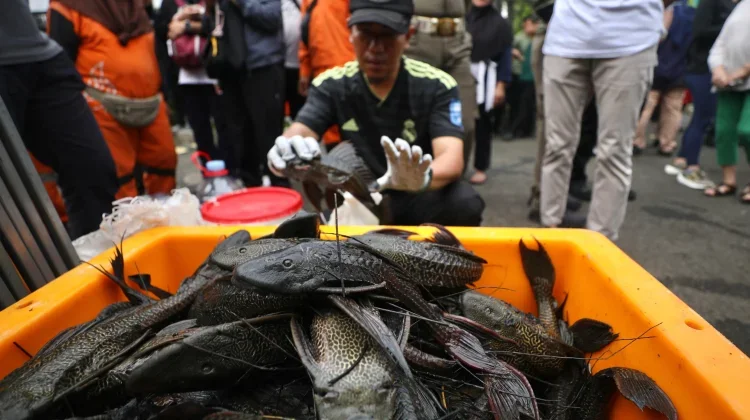
RRI.CO.ID, Jakarta - The National Research and Innovation Agency (BRIN) has warned that dozens of invasive fish species are accelerating damage to Indonesia’s aquatic ecosystems, raising concerns over biodiversity loss and ecological imbalance.
An associate researcher at BRIN’s Research Center for Biosystematics and Evolution, Gema Wahyudewantoro, said Indonesia is now home to around 50 non-native fish species, at least 18 of which are classified as invasive predators.
“About 11 species belong to the cichlid family. Three are known as pleco or sucker fish, one is suspected to be a hybrid, and another is still under study,” Gema said on Thursday, April 23, 2026. He added that at least five types of pleco have been detected in Indonesian waters, some of which are believed to be hybrids.
Beyond pleco, Gema highlighted other high-risk predators such as alligator gar and arapaima gigas, whose large size and aggressive feeding behavior allow them to prey extensively on native fish populations.
Among the most concerning species is the red devil fish, known for its sharp teeth and aggressive nature. “It is an active predator that can significantly disrupt local ecosystems,” he said.
Researchers suspect that the spread of invasive species is largely driven by the ornamental fish trade, with many fish released into public waters when owners can no longer care for them.
“They are often discarded out of boredom or neglect, whether intentionally or unintentionally,” Gema explained. He stressed the need for active removal and public education, urging hobbyists not to release exotic species into the wild. “If you can no longer keep them, don’t release them into the wild. That can cause serious ecological damage,” he emphasized.
Separately, an aquaculture lecturer at Airlangga University, Veryl Hasan, noted that many invasive fish species originate from the Amazon and are highly adaptable to new environments.
He warned that pleco pose a significant threat due to their opportunistic feeding behavior, which pressures native species such as freshwater minnows and snakehead fish, hindering their reproduction. “While sucker fish are high in protein, long-term consumption may still pose health risks. Education for aquarium hobbyists is crucial to prevent irresponsible release of exotic species,” Veryl said. (Misni Parjiati/Lasti Martina)
News Recomendation
Loading latest news.....