


2025 KERTAS Archive Exhibition: Recording Women in Democratic Spaces
- 10 Nov 2025 16:25 WIB
- Voice of Indonesia
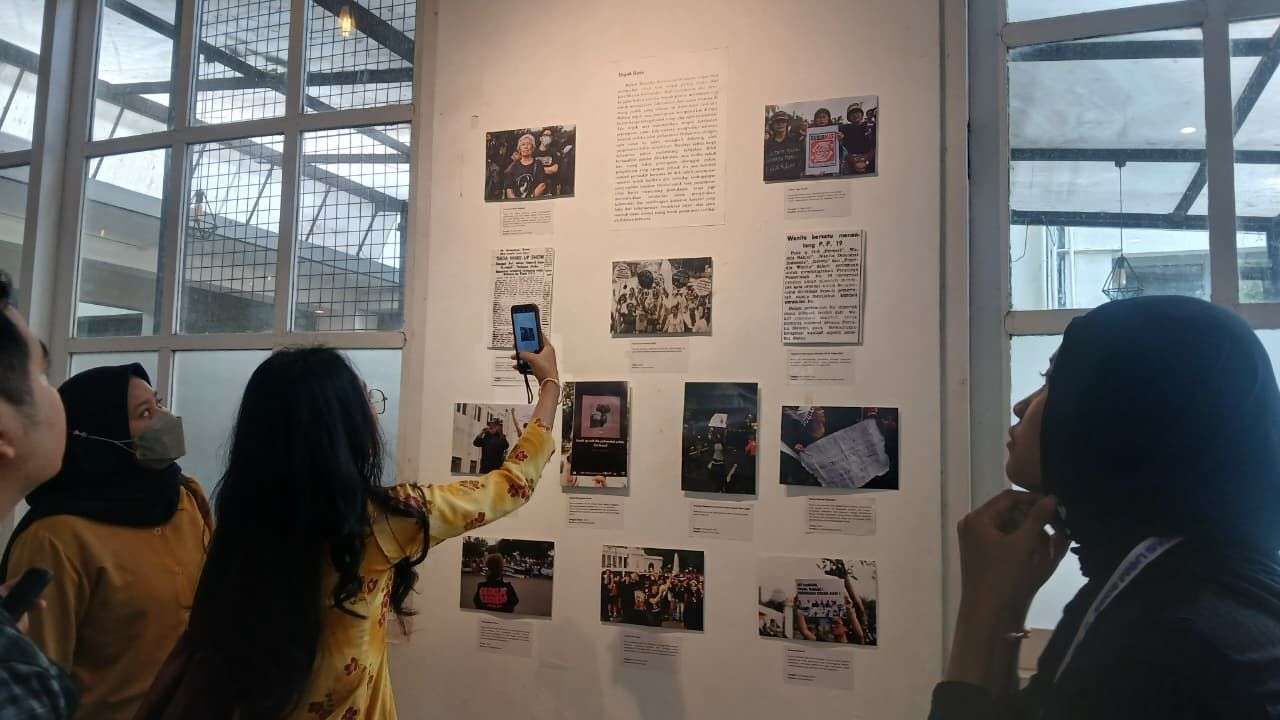
KBRN, Yogyakarta: The annual KERTAS archive exhibition has returned to the Iso Reksohadiprojo Building at the Department of Language, Arts, and Cultural Management, Vocational School, Gadjah Mada University (UGM). Running from November 8 to 15, 2025, the exhibition is open to the public and offers a compelling look at women’s participation in Indonesia’s democratic journey.
This year’s theme, “Equality: Recording Women in Democratic Spaces,” presents reflections on the struggles, contributions, and representation of women across political and social spheres. More than 260 archival materials—including photographs, documents, data, and audiovisual content—have been transformed into interactive infographics by students from UGM’s Archives Study Program. Through these visual narratives, the exhibition invites visitors to explore the dynamics of women’s engagement in democracy, from political participation to social repression and resistance.
According to event manager Irfan Rizky Darajat, the exhibition serves as both a documentation center and a platform for public dialogue. “This exhibition helps us explore how archival presentations can foster social discourse,” he said.
The exhibition is organized into three thematic rooms: Participation, Repression, and Resistance.
Participation: Pioneers and Representation
The first room highlights women’s involvement in the Trias Politica, encompassing the executive, legislative, and judicial branches, by showcasing pioneering figures who have shaped Indonesia’s democratic history.
Among them is Maria Ulfah Santoso, the country’s first female Minister of Social Affairs, and S.K. Trimurti, a journalist, educator, and activist who played a key role in the independence movement.
Also featured is Sri Widoyati, who became the first woman appointed as a Supreme Court judge in 1968. The exhibition includes Siti Sukaptinah, a Yogyakarta-based advocate for women’s emancipation who was active in Jong Java, Jong Islamieten Bond, PB Muslimat Masyumi, and served as secretary of the First Indonesian Women’s Congress.
Supeni Pudjobuntoro, a female politician and diplomat during President Soekarno's era, is also recognized for her contributions to Indonesia’s political landscape.
This section also maps women’s representation in the House of Representatives (DPR), regional elections, and the judiciary, both before and after Indonesia’s reform era.
In addition, the exhibition showcases the work of grassroots organizations such as Mitra Wacana, Mama Aleta Fund, Beranda Migran, SP Kinasih, and others that support women’s rights and community empowerment across Indonesia.
Founded in 1996, Mitra Wacana began as the Women’s Information Service Center (PLIP). The organization focuses on gender justice and equality, with eight core areas: eliminating sexual violence, preventing child marriage, promoting women’s political education, combating human trafficking, countering intolerance and extremism (IRET), and advancing women’s roles in anti-corruption and disaster response.
Mitra Wacana’s approach includes direct community organizing, mentoring women leaders, advocating for gender-inclusive policies, and producing educational materials such as books, modules, films, and comics. Its presence at the exhibition illustrates how gender advocacy is practiced at the grassroots level.
Repression: Discrimination and Resistance
The second room explores systemic repression against women in both social and political contexts. Archival materials document discriminatory practices including sexual violence, femicide, political marginalization, land dispossession, and the domestication of women’s roles.
A key highlight is the story of Mama Aleta Baun, a weaving activist from East Nusa Tenggara (NTT), who led a peaceful resistance against marble mining by organizing collective weaving at the mining site, a powerful symbol of cultural defiance.
Resistance: Voices and Expressions
The final room celebrates women’s resilience and solidarity through four forms of cultural activism: demonstrations, writing, digital advocacy, and visual art. This section highlights that resistance is not only a political act. It is also a courageous act for women to document and share their lived experiences.
To enhance accessibility, the organizing committee has provided a downloadable digital guidebook via the official website: https://pameranarsip.sv.ugm.ac.id/koleksi/.
The guide features curated themes, detailed room descriptions, and collection highlights to assist visitors in navigating the exhibition, both in person and online. (Misni Parjiati/Ed. Lasti Martina)
News Recomendation
Loading latest news.....