



Indonesia–Malaysia University Collaboration Turns Histology into Batik Art
- 28 Jul 2026 17:27 WIB
- Voice of Indonesia
Key Points
- UB and USM launched “Histology Meets Heritage,” blending science and batik design for academic and cultural collaboration.
- The workshop united lecturers, art students, and batik artisans to transform microscopic tissue patterns into creative batik motifs.
- The program produced initial histology‑inspired batik designs, laying groundwork for joint publications and sustainable cross‑border engagement.
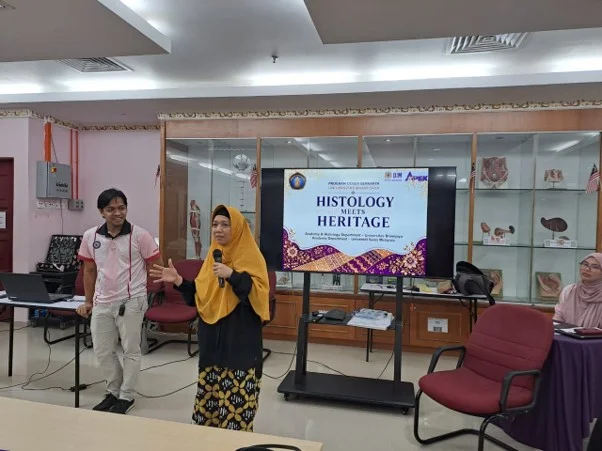
RRI.CO.ID, Malang – Indonesia's Universitas Brawijaya’s Faculty of Medicine (FK UB) and Universiti Sains Malaysia (USM) are breaking new ground by blending medical science with cultural heritage.
Through the “Histology Meets Heritage” program held on July 27, 2026, at USM’s Anatomy Museum in Kelantan, the two institutions introduced batik designs inspired by microscopic human tissue structures, an initiative that strengthens both academic collaboration and cultural ties between Indonesia and Malaysia.
Part of UB’s Program Dosen Berkarya (Lecturer Contribution Program) 2026, the workshop featured FK UB lecturers Indriati Dwi Rahayu and Wike Astrid Cahayani, supported by USM’s Department of Anatomy faculty.
The event brought together 21 participants, including lecturers, art students, and batik artisans, creating a multidisciplinary space where medicine, art, education, and creative industries intersect.
Indriati explained that histology‑based batik motifs serve as a universal visual language, translating science into beauty while fostering innovation in learning, cultural preservation, and community empowerment.
“Histology‑inspired batik becomes a universal visual language. By translating science into aesthetics, this program unites education, culture, and humanity in one collaborative space,” she said, as quoted on UB's official website.
Participants explored how microscopic tissue patterns--lines, layers, repetitions, and compositions--can be transformed into batik ornaments with both artistic and educational value.
The workshop guided them through theme selection, motif design, and creative application, aligning with the STEAM approach that integrates science, technology, engineering, art, and mathematics.
Beyond academic enrichment, the program also engaged batik artisans, ensuring that innovation extends beyond classrooms into practical cultural production.
The collaboration produced initial concepts for histology‑inspired batik designs, laying the foundation for joint publications, academic outputs, and a roadmap for sustainable international community engagement between UB and USM.
By merging histology with batik, the initiative demonstrates how scientific knowledge can coexist with cultural preservation. It highlights that medical education can be enriched through creative approaches, while traditional textile art can serve as a medium to expand scientific literacy and strengthen shared cultural identity. ***
News Recomendation
Loading latest news.....