



Puhua Trilingual School Marks 120 Years in Indonesia
- 27 Apr 2026 10:19 WIB
- Voice of Indonesia
Key Points
- Founded in 1906 as one of Indonesia’s earliest Chinese schools, Puhua School has grown into a trilingual institution teaching Indonesian, English, and Mandarin, with more than 1,000 students across two campuses.
- The school recently celebrated its 120th anniversary alongside the first anniversary of the Puhua Mandarin Language Center.
- Puhua has become a model of multicultural education, where diverse students learn together and experience Mandarin through arts, music, and culture.
RRI.CO.ID, Purwokerto - Established in 1906 as one of the earliest Chinese schools in Indonesia, the institution once known as Sekolah Tionghoa Hwee Kwan in Purwokerto, Central Java, has evolved into today’s Putera Harapan Trilingual School (Puhua School).
On Saturday, April 25, 2026, the school hosted more than 200 principals, teachers, and education officials from over 30 trilingual schools nationwide for a forum on Mandarin language education.
The gathering coincided with three milestones: the 120th anniversary of the Chinese school in Purwokerto, the 20th anniversary of Puhua School, and the first anniversary of the Puhua Mandarin Language Center.
The center, inaugurated in January 2025 to mark 75 years of diplomatic relations between China and Indonesia, was built in collaboration with Baoding University and Baoding Secondary School Education Group, making it the first of its kind in Indonesia.
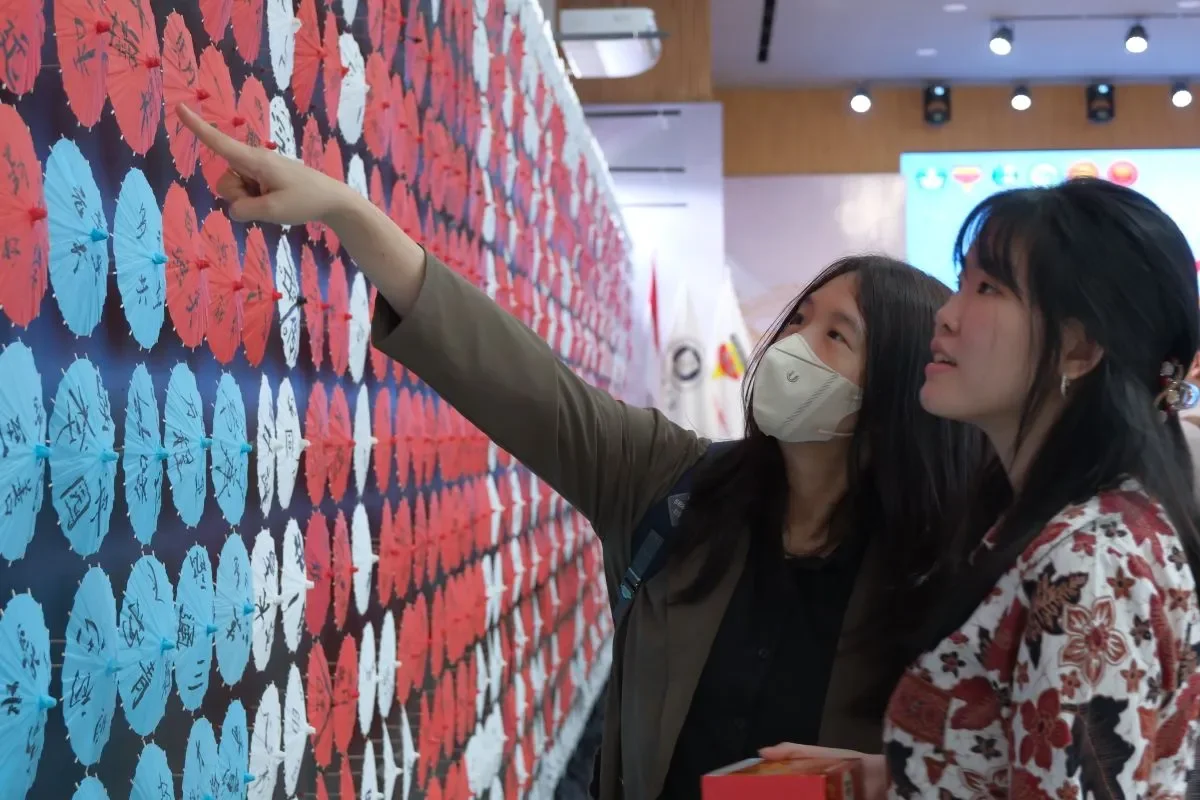
During the celebration, two striking art installations made of red, white, and blue paper umbrellas were unveiled in the auditorium. Forming the words Education for All and I Love Indonesia, they reflected the school’s philosophy of inclusivity and cultural harmony.
Across the campus, Indonesian, Mandarin, and English were spoken interchangeably, underscoring the school’s belief that languages serve as bridges connecting diverse communities.
Although not the largest trilingual institution in the country, Puhua has become a prominent example of Mandarin education. With more than 1,000 students across two campuses, over one-third are non-Chinese Indonesians.
Principal Chen Tao noted that local families increasingly see Mandarin not just as an additional skill but as a gateway to broader educational and professional opportunities.
Indonesian teacher Opsie Emalia Putri, who studied in Guangzhou and Tianjin, explained that students learn Mandarin through cultural activities such as paper-cutting, calligraphy, traditional music, and Chinese chess. “For many students, Mandarin is no longer something to memorize. It has become something they can live and experience directly,” she said, as quoted by Antara.
Teachers observed that the influence often extends beyond the classroom. Parents attending school events sometimes try writing Chinese characters themselves, allowing elements of Chinese culture to naturally enter family life.
Parents like Tifany and Meliana, whose children study traditional Chinese dance and the guzheng, said the school’s value lies in combining language learning with cultural understanding. They expressed support for their children should they choose to continue their studies in China.
Former Education and Culture Attaché at the Indonesian Embassy in Beijing, Yudil Chatim, praised the school’s openness, where students from different ethnic and religious backgrounds learn side by side.
China’s Consul General in Surabaya, Ye Su, described the trilingual institution as a model for Mandarin education in Indonesia, while the Puhua Mandarin Language Center offers young Indonesians new ways to engage with Chinese culture.
Assistant Deputy for Cabinet Sessions in Indonesia, Sjahriati Rochmah, emphasized the school’s role in helping children from diverse backgrounds grow together in a shared environment.
Over the past year, the Puhua Mandarin Language Center has expanded its reach beyond the campus through cultural exhibitions, calligraphy programs, and language activities at universities and local communities.
The center’s director from China, Zhang Jinghuo, said its role has grown beyond language instruction. “This Mandarin center has become a bridge connecting Indonesia and China, as well as linking the school with the wider community,” he said. ***
News Recomendation
Loading latest news.....