



Government Reinforces Vocational Talent and Absorbs Young Workforce
- 09 Apr 2026 13:22 WIB
- Voice of Indonesia
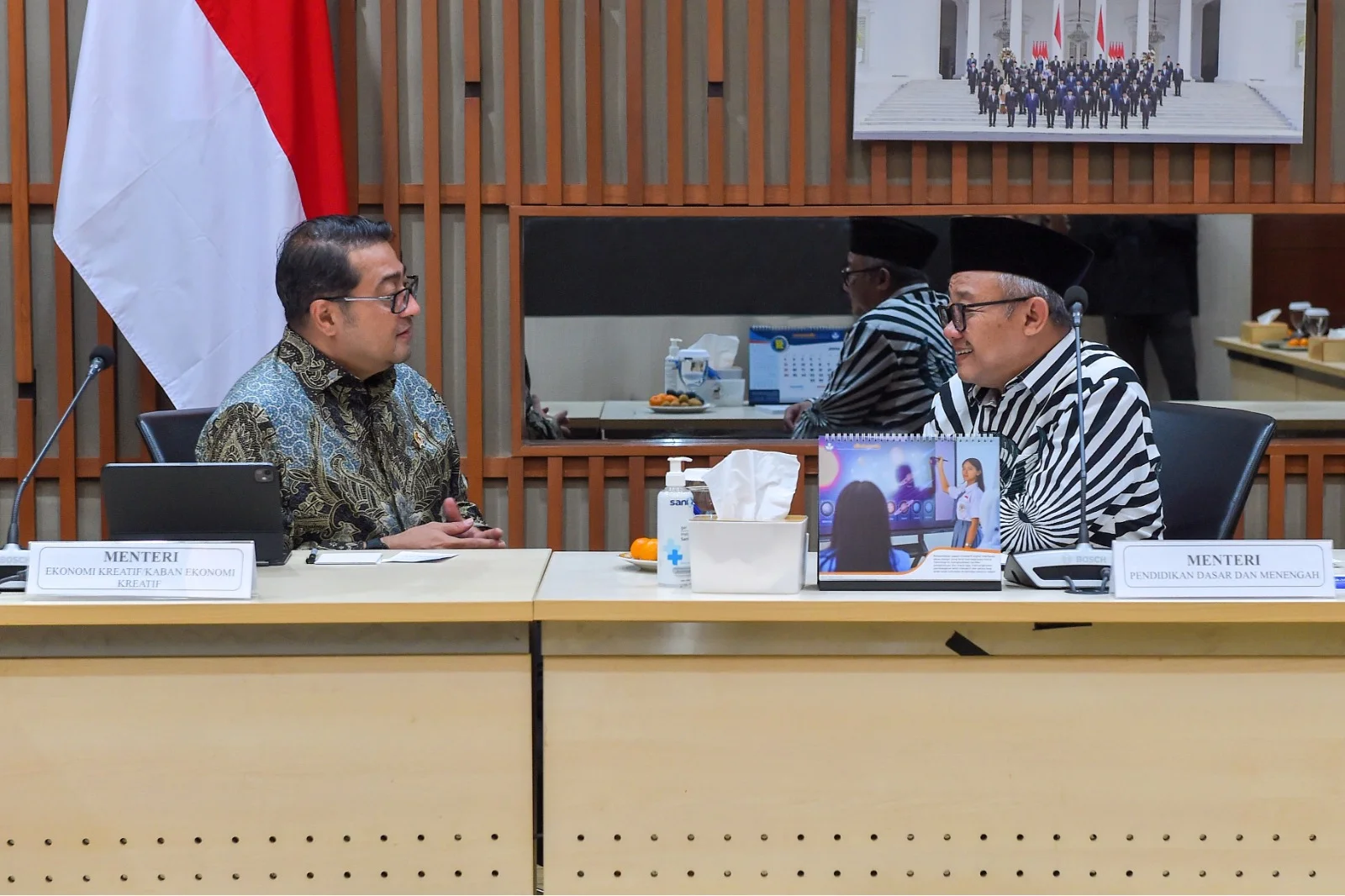
RRI.CO.ID, Jakarta - Minister of Creative Economy and Head of the Creative Economy Agency, Teuku Riefky Harsya, and Minister of Primary and Secondary Education, Abdul Mu'ti, discussed synergistic collaboration between ministries in the fields of vocational education and creative economy development. This discussion is a follow-up to the Memorandum of Understanding signed in November 2025.
The Ministry of Creative Economy believes the creative economy is a concrete solution for absorbing young workers. Furthermore, this collaboration is considered a strategic step to address the challenge of youth unemployment and encourage the growth of the national creative economy sector.
"Currently, the creative economy sector's targeted workforce of 25.5 million has reached 27.4 million jobs. They are mostly young people who are adaptable to technology and creativity (digital natives). Therefore, we see an opportunity to reduce unemployment by equipping educators with competencies related to the creative industry, which can be supported together," Teuku Riefky said in Jakarta on Wednesday, April 8, 2026.
Furthermore, the Minister added that collaboration with the Ministry of Education and Culture is key to strengthening the talent ecosystem from the educational level. At the meeting, two points of potential collaboration were discussed: creative economy modules and teaching materials for Vocational High Schools (SMK) and synergy scholarships to accelerate superior talent.
"We request input regarding the development of creative economy modules and teaching materials for vocational high schools across sub-sectors to improve teacher capacity, vocational student certification, and practitioner exchanges. Furthermore, we want scholarship synergy that has the potential to accelerate the development of creative economy talent through global experience, skills enhancement, and access to internships and residencies for outstanding talent," the Minister of Creative Economy stated.
Meanwhile, the Ministry of Primary and Secondary Education also hopes that follow-up collaboration initiatives will be implemented in the coming academic year, focusing on several pilot vocational high schools in various regions. This synergy is an optimistic step that can increase the competitiveness of the national industry while reducing unemployment among the younger generation.
"We already have a 'home' in vocational high schools, but the next challenge is how students' creative works or products can be marketed widely and have economic value, thus requiring marketing," Abdul Mu'ti said.
The discussion became increasingly lively as both parties also agreed on synergies in scholarship and internship programs, including access to international opportunities. Furthermore, pilot projects to strengthen leading creative economy subsectors such as culinary arts, games, applications, music, and animation are considered aligned with vocational education majors.
"Many vocational schools now have expertise programs that overlap with creative industries such as culinary arts, fashion, animation, music, and games. This demonstrates that the policy direction for strengthening creative economy-based vocational education is aligned with the interests of the current generation," Abdul Mu'ti stated.
News Recomendation
Loading latest news.....