



2025 School Revitalization Program Exceeds Targets, Spurs Local Economy
- 04 Mar 2026 18:03 WIB
- Voice of Indonesia
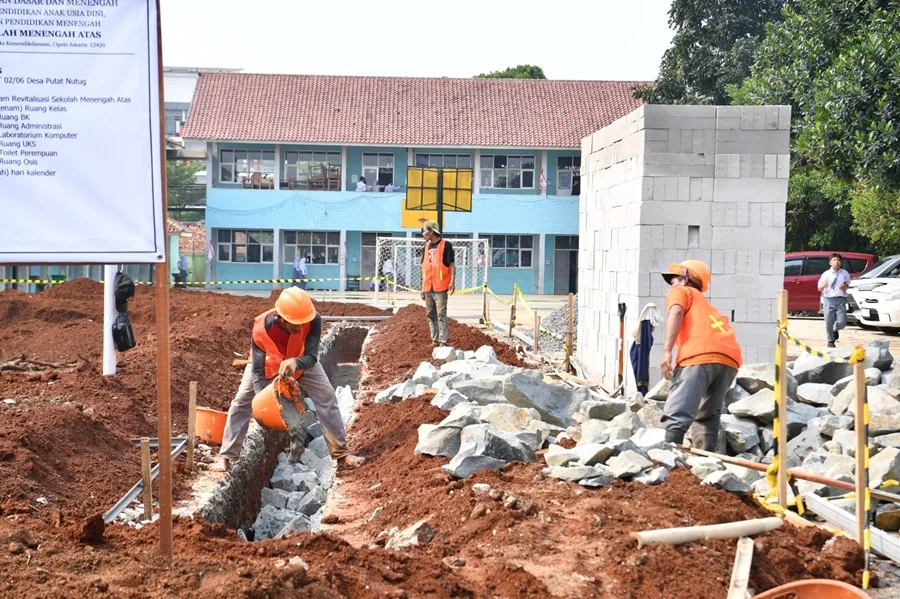
RRI.CO.ID, Jakarta - The school revitalization program implemented by the Ministry of Elementary and Secondary Education (Kemendikdasmen) in 2025 has exceeded its physical development targets and contributed to economic activity in various regions.
Initially targeting 10,440 educational units, the program revitalized 16,167 schools. Presidential Chief of Staff, M. Qodari, announced the achievement at a press conference on Wednesday, March 4, 2026, at the KSP Building in the Presidential Palace Complex in Jakarta.
The program is designed to improve classrooms and learning facilities while generating a multiplier effect on the local economy. It uses a self-managed scheme in which funds are transferred directly to school accounts, with community members involved in the development process.
In 2025 alone, construction under the program was estimated to employ around 646,680 people, assuming each school engaged an average of 40 workers, including planning teams, supervisors, and construction implementers.
“For vocational schools, 2,026 educational units have been revitalized, with a 97 percent completion rate. This program focuses on improving classrooms, learning facilities, and the school environment to support a more appropriate and high-quality learning process,” Qodari said, as quoted by Antara.
As of 2026, the government has allocated funds for the revitalization of 11,744 educational units, with a budget ceiling of IDR 14.06 trillion. In addition, the government has proposed an additional budget of IDR 89.49 trillion through the Additional Budget (ABT) program to accelerate the revitalization of up to 60,000 more educational units.
Significant changes have been made in budget management. Revitalization funds are now managed directly by the Ministry of Elementary and Secondary Education, previously handled by the Ministry of Public Works. This scheme provides greater opportunity for schools and communities to play an active role while strengthening oversight to ensure budget utilization remains on target.
The Education Unit Development Committee (P2SP) is responsible for technical implementation, involving community members along with 7–10 technical planning and supervisory staff, and 20–30 construction implementers at each school.
This approach is expected to provide more suitable, high-quality learning spaces while also serving as an instrument for equitable development and regional economic growth. ***
News Recomendation
Loading latest news.....