


Timeless Taste of Traditional Snacks at Pasar Ngasem Yogyakarta
- 10 Apr 2025 12:28 WIB
- Voice of Indonesia
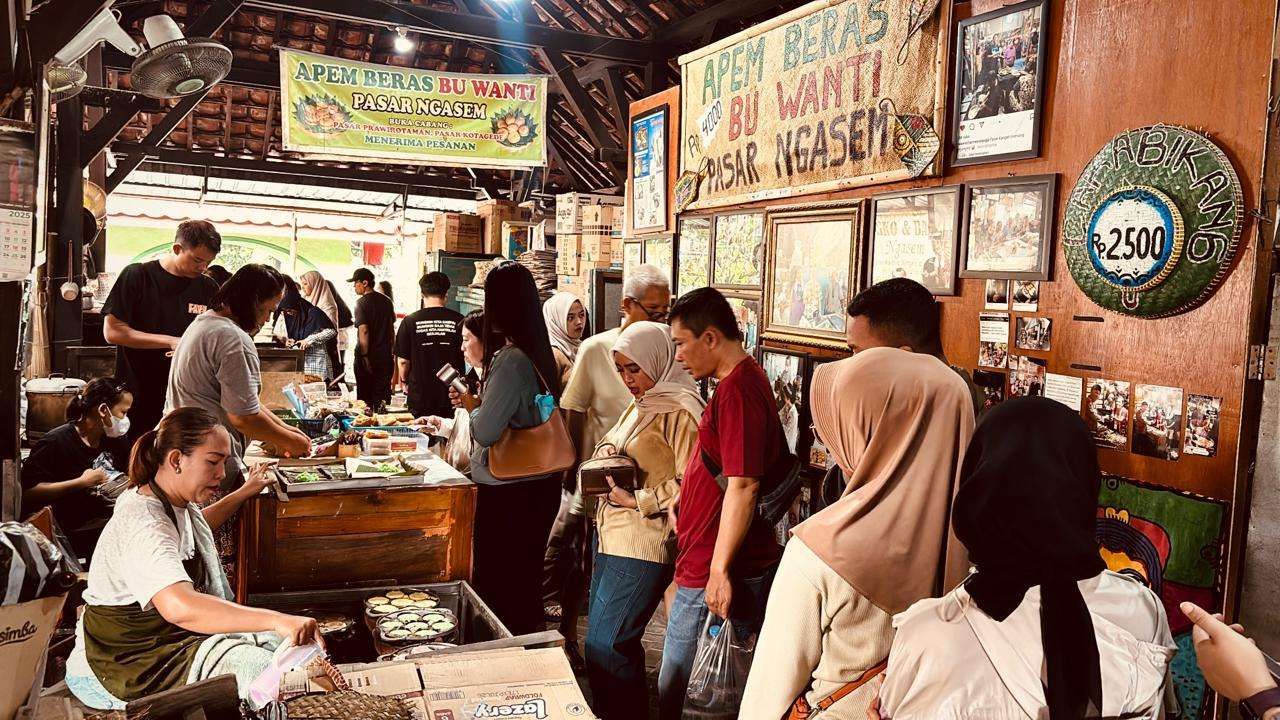
KBRN, Yogyakarta: Located within the Pasar Ngasem traditional market at Jalan Polowijan No. 11, Patehan Village, Kraton Subdistrict, Yogyakarta, is a culinary treasure where the enticing aromas of Bu Wanti's apem beras and Bu Kristi's carabikang captivate visitors.
These neighboring stalls, run by two sisters, have become beloved fixtures in the market, drawing crowds with their traditional recipes and mouthwatering treats.
The location within this bustling market provides the perfect backdrop for experiencing these authentic flavors, contributing to the vibrant atmosphere that makes Pasar Ngasem a must-visit for food enthusiasts.
The vibrant atmosphere of Pasar Ngasem comes alive with the enticing aromas wafting through the air.
The sweet scent of freshly cooked apem beras, a traditional rice flour cake, mingles harmoniously with the savory aroma of carabikang, a flower-shaped treat made from rice flour and coconut milk, offering an unforgettable sensory delight.
The vendors warmly offer their goods, while the enthusiastic buyers choose their favorite snacks. Laughter and friendly conversations add to the market's cozy ambiance.
The colorful traditional cakes, neatly arranged on tables, look incredibly appetizing. The morning sunlight filtering through the market's roof illuminates the bustling buying and selling activity, painting an authentic picture of local Yogyakarta life that is a shame to miss.
/tonbupgicsz8oxh.jpeg) Wanti is serving apem to a customer at their stall in Pasar Ngasem, while her husband tends to the apem cooking on traditional charcoal stoves. (Photo: RRI English/Diva Rifdah Rizkia Puspitaningnala)
Wanti is serving apem to a customer at their stall in Pasar Ngasem, while her husband tends to the apem cooking on traditional charcoal stoves. (Photo: RRI English/Diva Rifdah Rizkia Puspitaningnala)Two traditional snacks that are market favorites are Bu Wanti's apem beras and Bu Kristi's carabikang. Their delicious taste and affordable prices make these treats constantly sought after by people of all ages.
Interestingly, Bu Wanti's apem beras and Bu Kristi's carabikang stalls are located next to each other, creating a lively and tempting culinary corner. The sisterly bond between the two vendors adds to the warm atmosphere of the market. Bu Kristi, who is Bu Wanti's younger sister, also helps preserve the widely known traditional flavors.
"I took over my mother's apem beras business in 2000," shared Ade Purwantiningsih, the second-generation proprietor of Apem Beras Bu Wanti.
"My mother had been selling apem beras since the 1970s, but the name 'Apem Beras Bu Wanti' only came about when I started selling," she revealed on Thursday, April 10, 2025
Wanti explained that in the past, food choices were not diverse and were dominated by traditional dishes like gethuk, cenil, lotis, and apem. With the limited culinary variety at that time, Wanti's mother saw an opportunity and decided to sell her delicious apem beras.
"For myself, I focus on apem, and don't look at other kinds of snacks, because we really want to preserve apem beras. I sell with my husband and my siblings," said Wanti.
As the pioneer of the first apem beras stall in Pasar Ngasem, Bu Wanti's business initially operated on the west side of the market before eventually moving to its current location, which was formerly a bird market.
Since 2010, when the area was redeveloped into a new building, Wanti has faithfully sold her apem every day from 5.30 a.m. to 12 p.m. local time, and remarkably, all of her merchandise consistently sells out.
Wanti explained the cultural significance of apem, stating that it symbolizes a request for forgiveness.
In Yogyakarta, apem beras holds cultural significance as a customary offering during traditional events. It is often paired with sticky rice (ketan) and sweet coconut stew (kolak), symbolizing the host's hope for forgiveness and a seamless progression of their event
She elaborated that authentic apem beras is crafted using rice flour, young coconut milk, and eggs. The preparation starts daily at 3 p.m. with the creation of the biang (starter dough), which consists of fermented cassava yeast (ragi tape), rice flour, and granulated sugar.
This is then followed by the mixing of all ingredients, a meticulous process that lasts until 2 a.m., ensuring the quality and traditional essence of the snack
/axgtqf84gni5nhy.jpeg)
Golden-brown apem, cooked to utter perfection with beautifully textured surfaces, sat stacked and ready to delight eager customers. (Photo: RRI English/Diva Rifdah Rizkia Puspitaningnala)
Each day, Wanti produces between 200 and 500 pieces of apem beras. During special occasions, particularly in the Javanese month of Ruwah, which involves the apeman or ancestral commemoration (nyadran) rituals, her apem sales can surge to 1,000 pieces, in addition to orders for ketan and kolak.
The popularity of Bu Wanti's apem beras has steadily increased, with a significant rise in customers after the Covid-19 pandemic and her successful participation in the Pasar Kangen (Nostalgia Market) annual event.
The deliciousness of this traditional apem beras has even captivated international palates, attracting enthusiasts from countries like the Netherlands, Suriname, and Italy, who appreciate its authentic taste.
"Our apem doesn't contain any preservatives because the ingredients are natural, so it only lasts for 2 days. Currently, the price here is IDR 4,000 (USD 0.24) per piece, and the price we set depends on the cost of raw materials," Wanti stated.
"A unique aspect of our apem is that we thoroughly cook the coconut. After grating it, we steam it first, so it lasts longer when taken out of town. We maintain the traditional way of cooking apem using a charcoal stove (anglo) because it gives a different taste and aroma compared to using a gas stove," she added.
/ltcnqliuot4sxn8.jpeg)
Over the hot coals, apem batter sizzled in the traditional molds, slowly transforming into goldenfragrant cakes under the watchful eye of the cook, filling the air with a sweet, inviting aroma that hinted at the deliciousness to come. (Photo: RRI English/Diva Rifdah Rizkia Puspitaningnala)
Wanti shared her strategy for preserving traditional snacks, emphasizing the importance of maintaining the authentic recipe, avoiding modern toppings, using genuine sugar, and never reducing the ingredient measurements passed down through generations.
"My hope is that year after year, apem, which is part of our local wisdom, can be recognized by the younger generation. It’s important they recognize this traditional delicacy, not just as food but as something deeply meaningful, carrying its own rich story," Wanti expressed.
Inside the bustling market, long queues of eager buyers can be seen patiently waiting to purchase Bu Wanti's apem beras. They also don't miss the opportunity to buy the delicious carabikang sold by Bu Kristi.
Bu Kristi's carabikang business, run by Wanti's younger sister, started in 2020, yet its popularity is just as impressive, with her entire stock selling out every day.
"This carabikang was originally the business of my husband's grandmother in 1986, but she used to sell in Lempuyangan, Yogyakarta. When no one from my husband's family continued it, I took over and started selling it in Pasar Ngasem," Kristiyaningsih Febianti recounted the origin of her business.
Kristi shared the unique story behind the name carabikang, which began with a conversation between a Chinese vendor and a Javanese customer. She said the name "carabikang" originated from a simple miscommunication.
It was told, a Chinese vendor was making serabi (a type of pancake), and when a Javanese customer inquired about its name, the vendor replied, "Serabi, Kang" ("Serabi, Brother"). Mishearing the response, the Javanese customer interpreted it as "carabikang," and the name has been affectionately used ever since.
/uil2pip9zy7t69i.jpeg)
Bu Kristi skillfully tended to several pans of carabikang, each showcasing a vibrant array of colors – pink, green, yellow, purple and brown– as they cooked over the hot coals. (Photo: RRI English/Diva Rifdah Rizkia Puspitaningnala)
"On a regular day, I need 10 kilograms of rice flour, but on weekends and holidays, it usually reaches 20 kilograms. I also cook the carabikang using a charcoal stove because it cooks more evenly than a gas stove," Kristi explained.
"Traditionally, carabikang was only available in white and pink hues, just like the ones my husband's grandmother used to make, relying solely on food coloring without any added flavors. I've since innovated by introducing a variety of flavors to ensure people don’t tire of the same taste."
Bu Kristi's carabikang offers a tempting variety of flavors, including yellow with jackfruit flavor, purple with purple yam flavor, green with pandan flavor, brown with chocolate flavor, and the best-selling pink with es doger (coconut milk-based shaved ice dessert) flavor.
/nm7amh4h6vn3hyf.jpeg)
Vibrant stacks of carabikang, showcasing their signature flower-like shapes in shades of pink, yellow, purple, and brown, rested invitingly on a fresh banana leaf. (Photo: RRI English/Diva Rifdah Rizkia Puspitaningnala)
Every day, Bu Kristi personally makes these delectable carabikang, and despite her stall being open from 6 a.m to 10.30 a.m. local time, her entire stock typically sells out before 10 a.m. Priced at IDR 2,500 (USD 0.15) per piece, customers often purchase them in even numbers.
"One challenge I face while selling is the charcoal. If the quality is poor or it's a bit damp, the fire dies out quickly, so the charcoal is crucial for the carabikang to cook properly," Kristi revealed.
Andin, a customer from Yogyakarta, admitted that she was drawn to buy apem and carabikang at Bu Wanti's and Bu Kristi's stalls because of the long queues, which she found intriguing and made her believe the snacks must be delicious.
Although she had visited Pasar Ngasem before, this was her first time noticing Bu Wanti's apem beras and Bu Kristi's carabikang, making it her first purchase of these treats.
"I mostly want to find traditional snacks in Pasar Ngasem, which is why I want to try the apem beras and carabikang. I hope that traditional snacks like these continue to have many fans and remain sought-after culinary delights by the community," Andin said.***
News Recomendation
Loading latest news.....