



OJK Revises Carbon Exchange Regulation to Boost Market Liquidity
- 22 Mei 2026 15:15 WIB
- Voice of Indonesia
Key Points
- The Indonesian Financial Services Authority (OJK) has revised Regulation No. 14/2023 on Carbon Trading through IDXCarbon to boost liquidity in the national carbon market.
- OJK Chairperson Friderica Widyasari Dewi is optimistic Indonesia’s carbon market will grow through stronger regulations and inter‑ministerial coordination.
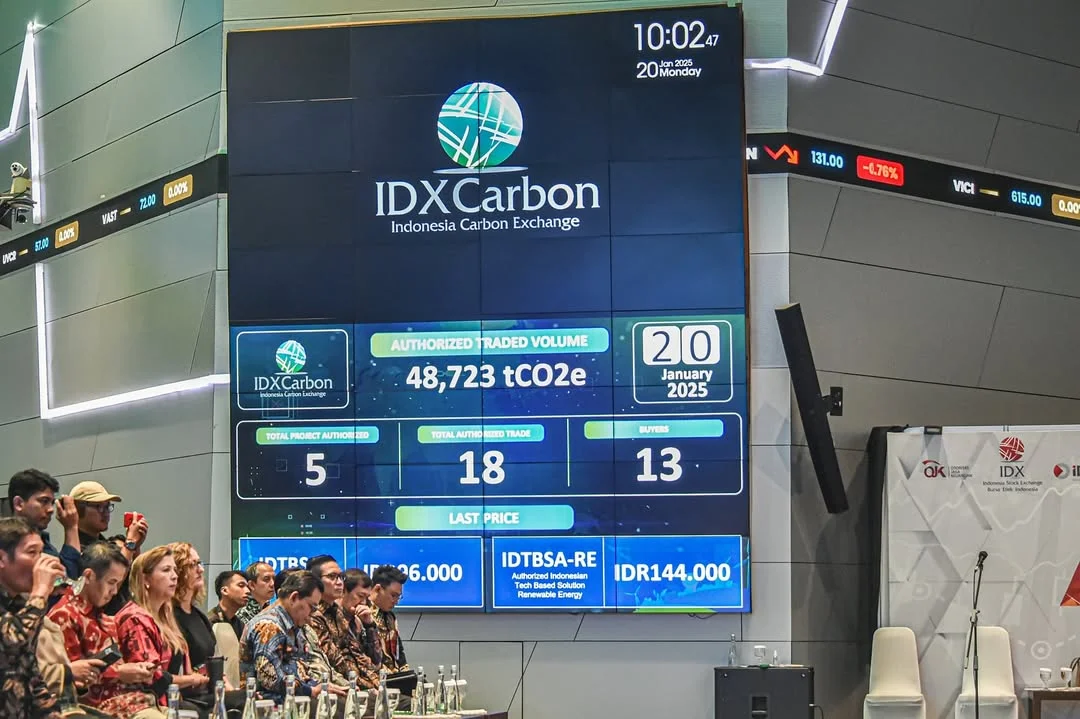
RRI.CO.ID, Jakarta - The Indonesian Financial Services Authority (OJK) has revised Regulation No. 14/2023 on Carbon Trading through the Carbon Exchange (IDXCarbon) to encourage greater liquidity in the national carbon market.
OJK Chairperson Friderica Widyasari Dewi said the revision reflects the significant potential of domestic carbon trading. OJK recorded 49 new emission‑reduction projects projected to generate 7.69 million metric tons of carbon dioxide equivalent (tCO2e), along with 10 existing projects expected to add 2.15 million tCO2e.
This brings the total projected tradable carbon units to 9.54 million tCO2e.
“The total projected additional tradable carbon units reach 9.54 million tCO2e, valued between IDR 560.9 billion and IDR 1.36 trillion (USD 31.62 million–76.81 million) based on current IDXCarbon prices,” Friderica said during a working meeting with the House of Representatives’ Commission XI on Thursday, May 21, 2026.
She expressed optimism that Indonesia’s carbon market will grow through stronger regulations and inter‑ministerial coordination, which are crucial for building transparency and preventing double counting.
Even so, she acknowledged that transaction values remain limited. Total transactions in the domestic carbon market amount to IDR 93.75 billion, far below the global carbon market, where the EU is valued at around USD 700 billion and China at USD 40 billion.
OJK is also working to integrate the national primary and secondary carbon markets. Friderica noted that carbon market development is influenced by supporting policies such as carbon taxes and emission quotas.
Meanwhile, Executive Head of Supervision for Capital Markets, Derivatives, and the Carbon Exchange at OJK, Hasan Fawzi, said limited supply remains the main challenge, as many projects are still undergoing certification.
He hopes the implementation of Presidential Regulation No. 110/2025 will accelerate the registration of carbon units in the National Registry System, which is connected to the carbon exchange.
“We hope more carbon units will be registered in the Carbon Unit Registry System linked to the exchange,” Hasan said. (Gusti Panji)
News Recomendation
Loading latest news.....