



Pertamina Prepares Alternative Imports to Anticipate Hormuz Strait Crisis
- 12 Mar 2026 21:44 WIB
- Voice of Indonesia
RRI.CO.ID, Jakarta - The state-owned oil and gas company PT Pertamina (Persero) is preparing anticipatory measures to maintain national energy security by seeking alternative import sources.
The move comes amid global energy distribution dynamics and the potential disruption of strategic shipping lanes in the Hormuz Strait due to geopolitical conflicts in the Middle East.
Pertamina President Director Simon Aloysius Mantiri said the company has prepared a diversification strategy to ensure energy supply security. “So, of course, we have anticipated this by seeking other sources. This is to ensure that stock security remains good and stable,” Simon said on Thursday, March 12, 2026.
He explained that Indonesia’s energy supply does not rely solely on the Middle East but also comes from Africa, the US, and other energy-producing regions. “As a precaution, we are also diversifying our sources,” he said.
Tensions in the Middle East have previously disrupted shipping in the Hormuz Strait, a strategic route connecting the Persian Gulf to global energy markets.
The Indonesian government notes that around 20–25 percent of Indonesia’s crude oil imports are shipped through the strait, making potential disruptions a serious concern for national energy stability.
Efforts to secure alternative import sources are also underway after two tanker ships owned by Pertamina International Shipping (PIS) remained in the Arabian Gulf.
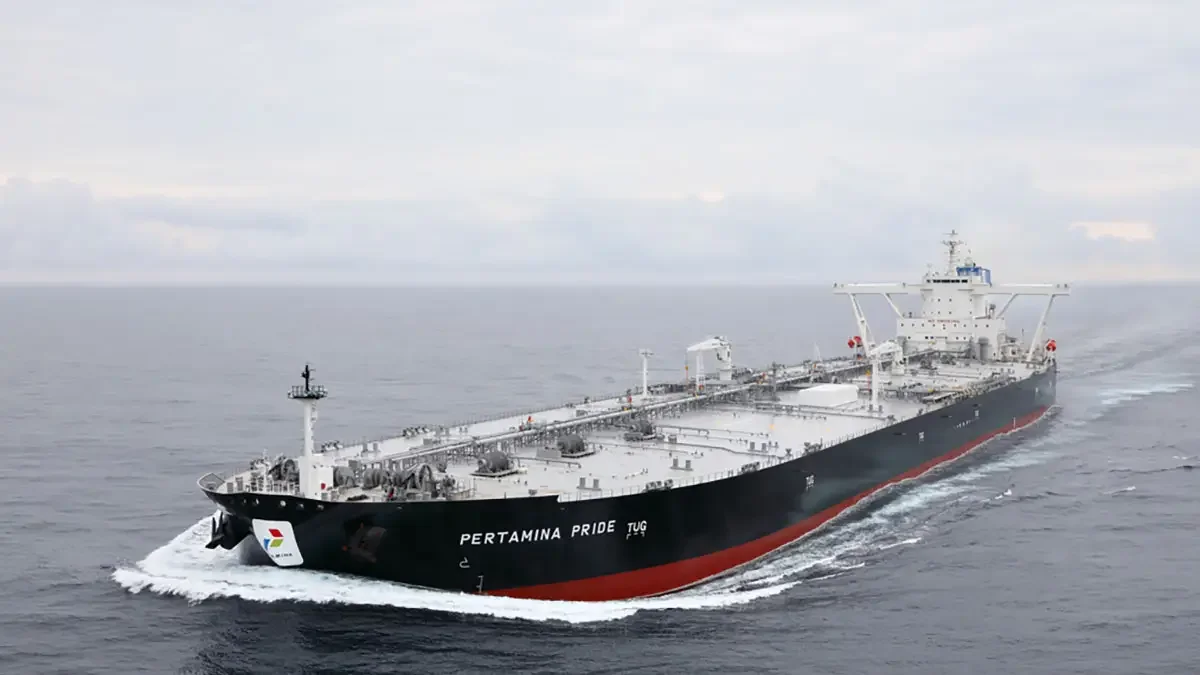
The vessels have been unable to cross the Hormuz Strait due to the security situation. The ships are the Very Large Crude Carrier (VLCC) Pertamina Pride, managed by NYK, and the Gamsunoro, managed by Synergy Ship Management.
According to a PIS report on Monday, March 2, Pertamina Pride completed oil loading and is anchored in Ras Tanura, Saudi Arabia, while Gamsunoro is still loading oil at Khawr al-Zubair, Iraq. Two other PIS ships, PIS Paragon and PIS Rinjani, are reported to be located outside Middle Eastern waters.
Pertamina emphasized that crew safety and cargo security are the top priorities. “Our main concern is the safety of our crew and cargo,” Simon said. He added that the company continues to coordinate with various parties, including the Ministry of Foreign Affairs and relevant authorities, to monitor developments in the Middle East.
Currently, PIS operates around 345 ships to support national and international energy distribution. Of these, 266 transport fuel and jet fuel, 27 carry crude oil, 45 distribute LPG, and seven support petrochemical transportation and serve as floating storage.
In addition to securing supplies through imports, Pertamina continues to encourage increased domestic energy production, including by optimizing output in several strategic oil and gas blocks.
“We have a partnership in the Cepu Block, right? So we must both do our best,” Simon said. He added that with additional production facilities in the block, national energy production capacity is expected to increase, a step considered crucial to strengthening energy resilience amid ongoing global geopolitical dynamics. (Gusti Panji/Lasti Martina)
News Recomendation
Loading latest news.....