



Banyumas Traditional Arts Remain Relevant in the Modern Era
- 03 Sep 2026 07:58 WIB
- Voice of Indonesia
Key Points
- Traditional arts in Banyumas, Central Java, are being encouraged to evolve and remain relevant amid changing times.
- The Banyumas Regency Arts Council promotes innovation while maintaining the cultural roots of traditional art forms.
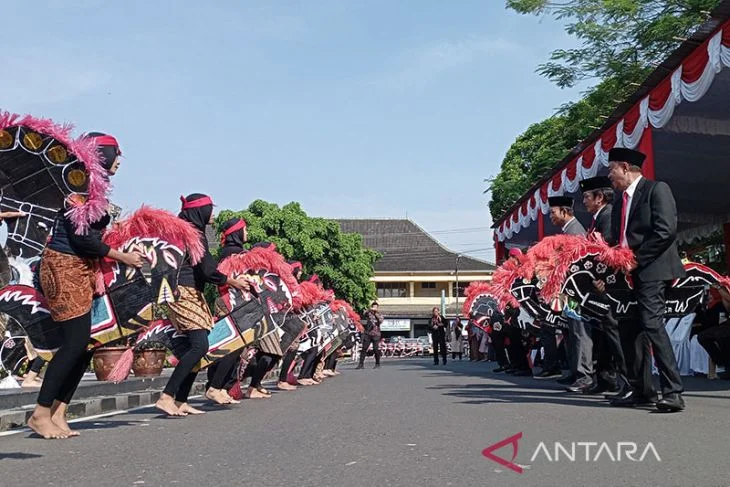
RRI.CO.ID, Banyumas - Traditional arts in Banyumas, Central Java continue to be developed to remain relevant amid changing times. The Banyumas Regency Arts Council is encouraging artists to innovate in their presentations without abandoning the traditional roots that define these art forms.
Secretary-General of the Banyumas Regency Arts Council, Jarot C. Setyoko, said traditional arts need space to evolve. In his view, traditional art does not always have to be presented in the same form as in the past.
“Traditional art must be able to adapt to the context of the times. As the Javanese say, ‘In my day, when I was learning the journey, we had to adjust to the conditions of the era,’” said Jarot on Wednesday, 2 September 2026.
Jarot explained that the council serves as a platform for developing various art fields in the region. Similar organizations exist at the regency, city, and provincial levels.
He likened the Arts Council to organizations overseeing specific sectors, such as the Indonesian National Youth Committee (KNPI) for youth affairs, the Indonesian National Sports Committee (KONI) for sports, and the Scout Movement for education.
According to Jarot, several Arts Council Banyumas programs are designed to bridge traditional arts with contemporary approaches. These efforts aim to keep regional arts relevant and more accessible to younger generations.
One initiative involves developing sendratari (a portmanteau of seni drama dan tari, or drama and dance art). Rooted in tradition, this art form is presented with a fusion of movement, music, choreography, and stage design that incorporates modern elements.
“Although traditional, it now has contemporary touches. The artists involved also come from many studios across Banyumas Regency,” he said.
In addition to sendratari, the council is developing fragments of Ebeg dance. While retaining a traditional atmosphere, this art form has been updated in its choreography, music, and performance concept.
“The appearance may still look traditional, but upon closer inspection, it’s different. That’s what we call a dance fragment,” he said.
Development efforts also extend to Banyumasan wayang, or traditional puppetry. Jarot noted that several puppeteers have worked on innovations for these performances, including Bima Putra, Dukuh Bayu Aji, Yakut, Panji, and others.
Meanwhile, the staging of Daglung by Teater Samudra serves as another example of traditional art being reinterpreted through a contemporary lens.
Jarot said sendratari, Ebeg dance fragments, Banyumasan wayang, and Daglung all share traditional roots. The difference lies in the fact that all four have undergone new artistic treatments to better align with societal developments and current audience preferences.
“These four art forms are rooted in traditional arts, but they’ve been reworked through a contemporary or ‘distance’ concept. So, they’re somewhat different because we’ve added modern touches,” he explained.
Efforts to broaden recognition of Banyumas arts also include involving artists and young people in national-scale events.
Jarot revealed that the council brought around 100 students and university students to perform in Jakarta. The Banyumas youth performance was part of the series of events commemorating the 81st Anniversary of the Independence of the Republic of Indonesia on 17 August 2026.
“Thank God, that performance at least sparked questions from people outside the region. That means we’ve succeeded in doing something,” he said.
He assessed that the emergence of interest from people outside the region shows that Banyumas arts still hold appeal when presented appropriately. According to Jarot, the current challenge for traditional arts is not only to preserve their existence but also to ensure they remain alive and accepted by new generations.
Therefore, innovation is seen as an inseparable part of developing traditional arts. Cultural roots are preserved, while presentation formats can adapt to developments in technology, music, choreography, and audience needs.
The staging of Dadhung Kepuntir is one example of an effort to reconnect traditional arts with younger generations. Produced by Teater Samudra, this performance reinterprets traditional arts with an approach more suited to today’s audiences.
Jarot hopes this step can serve as a bridge between the arts of the past and the present generation. In this way, traditional arts will not only remain a cultural heritage but will continue to be present in community life. “Through Teater Samudra, we hope that the arts of the past can draw closer again to the current generation,” he said.
He believes the sustainability of Banyumas arts requires collective efforts to preserve traditional roots while opening space for renewal. Through this approach, traditional arts are expected not to stop as relics of the past, but to continue evolving and finding their place amid the changing times. (Annaila Azzahra-EN)
News Recomendation
Loading latest news.....