



Trenggalek Educator Preserves Rare 19th-Century Islamic Manuscripts
- 17 Jul 2026 10:32 WIB
- Voice of Indonesia
Key Points
- A history teacher in Trenggalek has preserved and digitized nine rare handwritten Islamic manuscripts from the 19th century, now officially registered with the National Library.
- Digitization safeguards the fragile manuscripts while making their historical and religious content accessible for research and future generations.
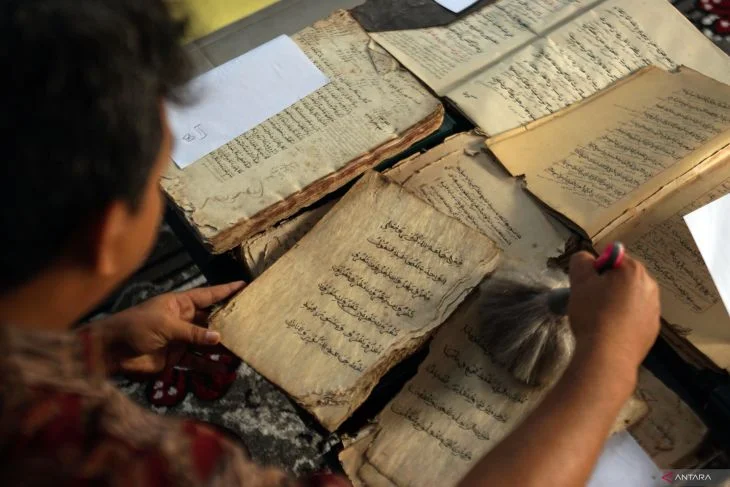
RRI.CO.ID, Trenggalek - The preservation of local historical assets and literary treasures has taken a significant leap forward in East Java, driven by a dedicated history educator who has successfully secured and digitized nine rare, handwritten 19th-century manuscripts.
A history teacher at the state-run vocational high school SMKN 1 Pogalan and an archaeology enthusiast, Harmaji, inherited the manuscripts from his late father in 2015.
Instead of keeping the heirlooms private, he registered them with the National Library of Indonesia (Perpusnas) to support national documentation and open access for public research.
“The total is eight volumes. Most of them are already in fragments, as many pages are damaged or lost due to age,” Harmaji said at his residence in Pogalan village, Trenggalek, on Wednesday, July 17, 2026, as quoted by Antara.
The manuscripts, written in ancient Arabic script, cover a wide range of classical Islamic knowledge. They include Arabic grammar (nahwu and sharaf), accounts of the Prophet Muhammad’s companions, Quranic exegesis (tafsir), and other religious treatises.
Physically, the texts reflect 19th-century publishing traditions. They were handwritten using dip ink on deluang paper made from tree bark, as well as antique imported European paper. When held to the light, the European sheets reveal historical watermarks, while the deluang paper shows natural wood fibers.
Harmaji began the preservation process in 2019 by reporting the manuscripts to the local library service. After identification, the texts were digitized and officially registered by the National Library in 2024.
He stressed that digitization ensures the manuscripts remain accessible to academics without risking damage to the fragile originals. “Digitization is the way to ensure that the knowledge within the manuscripts remains preserved and can be utilized by the next generation,” he said.
Registering manuscripts with Perpusnas provides collectors with significant benefits, including professional identification by philologists, free digital archiving, protective storage boxes, and official registration certificates.
Harmaji noted that these certificates make it easier for researchers to locate the documents through the national archive system or contact the owners directly.
Beyond administrative advantages, Harmaji expressed personal satisfaction in sharing his family’s legacy with the wider academic community. “The knowledge stored within the manuscripts does not stop at our house, but can be utilized for research and education,” he said.
Although the manuscripts lack written timestamps, their age clearly surpasses the 50-year threshold required under philological standards to be classified as ancient. Harmaji urged other community members who own similar historical documents to cooperate with local libraries for mapping and digital preservation. ***
News Recomendation
Loading latest news.....