



Rani Jambak Blends Minang Tradition and Sound Art at IWA #4
- 18 Mei 2026 08:26 WIB
- Voice of Indonesia
Key Points
- Sound artist Rani Jambak showcased her performance piece Mamasak Asa at the 4th Indonesian Women Artists (IWA) exhibition at the National Gallery of Indonesia on May 16, 2026.
- The performance combined traditional Minangkabau Suji Caia embroidery with digital audio technology.
- The artwork prominently features Mount Marapi, which holds deep spiritual significance as the legendary cradle of Minang civilization and serves as a symbol of the community's collective memory.
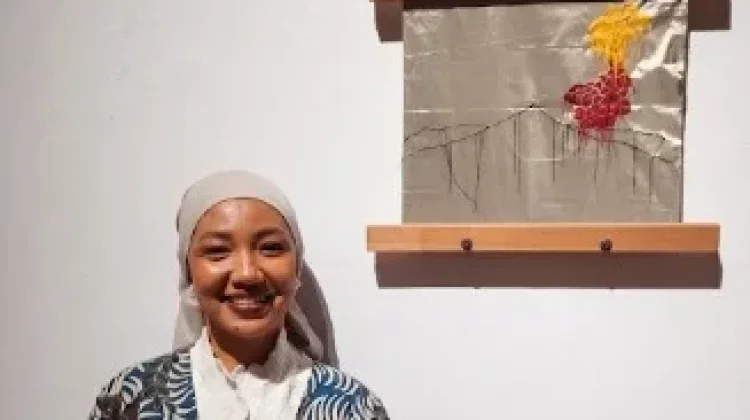
RRI.CO.ID, Jakarta — Sound artist Rani Jambak presented her performance piece Mamasak Asa (Nurturing Hope) at the 4th Indonesian Women Artists (IWA) exhibition at the National Gallery of Indonesia in Jakarta. The artwork highlights Mount Marapi as a symbol of the collective memory of the Minangkabau people.
The performance took place in the Exhibition Room of Building A at the National Gallery on Saturday, May 16, 2026. Rani showcased her sound art through the traditional Minangkabau practice of embroidery.
Every movement of the needle generated electronic sounds that filled the gallery space. These sounds were blended with audio recordings of recitations from the Tambo Alam Minangkabau, the traditional historiographical chronicle of the Minangkabau nature.
Rani utilized the Suji Caia embroidery technique to depict the motif of Mount Marapi, blending this traditional method with digital audio technology.
She embroidered onto an anti-radiation copper fabric connected to a Touch Me electronic device by Playtronica. Each touch of the needle transmitted MIDI signals, which were processed into a live, real-time sound composition.
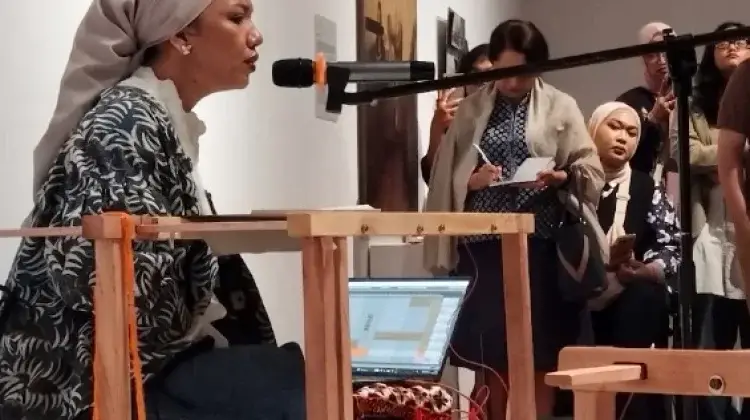
According to Rani, tradition should not be viewed as something static. Instead, it can evolve and engage in a dialogue with modern technology.
"I want to show that tradition actually possesses a frequency that we can still tune into today," remarked Rani after the performance.
The act of embroidery, long associated with women's domestic labor, was presented here as an artistic medium. Visitors were even invited to participate in the embroidery process and generate their own sounds within the Pamedangan installation.
The piece was also inspired by the history of Minangkabau women. One of the key figures referenced was Rohana Kudus, renowned as Indonesia's first female journalist, who founded the Kajinan Amai Setia craft house in Koto Gadang in 1915.
Furthermore, Rani conveyed through her work that Mount Marapi holds a profound significance for the Minangkabau community, as it is believed to be the cradle of Minang civilization and culture.
"Mount Marapi is not just a physical mountain, it is also a vital component of the collective memory of the Minangkabau people," said Rani.
She noted that her experience living at the foot of Mount Marapi heavily influenced her creative process. The volcano's activity evokes both fear and reverence for nature.
She explained that the eruptions and volcanic ash make humans feel small in the presence of nature. It is an experience she subsequently translated into an artistic creation.
The recitation of the Tambo Alam Minangkabau served as an essential element of the performance. The manuscript used originates from the Parak Laweh Surau, which is an Islamic assembly hall, in West Sumatra.
The tambo dictates that the ancestors of the Minangkabau first arrived at Mount Marapi, from which the life and customary law systems of the community later flourished.
The atmosphere of the performance felt akin to a ritual of listening to ancient memories. The repetitive sounds of the embroidery harmonized with the historical and spiritual narratives of the Minang people.
"When hearing the explosions and seeing the towering volcanic ash, I felt a deep need to respond through my work," added Rani, reiterating how her time living on the slopes of Mount Marapi shaped her artistry.
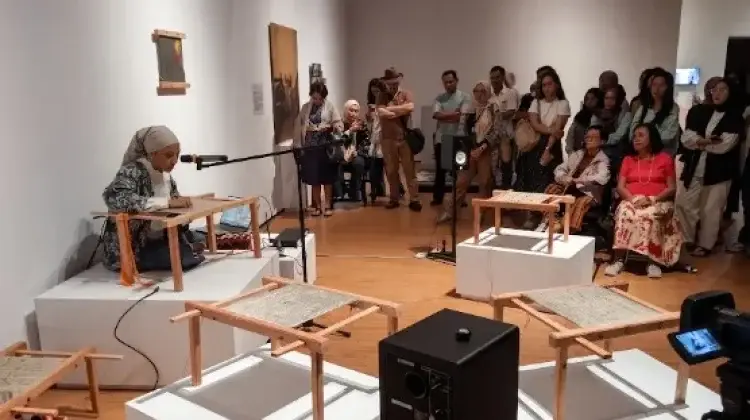
Approximately one hundred visitors witnessed the performance, with many in the audience appearing to immerse themselves in the meditative atmosphere created by the piece.
The Mamasak Asa performance is part of the Pamedangan multimedia installation. The installation will remain on display at IWA #4 until June 30, 2026.
Through this showcase, Rani aims to encourage the public to view the relationship between humanity and nature through a more reflective lens, using sound art as a medium to preserve Minangkabau history and cultural memory. (Annaila Azzahra/EN)
News Recomendation
Loading latest news.....