


Topeng Betawi, Jakarta’s Living Cultural Legacy
- 07 Okt 2025 11:50 WIB
- Voice of Indonesia
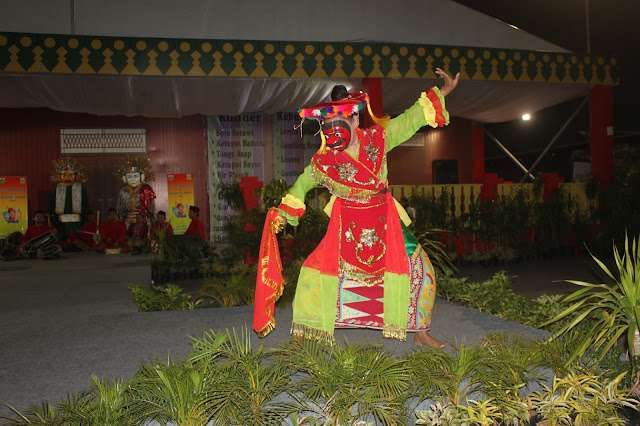
KBRN, Jakarta: Trang… tang… tangtangtang… gong! The metallic clang echoed off tin walls and tiled roofs in Kampung Dukuh, East Jakarta, drawing children to the sound and prompting curious glances from neighbors peeking through their windows. Something was about to begin: something old, something alive.
In the heart of the neighborhood, a centuries-old tradition stirred once more. It was Topeng Betawi, the masked dance drama of the Betawi people, revived in a modest studio named Sanggar Setiawarga. Here, the legacy of the late Haji Muhammad Bokir bin Dji’un, a legendary Betawi artist, lives on through his grandson, Malik.
“Topeng Betawi is actually a product of cultural fusion,” Malik explained, seated in the studio on Monday, October 6, 2025. “It draws from Sundanese wayang golek, but it has its own distinct character.”
Malik spoke with quiet pride, noting that while its history is long and complex, Topeng Betawi breathes with its own rhythm, different from Lenong or Sundanese arts.
Malik recounted how his grandfather first introduced Topeng Betawi while performing in Cikarang. From there, Haji Bokir founded Sanggar Makinang.
After marrying a woman from Kampung Dukuh, he brought the art form to East Jakarta and established Sanggar Setiawarga, where it continues to pulse through the community.
Every performance begins with Arang-arangan, also known as Tatalu, a musical overture that builds in three stages: slow, medium, and fast. As the tempo rises, it signals to the neighborhood that the show is about to begin.
Once the music fades, the host steps onto the stage, introducing the performers and the instruments that accompany them. He delivers a prologue, explaining that the music just heard was Tatalu, an invitation to witness the unfolding story of Betawi life.
The performance opens with Tari Langgam Dasar, a gentle dance that illustrates the foundational movements of the Betawi body. Tari Njot-njotan, a playful duet between male and female dancers, full of teasing charm and earthy humor, follows it.
Then comes Tari Anjeng, a lively portrayal of everyday Betawi joy and spirit. The beat of the bende, a small gong with a sharp, resonant tone, and the stomping feet of the dancers build toward the centerpiece: Tari Topeng Tunggal.
In this solo dance, a performer lays out a white cloth and places three masks: Panji, Samba, and Jingga. Each mask carries a distinct persona: Panji, soft and white, embodies grace, while Samba, pink and flirtatious, exudes mischief, and Jingga, fiery red with a thick mustache, channels anger and courage.
The evening culminates in Tari Lipet Gandes, also known as Ronggeng Belantek, where the character Bujang appears mid-dance to deliver comedic monologues on social issues. His performance sets the stage for the main story, played out by the ensemble.
Malik admitted that mastering Topeng Betawi isn’t easy. The music uses a non-standard scale called Da mi na ti la da, unlike the familiar Do Re Mi Fa Sol La Si Do. “The notes are really different, hard to explain,” he said with a chuckle. “But once you get used to it, you just follow the rhythm of the rebab.”
Today, Topeng Betawi faces steep challenges. Public interest is waning, and government support is scarce. “It’s a shame,” Malik said, his voice tinged with disappointment. “During Jakarta’s anniversary, there was no Topeng Betawi, just modern music on stage.”
He hopes the city will provide permanent performance spaces in each district so the tradition can thrive. “We still want to perform. There are still people who can preserve it, as long as there’s a stage,” he said, glancing at the large gong in the corner of the studio, waiting to be struck again, waiting to awaken the spirit of Betawi that grows quieter with each passing year. (Misni Parjiati/Ed. Lasti Martina)
News Recomendation
Loading latest news.....