


Yogyakarta’s Garebeg Mulud 2025 Features Once-in-Eight-Year Rituals
- 05 Sep 2025 17:55 WIB
- Voice of Indonesia
/0xgctu13fnlolb3.jpeg)
KBRN, Yogyakarta: This year’s commemoration of the Prophet Muhammad’s birthday (Mawlid), observed on Friday, September 5, 2025, carried special significance because it fell on a sacred Friday and aligned with the Javanese Year of Dal 1959, a rare occurrence that happens only once every eight years.
From early morning, the city was bustling with people who gathered at the historic Kagungan Dalem Bangsal Pagelaran (a grand hall within the Yogyakarta Palace) and Masjid Gedhe Ngayogyakarta (Kauman Grand Mosque) to witness the special Hajad Dalem Garebeg Mulud procession.
This event, organized by the Yogyakarta Palace, followed a series of activities for the Prophet's birthday celebration. The festivities, known as Hajad Dalem Sekaten, began on Friday, August 29, 2025, and concluded on Friday, September 5, 2025.
As part of this tradition, the palace released two sets of gamelan instruments, Kanjeng Kiai (KK) Gunturmadu and KK Nagawilaga, which were played at the Grand Mosque complex.
/ypvle10poxqs8qc.jpeg) The Wirabraja soldiers, easily recognizable by their predominant red uniforms and pointed hats, which earned them the nickname "Prajurit Lombok Abang" (Red Chili Soldiers), marched in front of the Kauman Grand Mosque during the procession. (Photo: RRI/Diva Rifdah Rizkia Puspitaningnala).
The Wirabraja soldiers, easily recognizable by their predominant red uniforms and pointed hats, which earned them the nickname "Prajurit Lombok Abang" (Red Chili Soldiers), marched in front of the Kauman Grand Mosque during the procession. (Photo: RRI/Diva Rifdah Rizkia Puspitaningnala).The Year of Dal 1959 added several special elements to the procession, including the Pareden Gunungan Brama, a special offering for the Sultan and his family. Following the recitation of the Prophet Muhammad's history, Sri Sultan Hamengku Bawono X returned to the palace in the Jejak Banonprocession.
This ritual involved the Sultan stepping on a pile of bricks at the southern entrance of the Kauman Grand Mosque, symbolizing a journey into a new life guided by Islamic teachings.
The Garebeg Mulud Dal 1959 celebration featured six types of gunungan (rice cone offerings), including the traditional Gunungan Kakung, Gunungan Estri/Wadon, Gunungan Gepak, Gunungan Dharat, and Gunungan Pawuhan.
A sixth and particularly special offering, the Gunungan Brama, was a rare addition, appearing only during the Javanese Year of Dal. Its presence marked this year’s procession as distinct from previous celebrations.
To ensure the procession ran smoothly, the Yogyakarta Sultanate issued guidelines for the public. The palace advised attendees to wait for the proper signal before taking their share of the gunungan after the blessing.
/xbzrj4wi8tk4k9v.jpeg) Amidst an enthusiastic crowd, the gunungan was distributed to the public in the courtyard of the Kauman Grand Mosque. (Photo: RRI/Diva Rifdah Rizkia Puspitaningnala).
Amidst an enthusiastic crowd, the gunungan was distributed to the public in the courtyard of the Kauman Grand Mosque. (Photo: RRI/Diva Rifdah Rizkia Puspitaningnala).While most offerings were distributed, the Gunungan Brama was returned to the palace. For this year's celebration, the distribution of offerings at Ndalem Mangkubumen was canceled, and two other Gunungan Kakung were taken to the Pakualaman Palace and the Kepatihan Complex.
Among the visitors who received a share of the gunungan was Kartini from Kulonprogo, who had arrived as early as 7:30 a.m. local time. She said she never misses a Garebeg celebration held by the Yogyakarta Sultanate, namely Garebeg Mulud, Garebeg Besar, and Garebeg Sawal, and always manages to secure a portion of the offerings.
Kartini explained that getting the gunungan required a struggle, as she had to push through hundreds of people.
"This time I got the most compared to what I got before. Today I got some from the Gunungan Kakung, like long beans, chilies, and bendul (small brown rice-flour cakes)," Kartini said on the sidelines of the event on Friday.
/a8wy551y7pxns1s.jpeg) Kartini holds a handful of offerings from the "Gunungan Kakung," consisting of long beans, chilies, and a bendul. (Photo: RRI/Diva Rifdah Rizkia Puspitaningnala).
Kartini holds a handful of offerings from the "Gunungan Kakung," consisting of long beans, chilies, and a bendul. (Photo: RRI/Diva Rifdah Rizkia Puspitaningnala).Another visitor, Tugiarto, came all the way from Wonosobo, Central Java, arriving the day before the event. He was willing to get there at 7 a.m. local time to secure a ticket to sit inside the Bangsal Pagelaran and watch the procession.
Tugiarto was very happy with his haul, which included items from both the Gunungan Kakung and Gunungan Estri. "This is my third time coming to Garebeg, and every time I come, I get something," he said, expressing a Javanese belief that the things he got would bring blessings, safety, more fortune, and good health for him.
During every Garebeg celebration, ten royal soldier regiments—Wirabraja, Dhaeng, Patangpuluh, Jagakarya, Prawiratama, Ketanggung, Mantrijero, Nyutra, Bugis, and Surakarsa—are tasked with escorting the gunungan. The Bugis regiment accompanies the offering to Kepatihan, while the Pakualaman Palace's soldiers, Dragunder and Plangkir, escort its specific gunungan.
For this year's Mawlid Garebeg, the Yogyakarta Sultanate reintroduced several historic regiments to the procession, namely Langenkusuma, Sumoatmaja, Jager, and Suranata. These groups were once integral to palace life and royal duties.
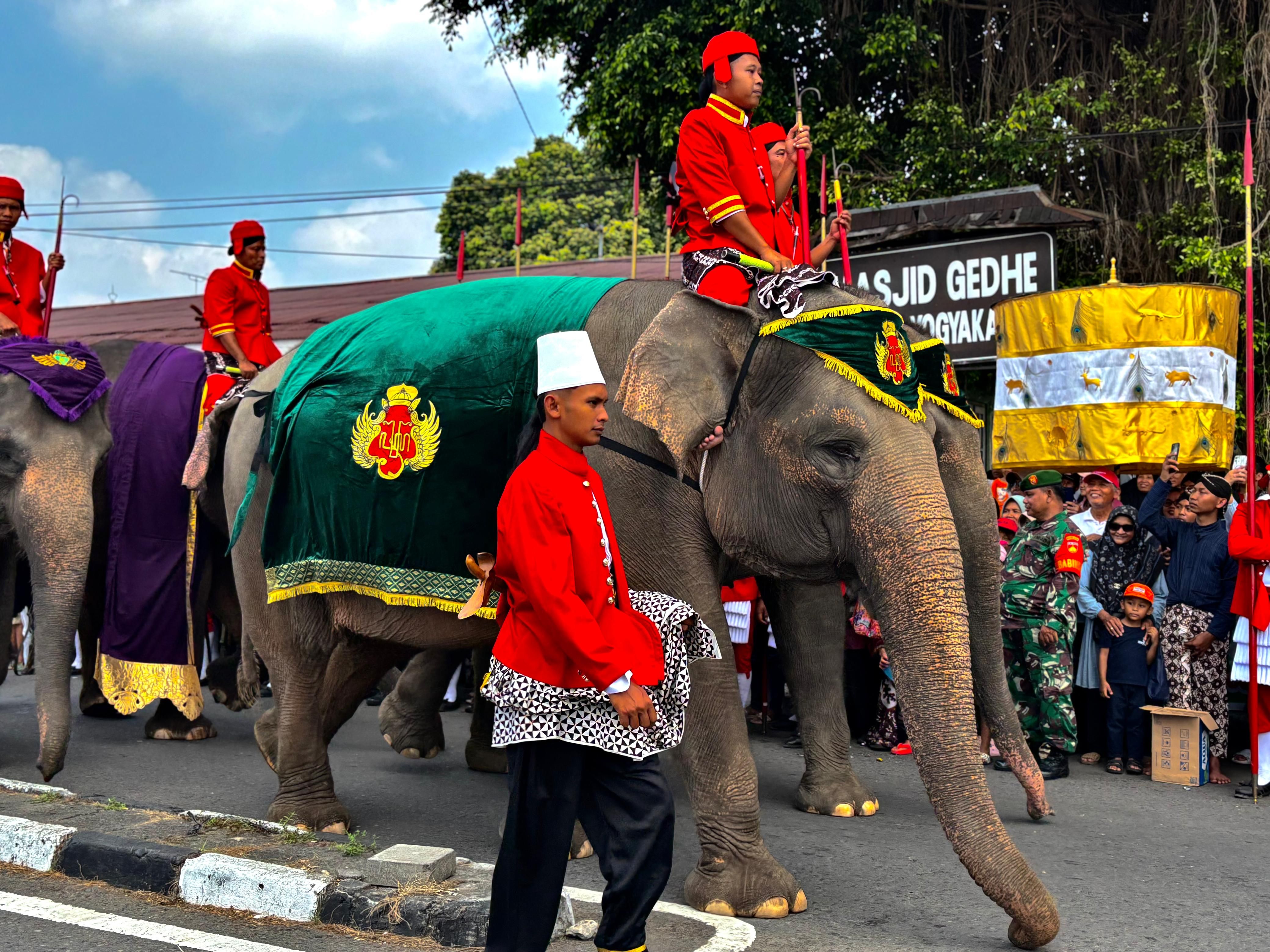
Accompanying six ceremonial gunungan of the Mawlid Garebeg procession of the Year of Dal 1959, elephants walked as a testament to tradition. (Photo: RRI/Diva Rifdah Rizkia Puspitaningnala).
To ensure the procession's solemnity and safety, the Yogyakarta Sultanate implemented a "no-fly zone" over the palace area for the entire duration of the Mawlid celebration.
This ban on drones and other unmanned aerial vehicles at altitudes of 0-150 meters was put in place to ensure all events, including the distribution of the royal offerings, proceeded without disruption.
The procession on Friday began with the Pisowanan ceremony at Bangsal Kencana, starting at 9 a.m. local time. During the ritual, Sri Sultan Hamengku Bawono X took rice from the Kanjeng Nyai Mrica pot, shaped it into small balls, and placed them on the Kanjeng Kiai Blawong plate. These rice balls were then distributed to GKR Hemas, followed by other royal family members and palace courtiers.
Later that evening, the Garebeg series concluded with the Bedhol Songsong ritual at Tratag Prabayeksa. Meaning “pulling out the parasols,” Bedhol Songsong is a historic ceremony that traditionally marked the departure of visiting officials from outside the palace.
In earlier times, their arrival was symbolized by planting ceremonial parasols in the palace grounds; the ritual’s conclusion involved removing them. Although officials no longer camp at the palace, the tradition was preserved symbolically by withdrawing the large parasol used in the morning procession.
The closing ceremony also featured an all-night wayang kulit (shadow puppet) performance, an enduring cultural marker of the Garebeg’s end. This year’s show was led by master puppeteer MB. Cermo Sugondo.
While the performance at Gedhong Prabayeksa was not open to the public, it was broadcast live via the Kraton Jogja YouTube channel, beginning at 7 p.m. local time. ***
News Recomendation
Loading latest news.....