



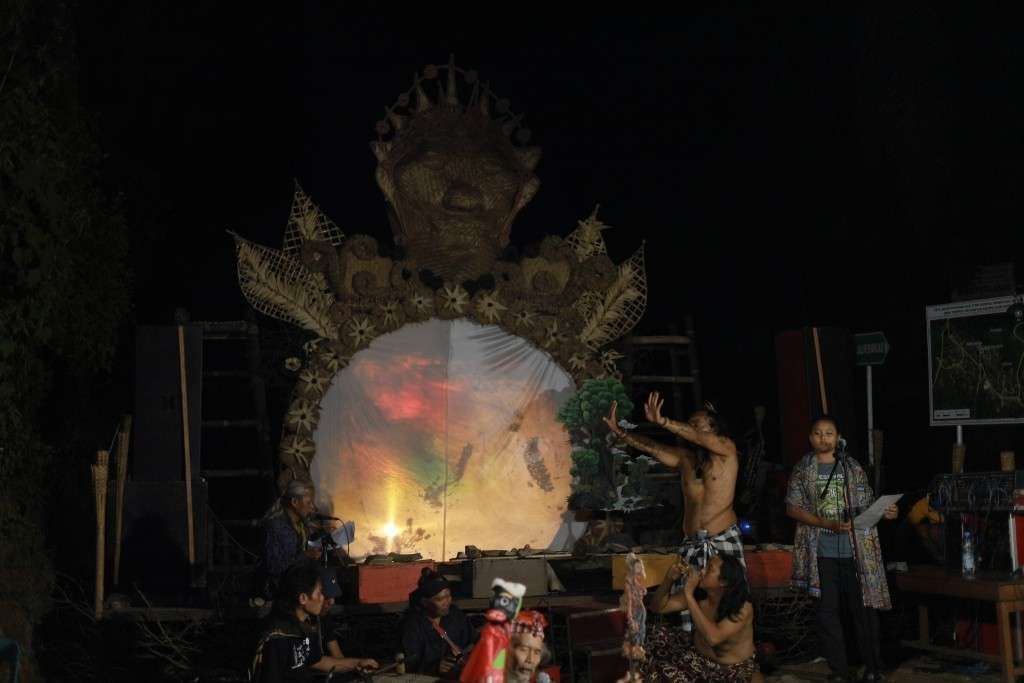
KBRN, Jepara: Amid the serene beauty of the Muria mountains, the fifth Muria Raya Festival (FMR#5) unfolded with vibrant energy and deep cultural resonance.
Held in Duplak Hamlet, Tempur Village, Jepara Regency, Central Java, from August 16–17, 2025, the festival carried the theme Wiwiting Werna Katresnan (“The Beginning of Diverse Love”), blending art, spirituality, and the human connection to nature.
Set against a backdrop of coffee plantations and rice fields, the festival served as a gathering space for local residents, artists, cultural scholars, and activists.
More than a spectacle, FMR offered an immersive experience that transcended boundaries through creative expression and community engagement.
Brian Trinanda K. Adi, head of the FMR committee, described the festival as a sacred collective symbol that strengthens the bond between people and the natural world. “Nothing is accidental. We are connected through shared vibrations and values,” he said.
Mountains as Spiritual Beacons
A discussion session titled Village Dialogue explored the spiritual significance of mountains in ancient traditions across the archipelago. Rather than mere geographic formations, mountains were portrayed as centers for seeking life’s deeper meaning.
Mang Pepep DW, author of Man and the Mountain, described mountains as sources of wisdom and cosmic balance.
Dr. Barbara Titus of the University of Amsterdam emphasized the importance of repatriating cultural archives to their original communities, citing the return of Jaap Kunst’s audio recordings to the Nias people as a concrete example of cultural decolonization.
“Honoring ancestors means reviving narratives that have been uprooted,” Titus said, asserting that archives belong not to institutions but to the living communities they represent.
Artist Rani Jambak presented a performance titled Future Ancestor, inviting audiences to reflect on their roles as future elders. “The older generation must learn to understand the new forms of youth expression,” she said, stressing that values can be passed down even as their forms evolve.
“This may not be the end of an era, but the beginning of a new civilization,” she added, suggesting that everyone is being prepared to become ancestors in their own time.
The festival’s main performance featured a collaboration between Sanggar Tari Arjuna, JALAKATA, Sarasuni, and experimental artist Dr. Memet Chairul Slamet. One of the most striking moments was a musical exploration of Muria’s ancient stones.
The project, Arranging Sounds, Tracing the Movement of Muria Stones, was the result of an artistic residency that mapped sounds from natural materials.
Artists such as Gempur Sentosa, YAW, and Dedy Satya transformed the stones into a contemplative sound ensemble, blending tradition with modernity.
This transformation illustrated that culture is never static. It continuously dialogues with time and the environment. Even ancient stones can speak in contemporary, meditative tones.
Festival Roots and Expansion
FMR began in 2020 in Gotanjung Village, Pati, as a small-scale cultural initiative during the COVID-19 pandemic.
It opened to the public in 2022 and welcomed international collaborators, including Japanese artist Yuta Kuroki. The fifth edition marked the festival’s first appearance in Jepara, expanding its reach and community impact.
A new ritual called Prasastu symbolized inter-regional brotherhood.
During the ceremony, speakers poured water from various springs into a symbolic stone, followed by a Brotherhood Oath spanning Pati, Jepara, and Kudus. Representatives from Blora, Bandung, Surakarta, and Demak also contributed water from their regions.
Another spontaneous ritual, Bluron Kali, featured dance and stone orchestration in a river setting. Participants engaged with nature through movement, water, and sound, an authentic celebration of togetherness.
The festival showcased glass gamelan instruments and coffee powder paintings, highlighting village commodities. Local SMEs joined the event, offering honey, traditional cuisine, and agricultural products.
FMR demonstrated how culture can drive a grassroots creative economy, organically supporting local livelihoods through art and enterprise.
FMR#5 affirmed that culture is not only to be celebrated, but lived and passed on. With its theme Wiwiting Werna Katresnan, the festival became a collective expression of gratitude for nature, for heritage, and for the shared human experience. ***
Translator: Naura Sofia
Editor: Lasti Martina
News Recomendation
Loading latest news.....