



Bantul set Record as Indonesia’s Longest Rain-Free Period at 131 Days
- 22 Sep 2026 16:07 WIB
- Voice of Indonesia
Key Points
- Bantul Regency, Yogyakarta, recorded Indonesia’s longest consecutive rain-free period at 131 days, according to BMKG.
- The prolonged dry period is linked to an extreme El Niño event and Pacific Ocean sea surface temperature anomalies reaching +2.63°C in the Niño 3.4 region during July–September 2026.
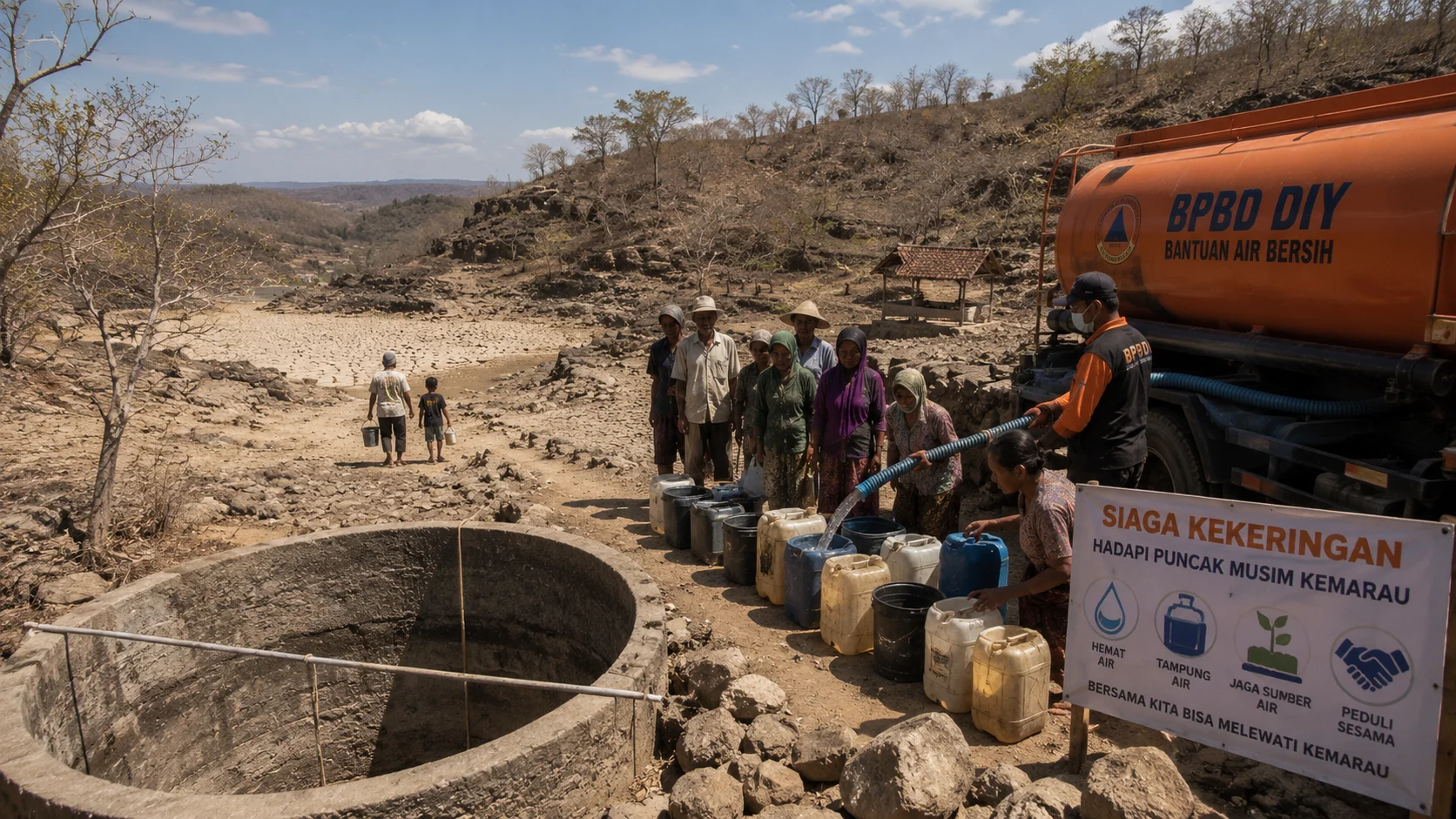
RRI.CO.ID, Jakarta - Anomalous sea surface temperatures in the Pacific Ocean that reach +2.63°C have directly suppressed rainfall across Yogyakarta Province. This extreme El Niño condition has led Bantul Regency to record the longest rain-free period (HTH) in Indonesia, at 131 consecutive days.
Deputy for Climatology at the Meteorology, Climatology, and Geophysics Agency (BMKG), Ardhasena Sopaheluwakan, said the trend of extreme meteorological drought is now expanding, affecting climate observation stations in 25 provinces.
“Many observation locations have reported consecutive rain-free days exceeding 60 days. The current record for the longest rain-free period is in Bantul, at 131 days,” he said during a press conference in Jakarta on Tuesday, 22 September 2026.
He explained that the widespread extension of the dry period is driven by a very strong El Niño phenomenon in the Pacific Ocean, with sea surface temperature anomalies in the Niño 3.4 region during July–September 2026 reaching +2.63°C.
This condition has directly affected 556 Monsoon Zones (Zona Musim/ZOM), or 61.91 percent of Indonesia’s land area, which remain locked in an extended dry season. Even climatic pressure from the 2026 El Niño has forced 98 out of a total of 110 ZOMs that are normally wet year-round to experience drought conditions instead.
The El Niño phenomenon is projected to persist until the first quarter of 2027. However, BMKG forecasts that the impact of extreme drought across various parts of Indonesia will gradually ease as the rainy season begins in stages.
“The onset of the rainy season will occur gradually, starting in November 2026 with 185 ZOMs, or 24.66 percent of the land area, followed by December 2026 with 266 ZOMs, or 17.31 percent of the land area,” said Ardhasena, as quoted by Antara.
Although its arrival is delayed, he said, accumulated rainfall across 510 ZOMs, or 69.76 percent of Indonesia’s land area, is predicted to fall within the normal category.
For the peak of the rainy season, BMKG projects it will occur in waves. Starting in December 2026 across 155 ZOMs (36.94 percent of the land area), January 2027 across 162 ZOMs (25.68 percent), and February 2027 across 190 ZOMs (16.79 percent). ***
News Recomendation
Loading latest news.....