



Jellyfish Surge Drives Cilacap Fishermen Toward Asia Export Market
- 18 Sep 2026 18:51 WIB
- Voice of Indonesia
Key Points
- An abundance of jellyfish in Cilacap waters during the eastern monsoon season has created a promising source of income for local fishermen.
- Small-boat fishermen, particularly those operating vessels below 5 GT, have shifted from catching fish to jellyfish because collectors readily purchase the commodity.
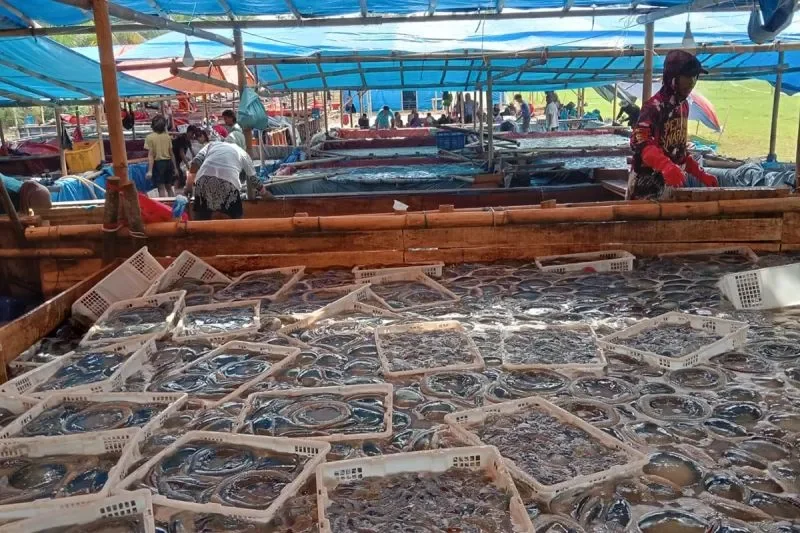
RRI.CO.ID, Cilacap - The abundant jellyfish population in Cilacap waters, Central Java, during the eastern monsoon season has become a promising business field for local fishermen. These catches are immediately absorbed by collectors for export to China and Japan as raw materials for culinary products and cosmetics.
Head of Cilacap Regency Fisheries Agency, Indarto, said the jellyfish abundance has prompted small-boat fishermen to switch to catching this commodity because it is easily absorbed by collectors and exporters.
"With the presence of jellyfish, fishermen's catches have increased. It has entered the second month and is indeed dominating," he said in Cilacap on Friday, September 18, 2026.
According to him, this condition has made fish auction activities at several Fish Auction Places (TPI) tend to be quiet because fishermen with vessels sized below 5 gross tons (GT) prefer catching jellyfish. He said the jellyfish caught by fishermen are sold to collectors and subsequently sent to exporters outside the Cilacap area.
After undergoing a drying process, the jellyfish are sent to exporters in Jakarta for distribution to East Asia, such as China and Japan. This commodity is utilized in destination countries as raw materials for processed food products and cosmetics.
"The selling price of jellyfish in urban Cilacap currently reaches IDR 800 (USD 0.045) per kilogram, while in Jetis it touches IDR 1,100 (USD 0.062) per kilogram. This price point remains relatively stable compared to the range observed in recent years," he said, as quoted by Antara.
He said that in one day, fiber boats sized around 5 GT that go to sea from morning can make up to three trips with results of about 1 ton of jellyfish per trip.
According to him, these fiber boats are usually occupied by two fishermen, and the distance traveled to catch jellyfish is not too far. "The jellyfish fishing area is around fishing route 1, or approximately 4 nautical miles from the coastline, so fuel oil requirements for fiber boat operations are not too much," he said.
Indarto estimated that jellyfish catching will continue for about two more months during the dry season and before rainfall occurs.
Chairperson of the Village Unit Cooperative (KUD) Mino Saroyo Cilacap, Untung Jayanto, conveyed that jellyfish caught by fishermen are generally sold directly to collectors. This direct sales practice causes the commodity not to enter the TPI production data managed by the cooperative.
"There's a lot, but it goes directly to collectors, not recorded in the cooperative," he said.
According to him, fish auction activities currently only run at TPI Tegal Katilayu and TPI Dock 3 of the Ocean Fisheries Port (PPS) Cilacap because auction activities at TPI Kemiren have been transferred to Dock 3 of PPS Cilacap.
Regarding fish auction results, he said production value in August 2026 reached around IDR 14 billion (USD 0.88 million). "In July it was still below IDR 14 billion. Hopefully, it can continue to increase in the future," said Untung. ***
News Recomendation
Loading latest news.....