



Banyuwangi Farmers Turn Rejected Dragon Fruit Into Higher‑value Products
- 26 Jun 2026 18:38 WIB
- Voice of Indonesia
Key Points
- The Sinar Cabe Farmers Group in Banyuwangi, East Java, has implemented a zero-waste approach by processing rejected dragon fruit into value-added products and liquid organic fertilizer.
- Dragon fruit rejected due to minor cosmetic defects is transformed into dried dragon fruit ("sale"), while unsold fruit is processed into homemade liquid organic fertilizer for reuse in cultivation.
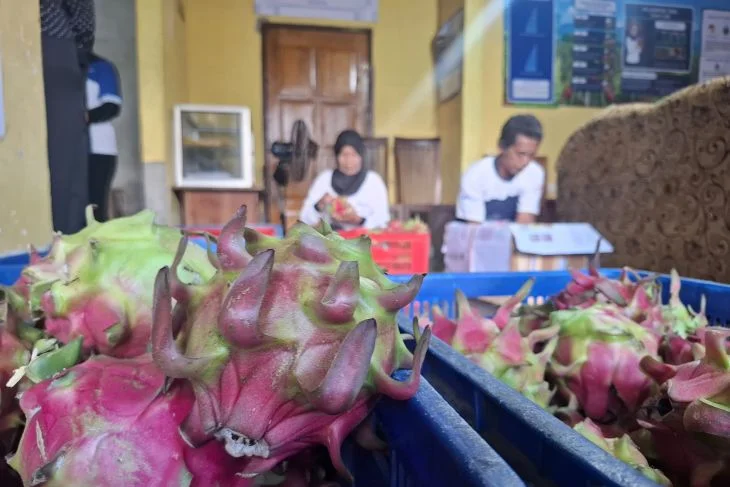
RRI.CO.ID, Banyuwangi - Applying a zero‑waste principle, the Sinar Cabe Farmers Group in Sumbermulyo Village, Pasanggaran Subdistrict, Banyuwangi Regency, East Java, has successfully processed rejected dragon fruit into value‑added dried “sale” products. The leftovers from this process are then converted into homemade liquid organic fertilizer.
Group leader Sumartini said dragon fruit with minor physical defects previously had no market value because it failed to meet fresh‑fruit market standards.
“The fruit that didn’t make money were the rejects. Rejects are slightly cracked or bruised, but still good. If they get hit or split, they won’t sell in the market,” said Sumartini in Banyuwangi on Friday, 26 June 2026.
She explained harvests are first sorted by size, weight, sugar content and physical condition. Top quality fruit is graded A for sale to modern retail, while grades B and C are sold to other market segments at different prices.
Rejected fruit, those with minor damage from impacts during harvest or distribution, are used as processed products or as feedstock for organic fertilizer. “The important thing is that nothing from the harvest is wasted. Everything must be utilized,” she said, as quoted by Antara.
Sumartini said the rejected dragon fruit are processed into dried sale through a business partnership, which the farmers group carries out drying, while downstream processing is handled by a partner company. Production began in March 2024 and by June 2026 the group had produced 19,125 packages, all sold.
The product is marketed at IDR 24,000 (USD 1.35) per package through modern retail outlets, souvenir centers in East Java, Bali and Yogyakarta, and online marketplaces. Based on production and selling price, total sales of the group’s dried dragon fruit are estimated at about IDR 459 million (USD 25,725) since production began in March 2024.
Besides dried sale, the group also produces dragon‑fruit dodol (a sticky toffee‑like confection) on order, while dragon‑fruit sponge cake remains in development. In 2025 they sent dried dragon‑fruit samples to the Netherlands to explore export opportunities, though the product has not yet been commercially marketed there.
Fruit that does not sell is also turned into liquid organic fertilizer to be reapplied in cultivation, ensuring harvest residues are repurposed to support organic dragon‑fruit farming.
“We took the initiative to make unsold fruit into liquid organic fertilizer for reapplication to the dragon fruit,” she said.
Product development has been supported by mentoring from the Astra-Dharma Bhakti Astra Foundation (YDBA), enabling farmers to expand market access while improving cultivation standards and business management.
Coordinator for Astra–YDBA Banyuwangi, Azzuhri Tri Ahara, said assistance to Sinar Cabe began under the Sejahtera Astra Village (DSA) program, which entered Sumbermulyo to help expand market access when dragon‑fruit prices were under pressure.
Over time, issues extended beyond marketing to cultivation, business management and postharvest handling, prompting YDBA to open a Banyuwangi branch in November 2021 to strengthen support.
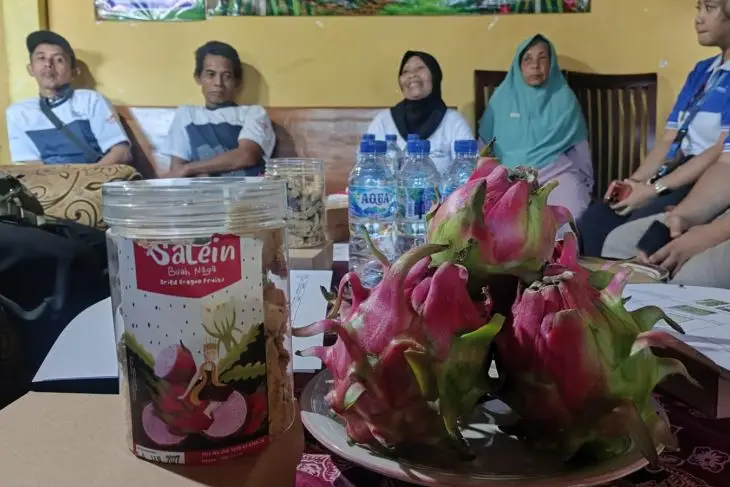
“Assistance was then broadened from cultivation strengthening, group administration, institutional and business legality, postharvest handling, to processed product development,” said Azzuhri.
Through this guidance, the farmers’ group obtained organic cultivation certification and implemented standard operating procedures (SOPs) for cultivation, sorting, grading, and postharvest handling. Additionally, they received support for intellectual property rights (HAKI) and Home Industry Food Licensing (PIRT).
Mentoring also encouraged farmers to produce organic fertilizer and biological agents independently, strengthen pest and disease control, and apply the 5R system (compact, neat, clean, well-maintained, diligent) in production areas and warehouses.
As a result, the group’s organic dragon fruit commands a higher price than conventional fruit. For grade A1 fruit, farm‑gate prices reach about IDR 22,000 (USD 1,23) per kilogram, approximately IDR 5,000 (USD 0.28) higher than conventional dragon fruit priced around IDR 17,000 (USD 0.95) per kg.
Currently, Sinar Cabe has 30 active members managing 9.2 hectares and producing about 300 tons of dragon fruit per year, with monthly revenue of around IDR 30 million (USD 1.677,95) from fruit sales. ***
News Recomendation
Loading latest news.....