



Mount Semeru Erupts Five Times, Sends Ash 1.2 Kilometers High
- 25 Jun 2026 15:56 WIB
- Voice of Indonesia
Key Points
- Mount Semeru erupted five times on June 25, with the largest eruption sending an ash column 1.2 kilometers above the summit and drifting southward.
- Authorities maintained Alert Level III status and enforced exclusion zones due to risks from pyroclastic flows, lava avalanches, and lahar floods.
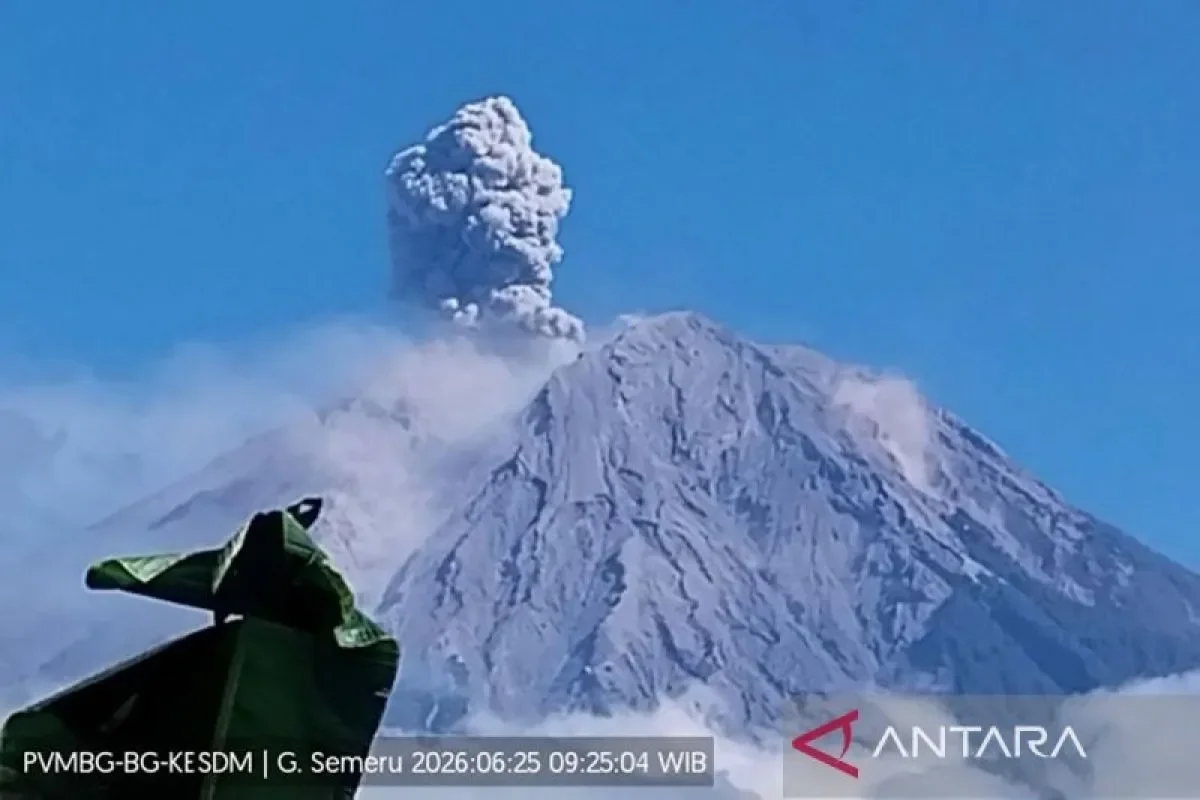
RRI.CO.ID, Lumajang - East Java’s Mount Semeru experienced a series of volatile eruptions on Thursday morning, June 25, 2026, culminating in a massive ash column that reached 1.2 kilometers above its peak, authorities reported.
The highest of the morning's blasts occurred at 9.24 a.m. local time, pushing volcanic debris to an altitude of 4,876 meters above sea level. Perched on the border of Lumajang and Malang Regencies in East Java, Java's tallest volcano has exhibited heightened geological activity, triggering strict safety warnings for nearby communities.
Semeru Volcano Observation Post officer Liswanto confirmed that the visual characteristics of the morning's main eruption indicated significant internal pressure. "The eruption of Semeru Volcano occurred on Thursday, June 25, 2026, at 9.24 a.m. local time, with an observed eruption column height of approximately 1.2 kilometers above the peak, or 4,876 meters above sea level," Liswanto said in an official report received in Lumajang, as quoted by Antara.
He added that the observation team recorded a moderate-intensity ash cloud, varying in color from white to gray, drifting steadily toward the south. The 9.24 a.m. blast was the climax of a remarkably active morning. Volcanologists logged a total of five separate eruptions starting shortly after dawn.
The day's first volcanic event was recorded at 5.44 a.m., sending an ash plume 700 meters skyward. This was quickly followed by a second, larger eruption at 6.36 a.m. that reached 900 meters.
The volcano vented twice more at 6.51 a.m. and 7.32 a.m., generating ash columns of 600 meters and 700 meters respectively, before unleashing its largest explosion of the day two hours later.
Semeru Volcano remains under a Level III (Alert) status, the second-highest level in Indonesia’s four-tiered volcanic alert system. In response to the escalating activity, center officials have tightly restricted human presence around the mountain's most vulnerable zones.
Residents and tourists are strictly prohibited from conducting any activities in the southeastern sector along the Besuk Kobokan river channel up to 13 kilometers from the summit.
"Beyond that distance, the public must not engage in activities within 500 meters of the riverbanks along Besuk Kobokan, as the area is highly susceptible to expanding pyroclastic flows and lahar movements up to 17 kilometers from the peak," Liswanto warned.
Furthermore, an absolute exclusion zone has been established within a five-kilometer radius of the active crater due to the severe threat of airborne incandescent rocks and volcanic projectiles.
Disaster management officials have urged local populations to maintain a state of high vigilance. The primary dangers facing the region include sudden pyroclastic flows, lava avalanches, and cold lava mudflows (lahar) cascading down the network of rivers originating at the summit, specifically threatening the valleys of Besuk Kobokan, Besuk Bang, Besuk Kembar, Besuk Sat, and their surrounding tributaries. ***
News Recomendation
Loading latest news.....