



BRMP Rawa Unveils Floating Rice Technology for Swampy Landscapes
- 27 Apr 2026 12:26 WIB
- Voice of Indonesia
Key Points
- BRMP Rawa introduces floating rice technology that adapts to changing water levels in swampy areas.
- The system enables farmers in Banjarbaru to maintain productivity and supports national food security efforts.
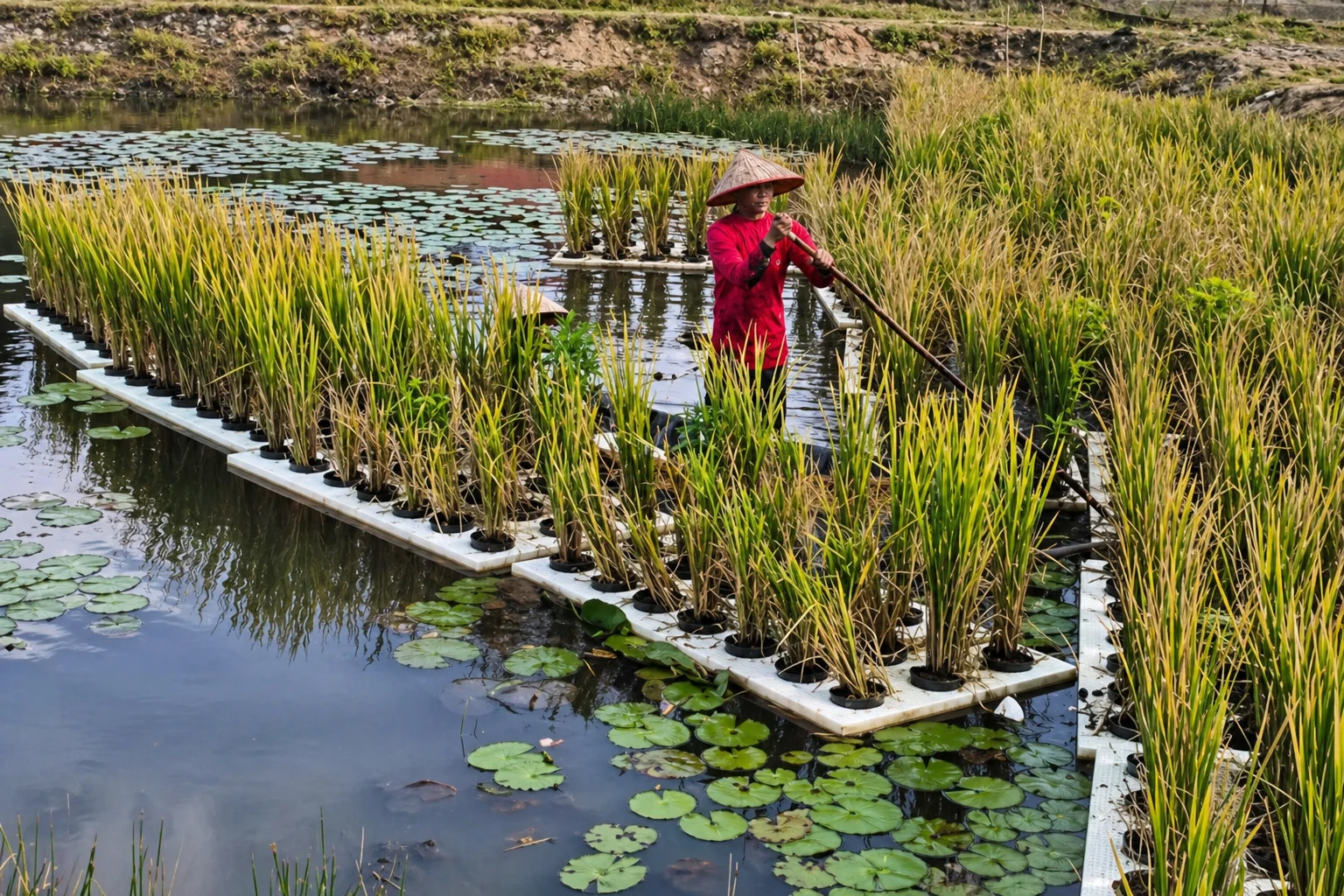
RRI.CO.ID, Banjarbaru - Swampland Agricultural Assembly and Testing Center (BRMP Rawa) at the Ministry of Agriculture has introduced a breakthrough floating rice technology designed to overcome the challenges of farming in flood-prone swampy areas. This innovation allows farmers to maintain productivity even when traditional planting methods are hindered by high water levels.
The technology utilizes floating media that automatically adjusts to the rising and falling water levels of lebak swamps, which are often difficult to cultivate conventionally due to frequent inundation.
"Through this innovation, rice is planted on floating media capable of following the rise and fall of the water level" said the Head of BRMP Rawa, Wahida Annisa Yusuf, in Banjarbaru, South Kalimantan, on Monday, April 27, 2026, as quoted by Antara.
The floating technology has undergone rigorous field testing at the Banjarbaru Agricultural Modernization Testing and Implemention Facility (IP2MP). The trials successfully utilized the Mekongga rice variety, which proved highly adaptable to the aquatic environment and produced optimal yields despite being grown on top of stagnant floodwaters.
Wahida emphasized that this innovation is a tangible contribution to Indonesia's national food self-sufficiency program. By providing a replicable model for local farmers, the agency aims to transform the perception of swampy terrain from a liability into a productive asset.
"Through appropriate technological innovation that can be replicated by farmers, we prove that swamps are not a problem," Wahida asserted.
This adaptive and sustainable approach ensures that flooding is no longer a barrier to food production. Instead, it offers a resilient solution for maintaining national food security in the face of unpredictable environmental conditions, proving that even inundated lands can serve as a foundation for a robust agricultural sector. ***
News Recomendation
Loading latest news.....