


BRIN Studies Rafflesia arnoldii Link Between Agam and Malaysia
- 14 Nov 2025 07:37 WIB
- Voice of Indonesia
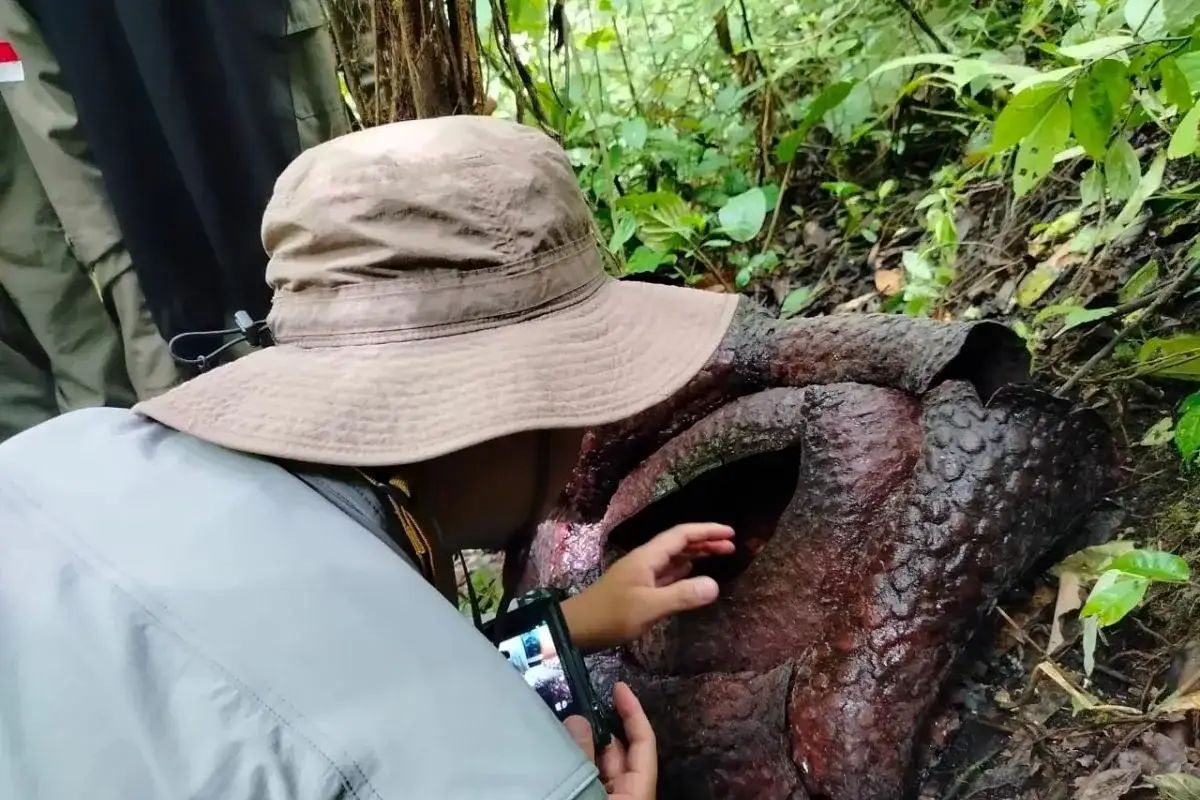
KBRN, Lubuk Basung: The National Innovation and Research Agency (BRIN) is researching the Rafflesia arnoldii species in the Palupuh Nature Reserve, Agam Regency, West Sumatra. The study seeks to confirm the phylogenetic kinship of this rare flower with specimens found in Malaysia.
Irvan Fadli Wanda, a Junior Expert Researcher at BRIN, said in Lubuk Basung, West Sumatra, on Thursday, November 13, 2025, that samples of Rafflesia arnoldii were collected on Wednesday, November 12, 2025. The sample is referred to as Rafflesia CF arnoldii pending further identification through both morphological and molecular analysis.
“The use of ‘CF’ stands for confer or ‘compare with,’ reflecting its form. Rafflesia CF arnoldii is the name used until the sample is definitively confirmed as arnoldii. This research is a multi-stakeholder collaboration involving the Natural Resources Conservation Agency (BKSDA), Bengkulu University, BRIN, and Oxford University,” he explained, as quoted by Antara.
He added that after the field specimen was collected, more rigorous observation will be carried out at the BRIN campus in Cibinong, West Java. The examination will include detailed morphological analysis using a scanning electron microscope (SEM), followed by DNA identification.
“This will be instrumental in formulating a taxonomic decision regarding the species classification,” he noted.
Irvan said the suspected arnoldii sample was taken in Batang Palupuh because previous publications had documented the presence of Rafflesia arnoldii there. The species is tentatively identified as arnoldii until confirmed through morphological and molecular approaches.
He added that two teams will conduct the examination. The first team will conduct a detailed morphological study, led by morphology experts Agus Susatya and Ridha Mahyuni.
“They will examine the specimens more closely, with support from other team members, to observe the ornamentation of the Rafflesia using a microscope. If necessary, we will employ a scanning electron microscope (SEM) to study its ultra-microscopic features,” he concluded. ***
News Recomendation
Loading latest news.....