



Poin Utama
- Indonesian visual arts maestro Nasirun passed away on August 1, 2026, leaving Indonesia’s arts community, particularly in Yogyakarta, in deep mourning.
- Fellow artist Jumaldi Alfi Chaniago described Nasirun as humble, generous, and deeply committed to supporting fellow and emerging artists.
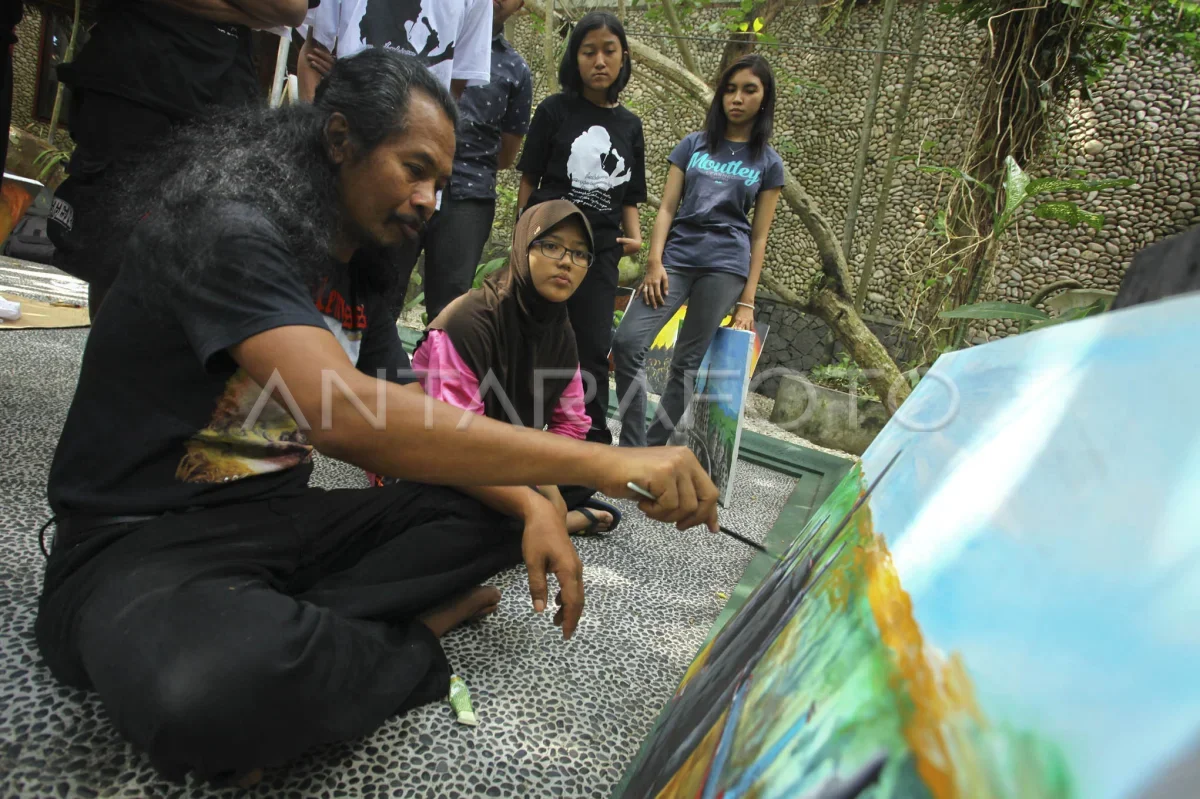
RRI.CO.ID, Yogyakarta - The passing of visual arts maestro Nasirun on Saturday, July 1, 2026, has left Yogyakarta’s arts community in deep mourning. Behind his dazzling international reputation, the celebrated artist is remembered as someone who consistently kept his distance from arrogance and chose instead to nurture grassroots relationships rather than confining himself to elite exhibition spaces.
Dozens of condolence wreaths lined up and nearly filled the Bayeman Permai Housing complex in Bantul, Yogyakarta Province, where the body of Nasirun, one of Indonesia’s master artists, was laid to rest.
Among the hundreds of mourners was Jumaldi Alfi Chaniago, who knew Nasirun very well. In addition to being neighbors in the same residential complex, Alfi was also a fellow artist and a junior of Nasirun at the Indonesian Academy of Fine Arts (ASRI), now the Yogyakarta Indonesian Institute of the Arts (ISI Yogyakarta).
Because they lived close to each other, Alfi met Nasirun almost every day. The sudden news of his passing left him in shock. Just the day before, they had still spoken as usual.
“The last time I saw him was Friday afternoon. When I was told this morning, I was really shocked because I never expected it,” said Alfi on Saturday, August 1, 2026.
In fact, just two days earlier they had attended an art exhibition together and exchanged jokes. Even so, Alfi admitted that Nasirun had seemed physically unwell in recent days. “But we thought it was because of the weather. Yogyakarta has been cold these days,” he said, as quoted by Antara.
On Saturday around 2 a.m. Jakarta time, Alfi received word that Nasirun had been rushed to the hospital after experiencing severe shortness of breath. Four hours later, around 5:50 a.m. Jakarta time, he received the news of Nasirun’s death.
Based on information from the family, Nasirun had been experiencing shortness of breath for the past three days. Yet, as was always his habit, he never complained about his health to others. Alfi only later learned that his friend had been suffering from pneumonia and acid reflux disease.
“So the family said he had been short of breath for these past three days, but it came and went,” he said.
Alfi had known Nasirun since around the early 1990s. In his memory, Nasirun was a deeply humble person. He never became arrogant when praised, and never took offense when insulted or cursed.
To Alfi, Nasirun was someone who had already settled his worldly affairs and his relationship with himself, and was no longer attached to material concerns.
“He was someone who had already lost that stance. In Sufism, it means a person who has finished with himself; even if beaten or insulted to no end, he would only respond with laughter,” he said.
Beyond his humility, Nasirun was also known for his generosity. He always tried to help anyone in difficulty. His deep concern for young artists also left a lasting impression. He never discriminated against anyone.
“He was the kind of person who, even when starving, would give the ready-to-eat bread in his hand to the person beside him who was hungry,” he said.
What impressed Alfi most was how Nasirun maintained his simplicity even after becoming an internationally recognized artist. His works were exhibited in various countries, yet he remained present and involved in grassroots art activities, even at the neighborhood level.
“Sometimes I’d ride a motorbike with him, and I’d say, ‘Someone like you has exhibited internationally everywhere, but you still want to join a neighborhood community exhibition between alleys,’” Alfi recalled, imitating his conversation with Nasirun.
Musician and Jogja Hip Hop Foundation member Marzuki Mohamad also said he admired Nasirun’s humility. His eccentric but simple, friendly, and helpful manner was a source of inspiration for him.
“Beyond his extraordinary work, he was a very simple person,” said Marzuki.
One of the things Marzuki admired most was Nasirun’s decision not to depend on gadgets amid the rapid pace of digitalization. According to him, that choice became a hallmark that set Nasirun apart from many other artists who often consider social media algorithms in their creative process.
“Nasirun did not. He did not want to be imprisoned by the demands of social media algorithms, and his work remained contextual,” he said.
A similar view was expressed by writer and cultural figure, R. Gabriel Possenti Sindhunata, widely known as Romo Sindhu. To him, Nasirun was a joyful, free-spirited person who did not want to be tied to anything, including gadgets.
“That shows he was dependent on nothing, including progress or facilities,” he said.
Romo Sindhu assessed that Nasirun had an aura radiating kindness, making anyone feel close to him. Even without a mobile phone, Nasirun’s social ties remained strong because he was always present and willing to help many people. ***
News Recomendation
Memuat berita terbaru.....