



BRIN Uses VR to Introduce Nuclear Technology Safely
- 03 Okt 2026 12:52 WIB
- Voice of Indonesia
Poin Utama
- BRIN's COGI VR offers a safe and interactive virtual tour of a nuclear irradiation facility.
- COGI VR significantly improves users' understanding of nuclear technology and radiation safety.
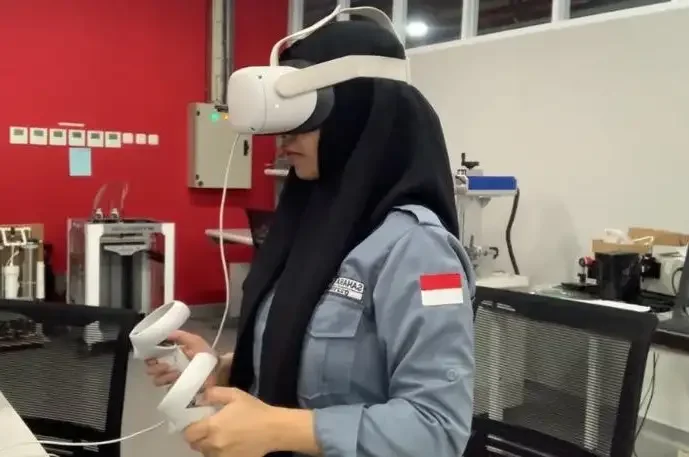
RRI.CO.ID, Yogyakarta - The National Research and Innovation Agency (BRIN) has developed COGI VR, a virtual reality simulator designed to introduce the public to nuclear technology through a safe, interactive learning experience.
The Indonesian Nuclear Technology Polytechnic (Poltek Nuklir) under BRIN developed COGI VR as a virtual replica of the Category I Gamma Irradiator facility at the Dr. Mirzan T. Razzak Laboratory in Yogyakarta.
The initiative aims to address limited public access to nuclear facilities and concerns about radiation, which remain challenges in improving understanding of nuclear technology. While nuclear technology is often associated with power generation, radiation technology is also widely used in healthcare, agriculture, food processing, and education.
Poltek Nuklir BRIN lecturer Halim Hamadi said the VR simulator allows users to learn about gamma irradiator operations and safety procedures without entering the actual facility.
"The simulator guides users through seven learning stages, starting from entering the laboratory, attending a safety briefing, collecting samples, entering the irradiator chamber, placing the samples, observing the irradiation process, and finally retrieving the irradiated samples," Halim said in a statement on Thursday, Oct. 1, 2026, as quoted by BRIN's official website.
The simulator also includes educational videos explaining the irradiation process, enabling users to understand both the equipment and the procedures involved in a three-dimensional virtual environment.
According to Halim, the approach provides a different learning experience. An initial survey involving 10 respondents found that seven participants, or 70 percent, were interested in learning about nuclear technology through a VR application.
"The public can directly visualize the facility and the irradiation process workflow in a virtual environment without having to face radiation risks or access restrictions associated with the actual facility," he said.
A pilot study involving 10 participants consisting of high school students and university students showed a significant increase in understanding after using COGI VR. Participants' average knowledge score rose from 30 before using the simulator to 88 after completing the learning session.
The study also found that all 15 functional testing scenarios were completed successfully without errors.
Knowledge of basic nuclear science and irradiation increased from 17.5 percent to 82.5 percent, while understanding of facility workflows and safety procedures improved from 40 percent to 92 percent.
Halim said the findings demonstrate COGI VR's potential as an interactive tool for introducing nuclear technology to the public. Information that was previously difficult to visualize because of restricted access to irradiator facilities can now be presented through a three-dimensional virtual environment.
"This development opens opportunities for more accessible nuclear technology education. People not only receive theoretical explanations but can also explore the laboratory environment, recognize supporting equipment, understand irradiation procedures, and learn about radiation safety through a virtual experience," he said.
The benefits are particularly important because gamma irradiators use high-activity radiation sources that require strict safety procedures and access controls. COGI VR introduces these aspects without exposing users to an actual radiation environment.
Halim added that virtual reality technology could serve as a bridge between the complexity of nuclear technology and the public's need for information that is easy to understand.
Future development of COGI VR is expected to include more advanced features, such as real-time dose simulation, user performance assessment and operator training functions.
"Our main focus remains introducing technology and improving public nuclear literacy in a safe, interactive and accessible way. Going forward, assessments of the COGI VR application need to be expanded to better understand public needs," Halim said. ***
News Recomendation
Memuat berita terbaru.....