



UGM’s Circular Farming Innovation Introduces Aquaponic RAS in Kulon Progo
- 18 Sep 2026 08:47 WIB
- Voice of Indonesia
Poin Utama
- Gadjah Mada University (UGM) is addressing rural food security through circular farming-based Recirculating Aquaculture System (RAS) technology.
- UGM emphasized that the program aims not only to provide infrastructure but also to strengthen residents’ capacity to manage the system sustainably.
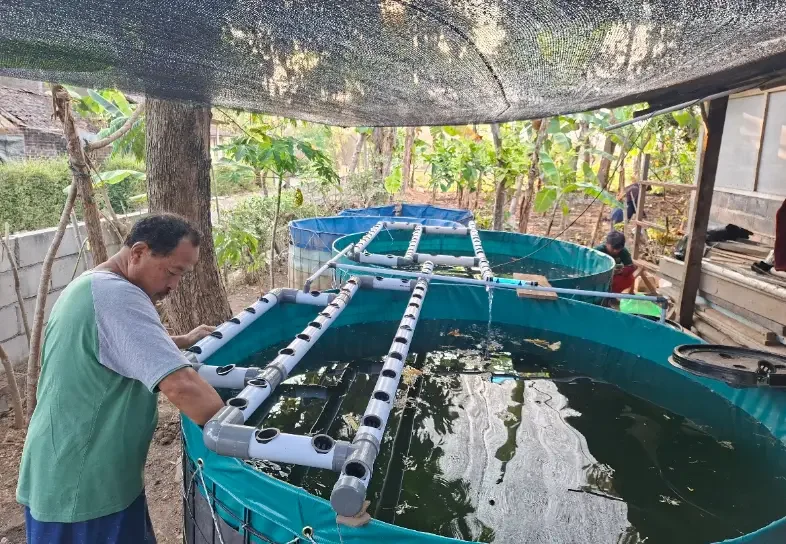
RRI.CO.ID, Yogyakarta - Gadjah Mada University (UGM) is addressing rural food security challenges through the application of circular farming-based Recirculating Aquaculture System (RAS) technology in Jatisarono Village, Nanggulan Subdistrict, Kulon Progo Regency, Yogyakarta Province.
In collaboration with the Amrih Rahayu Women Farmers Group (KWT), a team of UGM academics has introduced an integrated cultivation model that is resource-efficient and environmentally friendly.
This community service program focuses on improving the efficiency of space and water use through the installation of two aquaponic RAS units comprising four fish-rearing ponds.
The first unit is dedicated to catfish farming, with a capacity of 800 fish, while the second accommodates 600 tilapia. Uniquely, nutrient-rich water from the fish ponds is channeled directly to support the growth of various leafy vegetables, including pak choi, water spinach, and spinach, within the same integrated system.
Head of the UGM team, Artina Prastiwi, emphasized that the technology’s main advantage lay in the efficiency of its ecological cycle. “The concept we have implemented does not focus solely on fish production, but also utilizes wastewater from the cultivation system to support the growth of leafy vegetables. As a result, a single installation can produce fish and vegetables simultaneously,” said Artina.
A member of the UGM team specializing in fisheries engineering, Desy Putri Handayani, explained that RAS technology minimized water waste through a multi-stage filtration system. Water used to raise the fish is periodically filtered to remove waste, allowing its quality to be maintained for recirculation.
“In an RAS system, water from the cultivation ponds is not discharged immediately. Instead, it is passed through a series of filters to remove waste and maintain water quality before being returned to the ponds. This circulation system reduces water use because the water does not need to be replaced frequently and can be used until harvest, while monitoring and replenishment are still carried out as needed due to evaporation and cultivation conditions,” said Desy on Tuesday, September 15, 2026.
Meanwhile, a member of the community service team from UGM’s Faculty of Veterinary Medicine, Yudhi Ratna Nugraheni, highlighted the importance of strengthening community self-reliance. She said the program was not merely intended to provide physical assistance, but also to build residents’ capacity to manage the technology sustainably.
“We want to develop a cultivation model that not only produces food but is also efficient in its use of resources. We developed this aquaponic RAS-budikdamber system as part of a circular farming concept that can be adapted to the conditions and potential of the Jatisarono community,” said Yudhi. (Annaila Azzahra-EN)
News Recomendation
Memuat berita terbaru.....