



AI and IoT Drive Indonesia’s Agricultural Transformation Toward Smart Farming
- 25 Agt 2026 17:56 WIB
- Voice of Indonesia
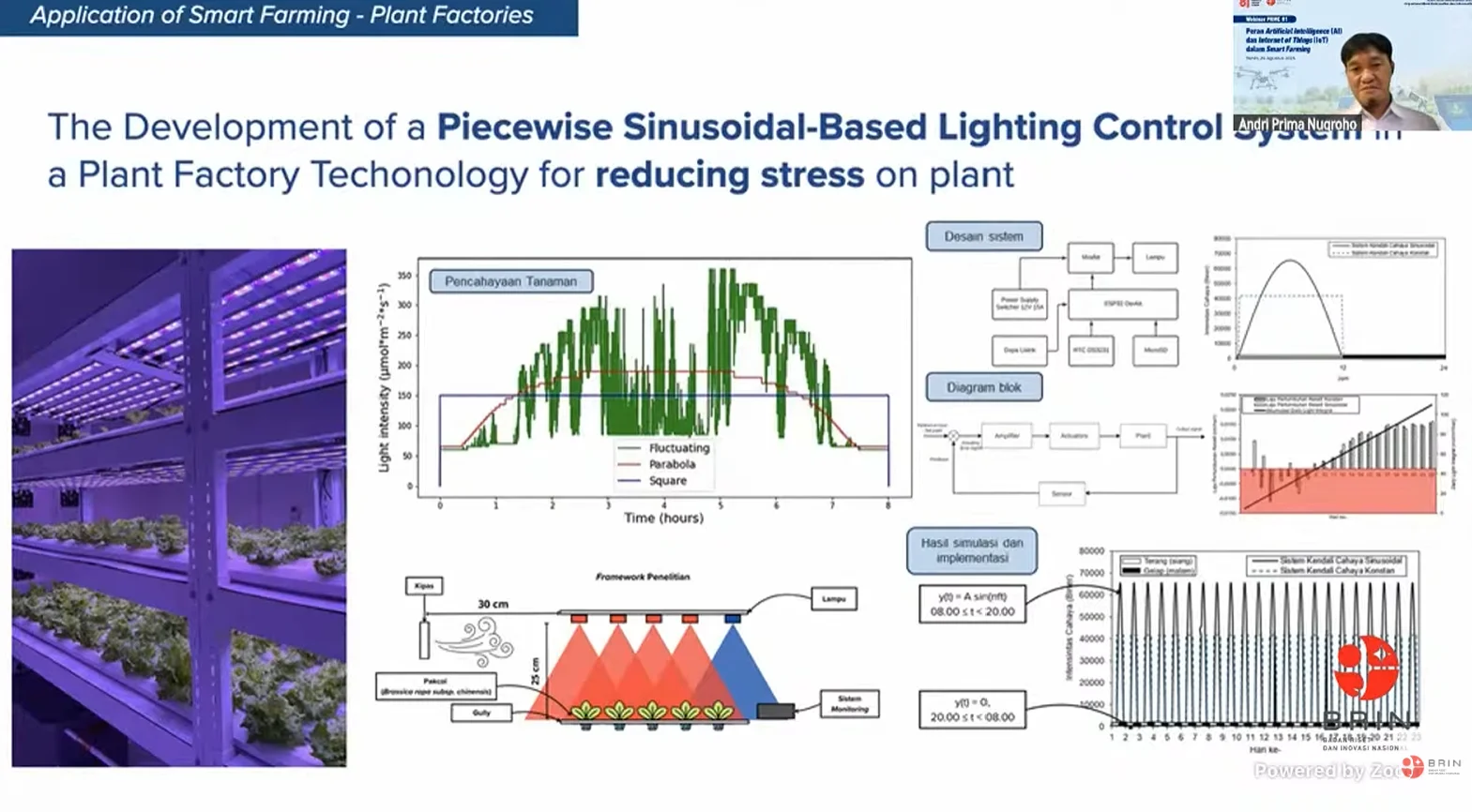
RRI.CO.ID, Jakarta - The use of artificial intelligence (AI) and the Internet of Things (IoT) is considered capable of driving Indonesia’s agricultural transformation toward smart farming systems. On Monday, 24 August 2026, the National Research and Innovation Agency (BRIN) held a seminar on the “Role of Artificial Intelligence (AI) and Internet of Things (IoT) in Smart Farming.”
At the seminar, Universitas Gadjah Mada (UGM) lecturer Dr. Andri Prima Nugroho said AI could transform the use of agricultural technology from mere digitalization into a more intelligent decision-making system. He said various data collected through sensors, satellite imagery, and monitoring devices could be processed to generate recommendations suited to field conditions.
He explained that AI could be used, among other things, to predict crop yields, water requirements, and potential pest outbreaks. Meanwhile, computer vision technology could help monitor crop conditions and quality in real time.
“AI is transforming smart farming from mere digitalization into an intelligent decision-making system,” Nugroho said.
According to him, the application of such technology needs to be supported by an understanding of plant biology. Data from sensors, such as temperature, humidity, soil conditions, and plant health, must be interpreted through an understanding of plant physiology before being used as a basis for decision-making.
He added that precision agriculture involves several stages, ranging from data collection and interpretation to decision-making and action in the field. This approach allows water, fertilizer, and other agricultural inputs to be adjusted according to the needs of crops.
One of the applications being developed is the SIPASI irrigation management system, which has been implemented in two pilot irrigation areas in South Sulawesi. According to Nugroho, the system has reduced water use by up to 25 percent while also helping reduce conflicts over irrigation water management.
Similar technology is also being developed for oil palm plantations, including the use of AI and computer vision to count the number of trees in a particular block. The data can then be used to determine fertilizer dosages more precisely.
Nugroho acknowledged that applying AI to day-to-day agricultural operations remains challenging. Therefore, he recommended the use of local data supported by decision-making based on the experience of farmers.
“Farmers’ experience and their background, when they have sufficient experience, are very valuable. It can improve decision-making and make it more precise,” he said.
News Recomendation
Memuat berita terbaru.....