



Prambanan, Borobudur, Mendut and Pawon Set for Religious Use
- 17 Sep 2026 19:09 WIB
- Voice of Indonesia
Poin Utama
- Religious, cultural, and tourism ministries, along with state‑owned enterprises and the Central Java and Yogyakarta provincial administrations, signed an agreement to preserve and sustainably utilize four heritage temples.
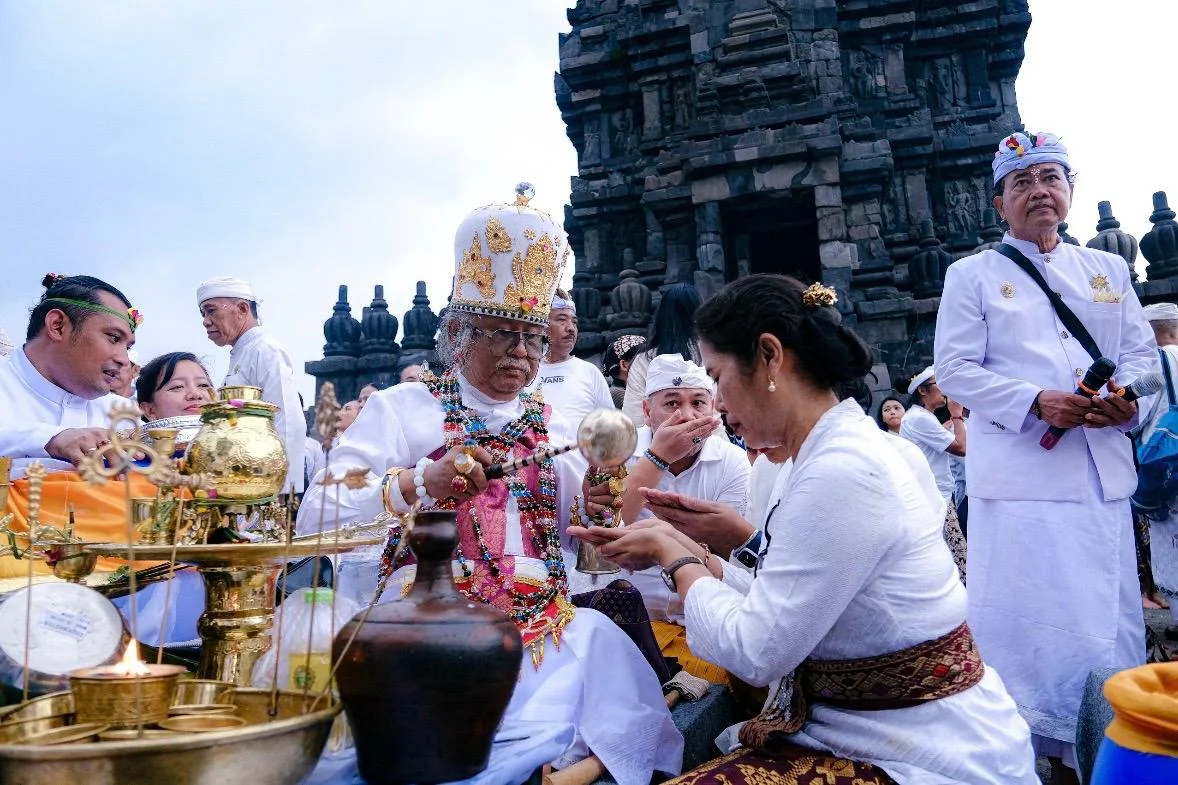
- Prambanan Temple will serve as a place of worship and Tirtha Yatra for Hindus, while Borobudur, Mendut, and Pawon temples will continue to serve as spaces for Buddhist worship and Dharmayatra.
RRI.CO.ID, Jakarta - The Indonesian Ministry of Religious Affairs, the Ministry of Culture, the Ministry of Tourism, the Ministry of State‑Owned Enterprises, and the provincial administrations of Central Java and Yogyakarta have signed a Memorandum of Understanding (MoU) to cooperate in preserving Prambanan, Borobudur, Mendut, and Pawon temples.
The collaboration aims to preserve the four temples as cultural heritage sites while sustainably utilizing them for religious, cultural, educational, research, tourism, and economic purposes.
Religious Affairs Minister Nasaruddin Umar said the temples must serve multiple purposes and be respected for their spiritual value.
“We hope these temples will be developed to serve religious interests with multifunctional and comprehensive objectives,” Minister Nasaruddin said during the MoU signing ceremony at the Ministry of Religious Affairs building in Jakarta on Thursday, September 15, 2026, as quoted by Antara.
The MoU follows up on a collaboration established in 2022. Under the agreement, Prambanan Temple will serve as a place of worship and Tirtha Yatra (pilgrimage) for Hindus, while Borobudur, Mendut, and Pawon temples will continue to serve as spaces for worship and Dharmayatra (pilgrimage) for Buddhists.
Beyond their religious use, the four temples are also intended to become hubs for religious tourism and cultural activities. They may also serve as centers for research and innovation in religion, history, art, and culture, while supporting local community empowerment.
He emphasized that the utilization of the temples must go hand‑in‑hand with efforts to preserve their spiritual values. According to him, temples and places of worship serve as spaces for human encounters with the Divine. Therefore, their existence must be preserved and their sanctity upheld.
“No matter how advanced a nation becomes, it must not abandon its spiritual values. This is where places of worship play a role: reminding us not to neglect our spiritual lives,” he said.
Coordinating Minister for Human Development and Cultural Affairs (Menko PMK) Pratikno also called on all parties to safeguard these temples so they can continue to serve religious, cultural, and community needs.
“We must preserve this cultural heritage so that its significance is understood. We must also maintain its usefulness to the tourism industry and its economic benefits to local communities,” he said.
He noted that the temples reflect Indonesia's tolerance and diversity. They also stand as evidence of the scientific and technological advancements of their time. Consequently, he urged the public to uphold the values of tolerance and diversity that this cultural heritage embodies.
“Let us continue to safeguard this tolerance and diversity. Our Bhinneka Tunggal Ika (Unity in Diversity). Let us prove to the world that, despite global challenges, we are united and committed to mutual cooperation and tolerance,” he said.
Director General of Buddhist Community Guidance at the Ministry of Religious Affairs, Supriyadi, said the agreement provides direction and guidelines for the parties involved in using the four temples.
“Thus, the temples can be used for religious activities through inter‑party coordination while ensuring the protection and sustainability of the cultural heritage,” Supriyadi said. ***
News Recomendation
Memuat berita terbaru.....