



Indonesia Develops Multi-Feedstock and Multi-Generation Bioethanol
- 15 Sep 2026 13:45 WIB
- Voice of Indonesia
Poin Utama
- The Bioethanol Development Center in Tegineneng uses local materials and both first-generation (1G) and second-generation (2G) technologies to make bioethanol.
- Sorghum is chosen as a key crop because it can be harvested three times a year and used for both 1G and 2G bioethanol.
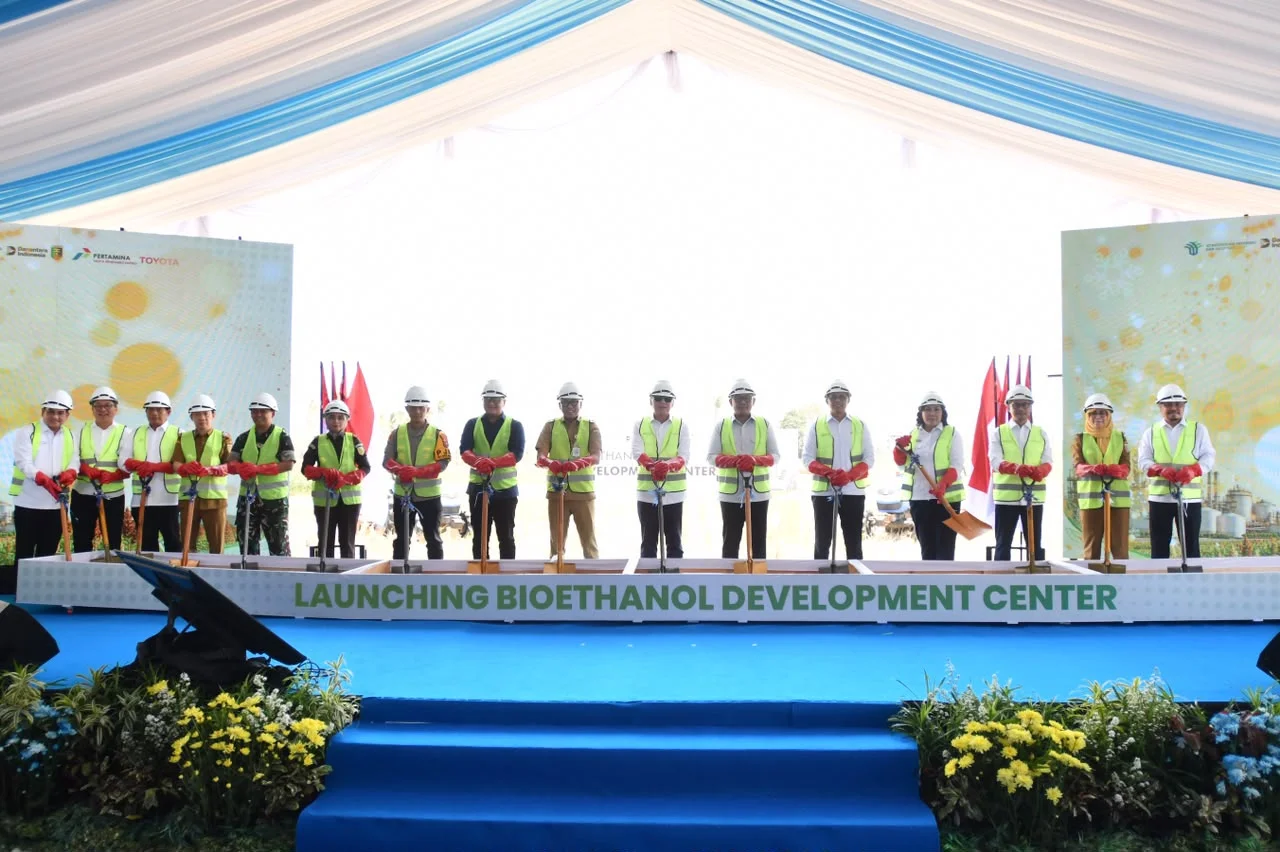
RRI.CO.ID, Lampung – Pertamina, through its subholding Pertamina New & Renewable Energy (Pertamina NRE), officially launched the Bioethanol Development Center in Tegineneng, Pesawaran, Lampung, on Monday, September 14, 2026. The launch event was attended by various stakeholders from the government, Pertamina, industry, academia, and strategic partners.
Attendees included Vice Minister of Investment and Downstreaming/Deputy Head of the Investment Coordinating Board (BKPM) Todotua Pasaribu, Pertamina's President Commissioner Mochamad Iriawan, Pertamina's Risk Management Director Ahmad Siddik Badruddin, Pertamina NRE President Director John Anis, Lampung Governor Rahmat Mirzani Djausal, as well as Toyota Motor Manufacturing Indonesia (TMMIN) President Director Nandi Julyanto and Toyota Tsusho Indonesia (TTI) President Director Toru Murakami.
Pertamina NRE President Director John Anis explained that the Bioethanol Development Center was developed using a multi-feedstock and multi-generation approach. This means the center utilizes various local raw materials and both first-generation (1G) and second-generation (2G) bioethanol production technologies.
The launch momentum was also marked by the signing of two memorandums of understanding. These include a Joint Agreement between Pertamina NRE and the Lampung Provincial Government for agribusiness, energy, and food security development in Lampung, and a Memorandum of Understanding between Pertamina NRE, TMMIN, TTI, and the Research Association of Biomass Innovation for Next Generation Automobile Fuels (raBit) to explore the technical and commercial potential of sustainable bioethanol production and utilization in Indonesia.
John further explained in his presentation that sorghum is an interesting raw material to develop because it has competitive productivity potential and harvest cycles. Sorghum development in Lampung is directed at applying a multi-generation approach, which utilizes sweet sorghum juice as a first-generation (1G) bioethanol raw material, while the stalks or remaining biomass after juice extraction can be developed as second-generation (2G) bioethanol raw material.
"What is interesting about this sorghum, besides its productivity, is that its cycle can reach three harvests a year," John stated.
The Bioethanol Development Center in Lampung was developed as a pilot facility with a bioethanol production capacity of up to 60 kiloliters per year. This facility will be used to test various combinations of raw materials and technologies, ranging from pre-treatment, hydrolysis, fermentation, distillation, to dehydration, including pre-treatment stages for 2G raw material processing.
The launch of the Bioethanol Development Center also marks the beginning of Lampung's development as an end-to-end bioethanol development hub, starting from raw material development and cultivation to processing and technology validation. Moving forward, the test results on a pilot scale will serve as the basis for technical, economic, and commercial assessments to determine development toward demonstration and commercial scales.
News Recomendation
Memuat berita terbaru.....