



Government Targets 2,000-Hectare National Salt Industry Center in Rote Ndao
- 03 Sep 2026 16:49 WIB
- Voice of Indonesia
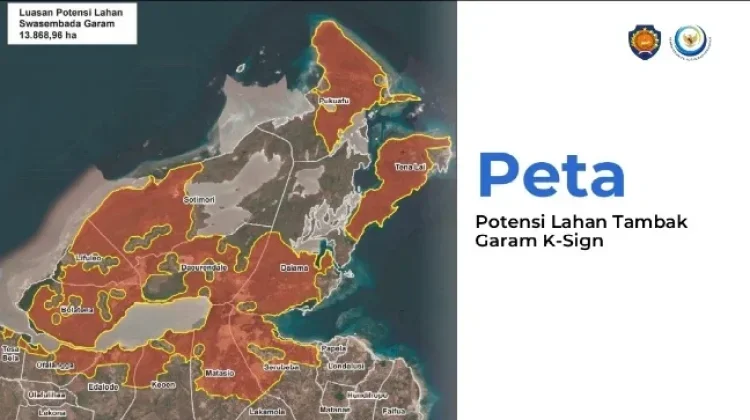
RRI.CO.ID, Jakarta - The Indonesian government is targeting the development of the National Salt Industry Center (K-SIGN) in Rote Ndao, East Nusa Tenggara (NTT), to cover an area of up to 2,000 hectares. The program is part of efforts to promote more balanced regional development, drive economic growth, and achieve national salt self-sufficiency.
Head of the Government Communications Agency, Muhammad Qodari, said the development of K-SIGN is being carried out in stages by the Ministry of Marine Affairs and Fisheries (KKP). The first phase, covering 616 hectares, has been completed, while the second phase covers 751 hectares. The development involves cooperation in utilizing land owned by local communities, allowing residents to benefit economically from the program.
“The development of the National Salt Industry Center in Rote Ndao is also part of efforts to promote more balanced development in NTT. This priority program is expected to stimulate economic growth, create jobs, and help reduce poverty in the area,” Qodari said at a press conference in Jakarta on Wednesday, September 2 2026.
The KKP is currently conducting trial salt production on the 616-hectare site, with the first harvest targeted for November 2026. Overall, the development of Rote as a location for the National Priority Work Program covers approximately 10,764 hectares, with around 8,000 hectares to be developed by investors.
Qodari said the development of K-SIGN is part of the government’s strategy to increase national salt production. Output is targeted to rise from a baseline of around one million tons to 2.5 million tons in 2026, 3.5 million tons in 2027, and five million tons in 2029, while salt imports are targeted to fall to zero by 2029.
“In line with this, salt imports are targeted to decline from a baseline of around 2.6 million tons to two million tons in 2026, one million tons in 2027, and eventually reach zero by 2029, as part of efforts to achieve national salt self-sufficiency,” he explained.
The development of the 2,000-hectare K-SIGN in Rote Ndao is estimated to require around 2 trillion rupiah in investment for salt ponds and supporting infrastructure. In the initial phase, the KKP is using geomembranes, or High-Density Polyethylene (HDPE), to improve production volume and quality, while preparing for gradual technological modernization, including the use of renewable energy such as solar power.
News Recomendation
Memuat berita terbaru.....