



Indonesian Officials Explore AI-Based Heritage Conservation in China
- 18 Sep 2026 19:33 WIB
- Voice of Indonesia
Poin Utama
- Indonesian officials joined a week-long seminar in Huangshan, China, on AI-driven heritage management.
- Ministry of Tourism analyst Bennasita Dyah Ramya highlighted China’s approach to balancing tourism with site preservation.
- The Huangshan Scenic Area serves as a regional base for international heritage conservation cooperation.
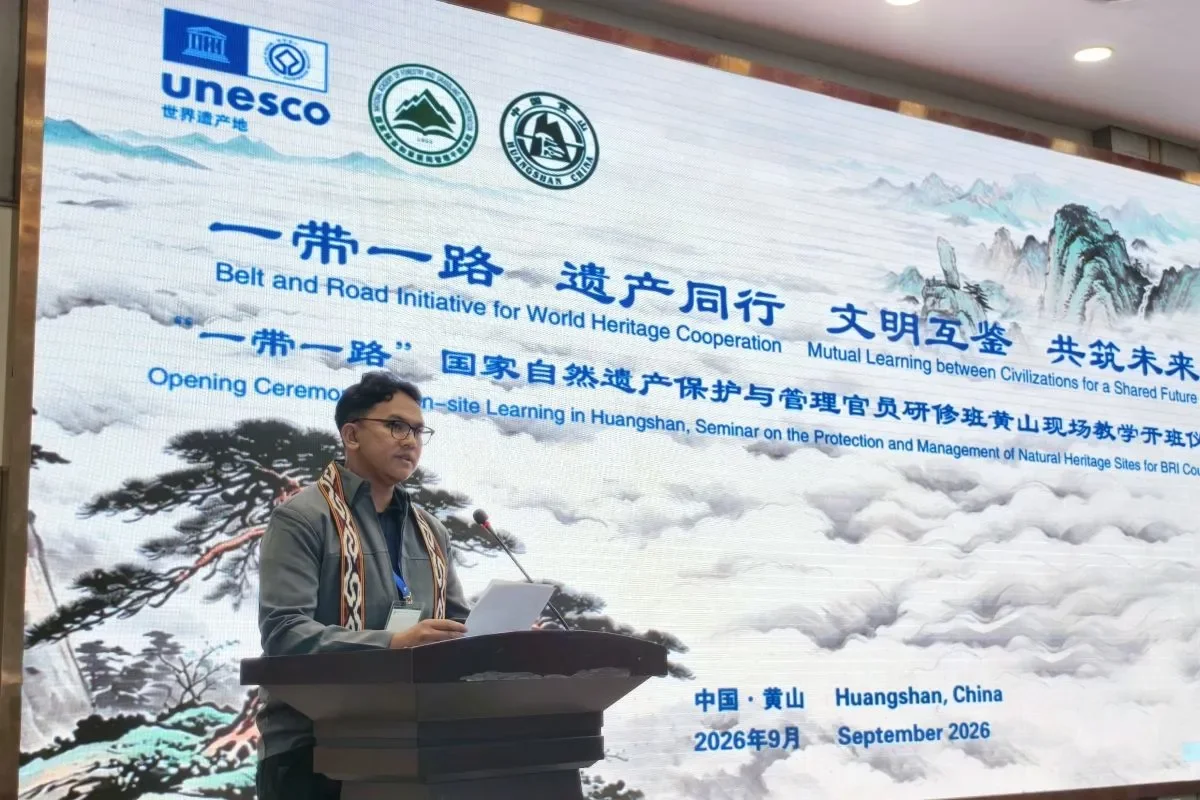
RRI.CO.ID, Jakarta - Indonesian officials are exploring how artificial intelligence and digital monitoring tools can support heritage conservation, as a week-long training program in eastern China showcases the growing role of technology in managing natural and cultural heritage sites.
The discussion is taking place during the Seminar on the Protection and Management of Natural Heritage Sites for Belt and Road Initiative (BRI) countries, held in Huangshan, Anhui Province, Eastern China, opened on Tuesday, September 15, 2026.
The program brings together heritage conservation and management officials from 10 countries, including Indonesia, Cambodia, and Jordan, to exchange views on heritage preservation, digital management, and community engagement.
Organized by the National Academy of Forestry and Grassland Administration of China and the Management Committee of the Huangshan Scenic Area, the seminar is being held under the theme "Belt and Road Initiative for World Heritage Cooperation, Mutual Learning Among Civilizations for a Shared Future."
For Indonesian participants, one of the key areas of interest has been China's use of modern technology to safeguard heritage sites while ensuring sustainable tourism development.
Technical policy analyst Muhammad Asad Nuzulul of the Indonesian Ministry of Forestry said the seminar provides an important platform for heritage professionals from Belt and Road countries to share knowledge and experiences.
Meanwhile, Bennasita Dyah Ramya, a policy analyst at Indonesia's Ministry of Tourism, said she was particularly interested in Huangshan's approach to balancing tourism activities with the preservation of the site's natural and cultural values.
"I am very interested in how Huangshan manages tourism while preserving the site's natural and cultural values, as well as how it implements long-term planning and risk management," she said, as quoted by Antara.
During the seminar, participants are learning how technologies such as artificial intelligence and continuous monitoring systems are used to observe and analyze heritage sites, identify potential risks, and support conservation efforts.
The technology can also be applied to monitor ecological elements, including wildlife and vegetation, as well as environmental factors that may threaten heritage areas.
"This is something that truly interests me because modern technology has become an important factor in heritage management," Bennasita said.
She expressed hope that the exchange program would help participants explore innovative solutions, deepen international cooperation, and work together to protect heritage assets shared by humanity.
Located in southern Anhui Province, Huangshan is renowned for its distinctive pine trees, dramatic granite peaks, seas of clouds, and hot springs. The site is recognized as both a UNESCO World Cultural and Natural Heritage Site and has received the highest ratings in several assessments conducted under the International Union for Conservation of Nature (IUCN) World Heritage Outlook.
Huangshan has also played an active role in international heritage cooperation, including initiating the RCEP World Heritage Cooperation Alliance and building partnerships with heritage sites around the world.
This year marks the fourth consecutive year that Huangshan has been selected as a field-training location for the program. Since being designated as a training base by China's National Forestry and Grassland Administration in 2023, the area has provided training to nearly 300 heritage conservation officials from Belt and Road countries.
Throughout the week-long program, participants are scheduled to visit Huangshan, Hongcun Village, a UNESCO World Heritage Site, the Huizhou History Museum, and Tunxi Ancient Street.
The study visits are designed to provide participants with a deeper understanding of China's approaches to conserving, protecting, and sustainably utilizing natural and cultural heritage, while identifying practices that may be adapted and applied in their respective countries. ***
News Recomendation
Memuat berita terbaru.....