



Singapore’s Defense Chief Highlights Diplomacy with Indonesia
- 16 Sep 2026 15:23 WIB
- Voice of Indonesia
Poin Utama
- Singapore Defense Minister Chan Chun Sing cited bilateral relations with Indonesia as an example of managing historical challenges through diplomacy.
- Chan outlined three core security principles: domestic-external alignment, interdependence, and maintaining diplomatic trust.
- He proposed strategic steps for international governance alongside global defense leaders.
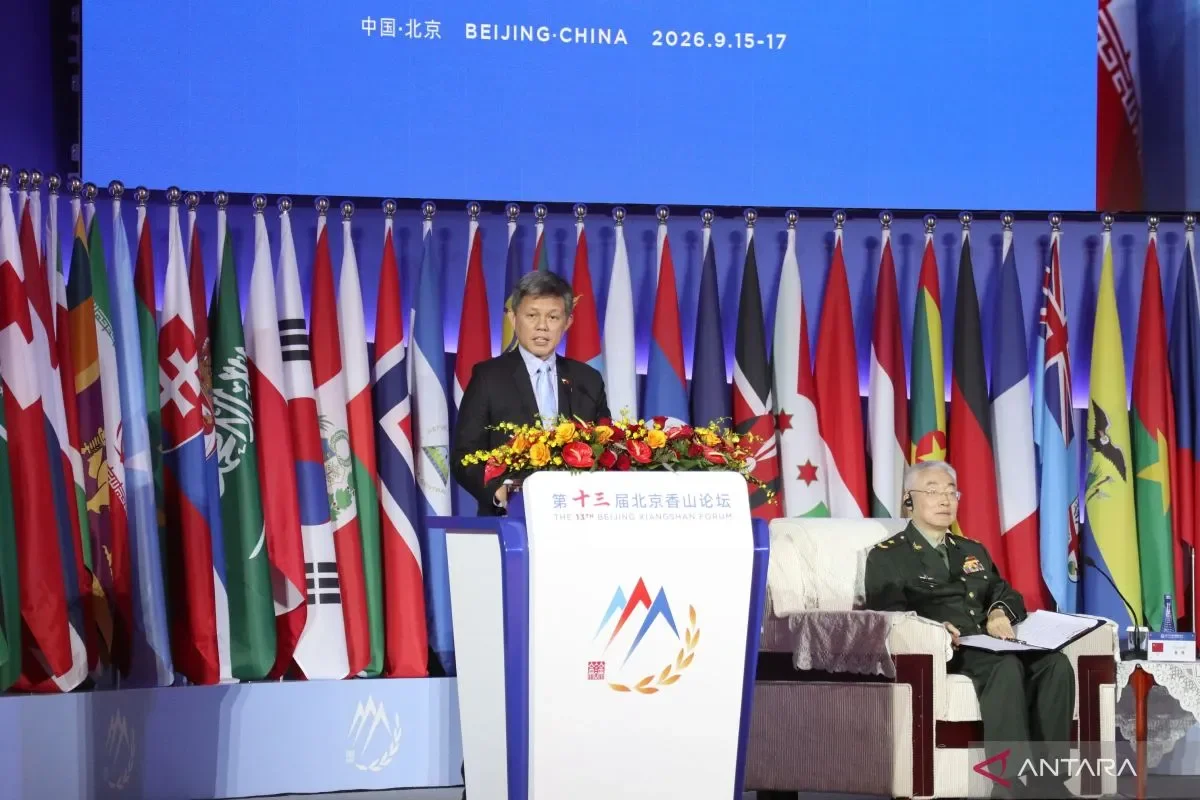
RRI.CO.ID, Jakarta - Singapore has pointed to its relationship with Indonesia as an example of how trust and diplomacy can help countries overcome historical challenges, with Defense Minister Chan Chun Sing arguing that cooperation remains essential for maintaining stability amid growing geopolitical uncertainty.
Speaking at the first plenary session of the Beijing Xiangshan Forum in Beijing, China, on Wednesday, September 16, 2026, Minister Chan said Singapore's experience with Indonesia demonstrates how countries can manage complex bilateral relations through dialogue and mutual understanding rather than confrontation.
"Like many countries, we had historical issues with our neighboring countries. However, we worked together to resolve those issues harmoniously in the interests of both national and regional interests. As an example, we successfully reached a diplomatic settlement with Indonesia, even though the relationship faced various challenges during Singapore's early years," Minister Chan said, on Wednesday, as quoted by Antara.
The remarks were delivered during a session themed Building Consensus on Stability, Advancing Shared Security Governance. The forum, now in its 13th edition, brought together hundreds of military officers, diplomats, and academics from Asia, Europe, and the Middle East to discuss security issues and the international order.
According to Minister Chan, Singapore's growth and prosperity were made possible not only by geopolitical developments but also by sustained diplomatic efforts that helped create a stable external environment. "Geopolitical changes, combined with our diplomatic efforts, eventually created the space for Singapore to grow and prosper," he said.
Minister Chan outlined three principles he believes are essential in navigating an increasingly uncertain world. The first is the close link between domestic stability and external security. He argued that confidence and stability at home enable countries to engage constructively with international partners, while a favorable external environment also contributes to domestic resilience.
Singapore's own history illustrates this relationship, he said. Following independence in 1965, the country faced ethnic tensions, security challenges, economic hardship, and Cold War pressures. Singapore's founding leaders responded by prioritizing political stability, economic restructuring, and public trust. "It was crucial that our founding leaders established domestic political stability early on. They took urgent and decisive measures to restructure the economy, meet people's needs, and earn their trust," Minister Chan emphasized.
The second principle, he said, is that interdependence creates stability. While some countries may view interconnectedness as a vulnerability, Minister Chan argued that it ultimately expands shared interests and encourages cooperation. "Competition and rivalry do not mean we must become enemies. If managed properly, competition and rivalry can motivate all of us to improve," he said.
He noted that Singapore has consistently sought to build an open and inclusive environment by working with neighboring countries through institutions such as ASEAN and by supporting the development of international maritime law.
For the same reason, Singapore continues to advocate for a rules-based international order, which Minister Chan described as a foundation for global trade and exchanges. "As an example, Singapore has consistently supported transit rights for vessels passing through straits used for international navigation, such as the Strait of Hormuz," he said.
The third principle, Minister Chan said, is the concept of "first, do no harm," a well-known principle in medical ethics. He stressed that building trust begins with ensuring it is not damaged. "Trust is essential, but it is also fragile. Trust is built through consistency, yet it can be lost in an instant," he added.
Trust allows countries to address difficult issues calmly and discreetly before tensions escalate, according to Minister Chan. Without trust, even small misunderstandings can quickly grow into larger disputes, particularly in contested physical spaces and increasingly in cyberspace, where intentions are often difficult to determine and actors can be hard to identify. Summarizing his message, Minister Chan said domestic stability enables international cooperation, interdependence creates opportunities for collaboration, and trust makes that cooperation possible.
To strengthen those foundations, he proposed three practical steps. First, major powers should demonstrate greater responsibility so that smaller countries feel less vulnerable. Second, countries should exercise strategic patience and avoid pursuing short-term victories at the expense of long-term gains. "Not every capability needs to be displayed. Not every advantage needs to be immediately exploited, and not every provocation requires an instant response," he said.
Third, countries should continue seeking practical ways to create shared value through cooperation in areas of common interest. Minister Chan also highlighted Singapore's long-standing support for China's reform and opening-up policies and said China's military has the potential to make positive contributions to global stability and security.
At the same forum, Lieutenant General Sebastien Vallette, deputy director of the Directorate General for International Relations and Strategy at France's Ministry of the Armed Forces, reaffirmed France's commitment to the UN Charter, international law, multilateralism, and international cooperation. "However, we are also fully aware of the threats and challenges along that path. The international order inherited from World War II was built on a set of rules and principles, and today that order is under threat," Vallette concluded.
Other officials participating in the session included Vietnam Defense Minister Phan Van Giang, Thailand Defense Minister Adul Boonthumjaroen, Cambodia Defense Minister Tea Seiha, Belarus Defense Minister Victor Khrenin, and Russian Deputy Defense Minister Anna Tsivileva. ***
News Recomendation
Memuat berita terbaru.....