



Indonesia, ICRC Discuss Environmental Protection in Naval Warfare
- 07 Agt 2026 08:03 WIB
- Voice of Indonesia
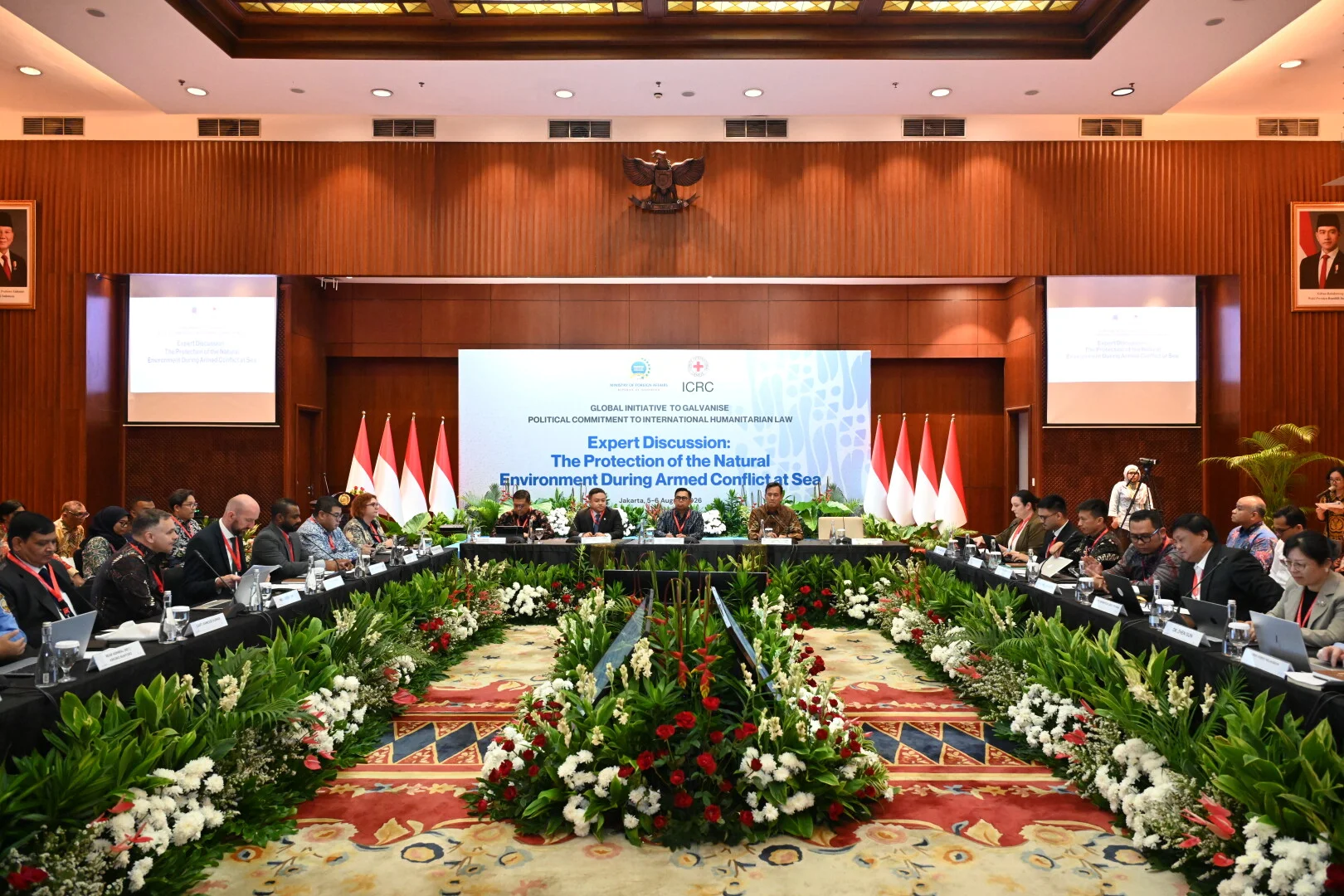
RRI.CO.ID, Jakarta – Indonesia's Ministry of Foreign Affairs and the International Committee of the Red Cross (ICRC) Regional Delegation for Indonesia and Timor-Leste held an Expert Discussion under the Naval Warfare Workstream of the Global Initiative to Galvanise Political Commitment to International Humanitarian Law (Global IHL Initiative) in Jakarta on August 5–6, 2026.
The discussion brought together 24 national and international experts to exchange views on the protection of the natural environment during armed conflict at sea. Key topics included the environmental impact of naval warfare, the law of naval warfare and its interaction with other branches of international law, as well as practical measures that states can adopt during the planning, conduct, and post-conflict phases of naval operations, including mine clearance and pollution response.
According to a statement received in Jakarta on Thursday, August 6, 2026, Indonesian Deputy Minister of Foreign Affairs, Arif Havas Oegroseno, stressed in his keynote address the importance of the discussion, particularly for an archipelagic state such as Indonesia. He noted that the legal framework governing the oceans continues to apply during armed conflict, while naval operations can cause serious, long-lasting damage to the marine environment with direct consequences for coastal communities.
He added that Indonesia cannot restrict navigation through its archipelagic sea lanes. Therefore, compliance with the obligation to exercise due regard for the protection of the marine environment is becoming increasingly important.
Director General for Legal Affairs and International Treaties at the Ministry of Foreign Affairs, Ricky Suhendar, who also serves as co-chair of the Naval Warfare Workstream and Chair of the Expert Discussion, said Indonesia has a strong interest in ensuring that armed conflict at sea does not undermine the rights of neutral states, coastal states, and archipelagic states, nor weaken the legal regime governing navigation rights and maritime zones.
According to him, clearer technical guidance is needed on the treatment of dual-use infrastructure, including submarine cables and ports. He also emphasized the importance of strengthening the protection of the marine environment, which supports the livelihoods of coastal communities and Indonesia's maritime economy, in accordance with the 1982 United Nations Convention on the Law of the Sea (UNCLOS), international humanitarian law, and relevant international environmental conventions.
Meanwhile, Head of the ICRC Regional Delegation for Indonesia and Timor-Leste Martin De Boer said naval warfare should not be viewed as a conflict far removed from everyday life. He stressed that the oceans are vital to global food security, digital connectivity, and marine ecosystems that sustain civilian populations and the planet.
The Ministry of Foreign Affairs and the ICRC expressed hope that the series of technical discussions under the Naval Warfare Workstream would produce concrete, practical, and actionable recommendations to strengthen respect for international humanitarian law, protect humanity, and mitigate the humanitarian and environmental consequences of armed conflict at sea.
The expert discussion was the second such event held in Jakarta, following a previous meeting on international humanitarian law, the law of naval warfare, and the application of the 1982 United Nations Convention on the Law of the Sea (UNCLOS) during armed conflict, which took place on May 6–7, 2025. The discussion also forms part of the Global IHL Initiative, particularly the Naval Warfare Workstream, which is co-chaired by Indonesia and Egypt.
News Recomendation
Memuat berita terbaru.....